
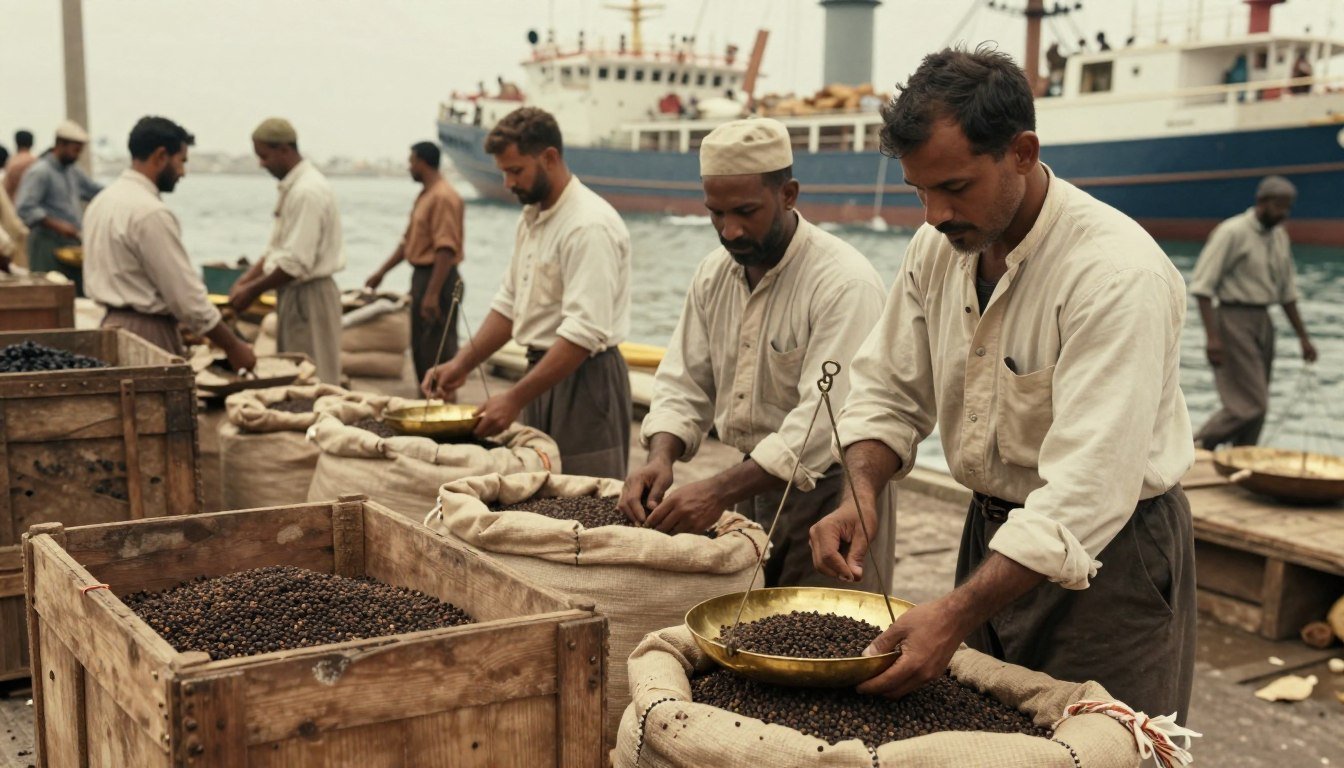
The smell of a crowded 15th-century harbor hits first: sweat, hot tar, wet rope and, under it all, a sharp spice that makes the nose tingle. Dockhands haul sacks of dark peppercorns to the scales, and a clerk sets small brass weights on the other pan.
Peppercorns were so valuable that merchants weighed them like gold. A sailor watching the needle settle knows that one sack can change a family’s fortune.
The history of black pepper trade is the story of who controlled that cargo. It runs from a climbing vine on India’s southwest coast to a fortune in European courts. Vasco da Gama reached Calicut in 1498 to cut that chain short.
The story starts with the vine itself, and with why its berries were worth this much.
Key Takeaways
- Black pepper first grew on the Malabar Coast of southwest India.
- A small growing area and slow vines kept supply tight for centuries.
- Roman sailors, Arab traders and Venetian merchants each took a cut.
- High prices pushed Portugal and Spain to search for sea routes.
- Dutch and British companies fought for control of the pepper ports.
- Vietnam now leads output, and whole peppercorns beat pre-ground pepper.
Where Black Pepper Came From and Why It Was Worth Its Weight in Gold
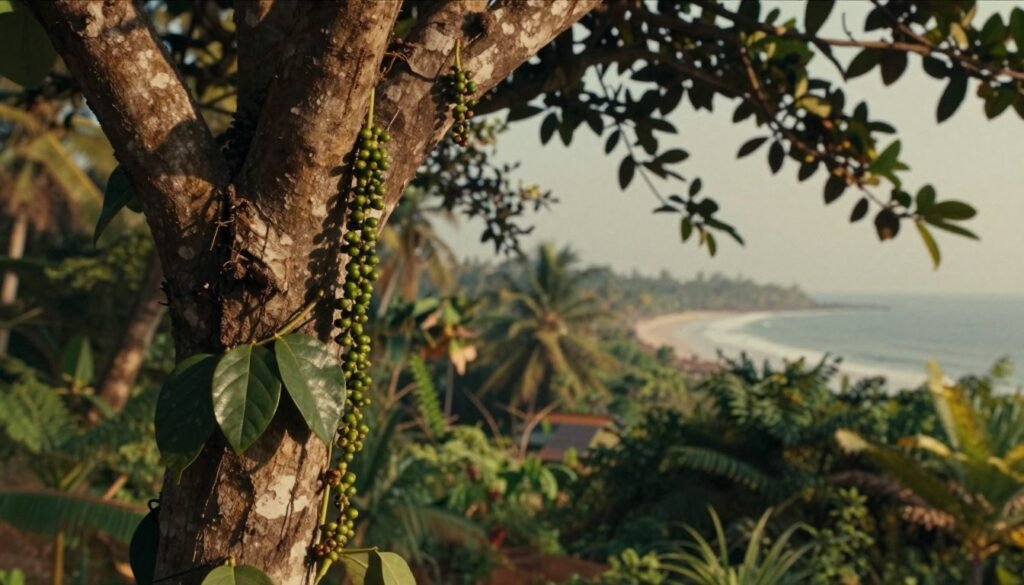
Black pepper first grew on the Malabar Coast of Kerala in southwest India, where people have farmed it for over 4,000 years. The humid, rainy climate there suits the pepper vine (Piper nigrum) perfectly.
The vine is a perennial climber that can reach about 10 meters (33 feet). It needs a long rainy season, high heat and partial shade, so for centuries pepper grew only in that small region of India. That scarcity set the price.
Pepper stayed rare because it grew in one small place, and the vine could not be hurried.
A peppercorn is the small dried berry of the Piper nigrum vine, ground to make black pepper. The fruit is a drupe about 0.2 inch across, grown in clusters called spikes. Its heat comes from a compound called piperine.
The vine adds a hidden limit. It begins bearing in 2 to 5 years, though it can then produce for up to 40 years. When demand jumped, growers could not raise supply quickly.
That is why pepper worked as money. People used it for:
- Taxes
- Tributes
- Dowries
- Rent
- A medium weighed like gold
Nicknames followed: black gold and king of spices. In medieval Germany, rich men were called “pepper sacks.” The Greeks even used it against the effects of hemlock.
The word itself traveled. Sanskrit pippali became Greek peperi and then Latin piper. Traders carried the cargo west along the same path.
The History of Black Pepper Trade From Roman Ships to Arab Middlemen
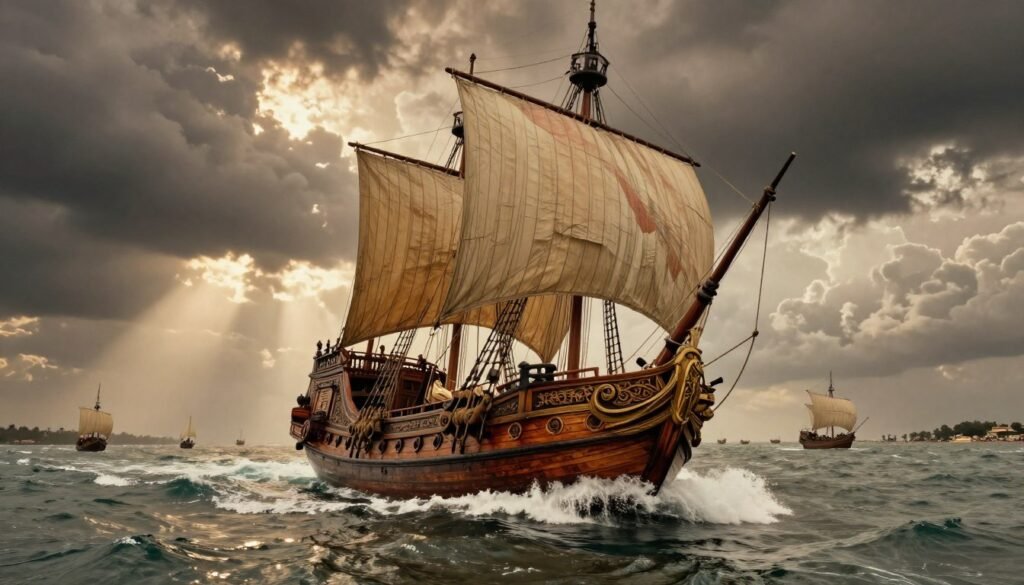
The monsoon winds carried Roman ships straight to Muziris, and that run made pepper a real trade good of the ancient world. Later, Arab, Venetian and Genoese middlemen took over, and each one raised the price.
Roman Sailors and the Monsoon Run to Muziris
Pepper reached the West early. Peppercorns were found in the nostrils of Ramesses II’s mummy, dated to about 1213 BCE. Alexander the Great’s campaigns in the 4th century BC first introduced it to the Greeks and their neighbors.
By the 1st century CE, Roman captains rode the seasonal monsoon winds across the Arabian Sea to Malabar ports such as Muziris. They sailed out with one wind and home with the other. Rome cut out middlemen long before the Portuguese did.
The cargo was worth a city. In 410 CE the Visigoth king Alaric demanded 3,000 pounds of pepper as part of Rome’s ransom.
Arab Traders, Venetian Merchants and Guarded Secrets
After Rome fell, Arab traders controlled the overland routes. They moved luxury goods along the Silk Road and hid the plant’s true origin behind myths. Buyers in Europe never learned where pepper really grew.
In the Middle Ages the Venetians and Genoese became the main distributors in Europe. Their ships picked up pepper at Alexandria and Constantinople. Every added middleman raised the price, and the records of the time show how rich those cities grew.
Venice held the supply tightly, and European kings grew tired of paying its price. They began to dream of a sea route that skipped the whole chain.
How Pepper Drove the Age of Discovery
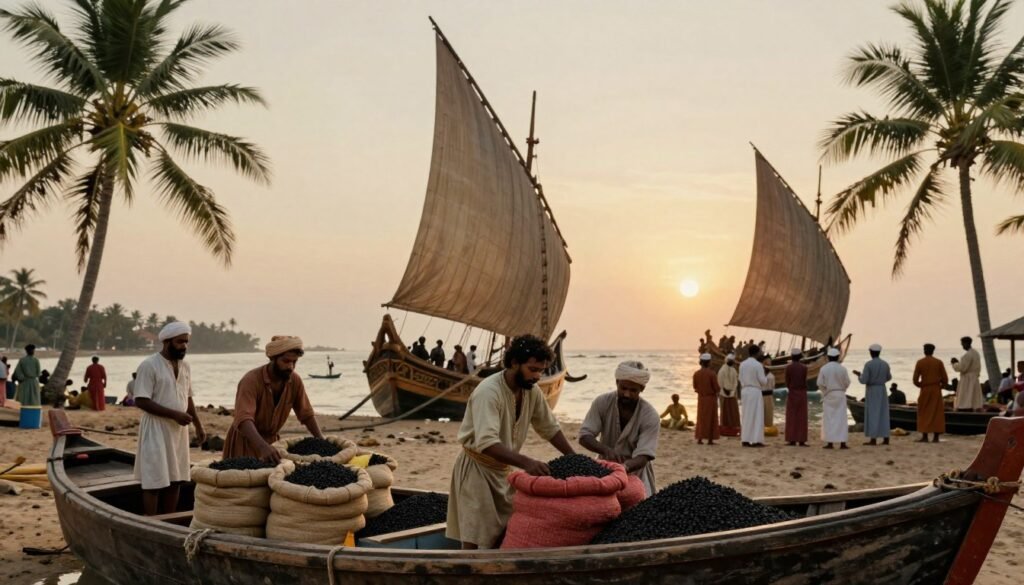
Pepper drove the Age of Discovery because its high price pushed European kings to find a sea route to India. Da Gama’s ships dropped anchor off Calicut (now Kozhikode) in 1498 after a dangerous voyage around the Cape of Good Hope.
The prize was huge. Direct sailing to the source ended the Venetian and Genoese near-monopoly and led to Portuguese domination. Lisbon became a wealth hub almost overnight.
Pepper had long been a status symbol of medieval European cookery. Elite tables showed off the spice, and a heavy hand with it signaled wealth. The idea left a mark on law: peppercorn rent survives in English property law as a nominal payment.
Spain chose a different course. Christopher Columbus sought direct trade with Indian pepper and instead reached the Americas. He mislabeled the people he met “Indians.”
The mix-up grew. Chili peppers, native to the Americas, first reached Europe as a substitute for black pepper. They came to be called “red pepper.”
The confusion in names persists today. Chili is unrelated to the Piper nigrum vine, though both stir up heat on the tongue.
Once Portugal held Calicut and the nearby ports, rival powers took notice. They soon fought over the Malabar ports.
Empires, Companies and the Fight for Malabar’s Pepper Ports
No power held Malabar’s pepper for long. Arabs, Venetians, Portuguese and British each held a monopoly at different times, and the Dutch joined the fight in between.
The history of black pepper trade does not follow a clean line from one empire to the next. Their reigns overlapped, and local rulers pushed back. In the 17th and 18th centuries the Dutch East India Company and the British East India Company displaced the Portuguese.
| Controller | Period | How it held supply |
|---|---|---|
| Arab traders | From before the Common Era | Overland routes and secrecy |
| Venetians and Genoese | Middle Ages | Mediterranean distribution via Alexandria and Constantinople |
| Portuguese | From 1498 | Calicut and Lisbon |
| Dutch and British East India Companies | 17th and 18th centuries | Corporate and military control of cultivation and trade |
Not everyone gave way. Travancore, under Marthanda Varma, fought the Dutch at the Battle of Colachel in 1741 to resist European control of pepper ports.
A scholarly chapter on pepper’s Indian Ocean trade and European colonisation traces four stages of this trade, from early Arabian and Phoenician days to the colonial era.
The history of black pepper trade slavery question has a plain answer. Colonial companies enforced their monopolies by forcing deliveries and controlling growers. The fortune rested on coerced labor.
The grip did not last. Pepper later spread to new lands, and it stopped being a king’s ransom and became a pantry item.
From Spice Rack to Single-Origin: Black Pepper Today
Vietnam, not India, now leads the world’s pepper output. In the 19th and 20th centuries, cultivation spread beyond India to Southeast Asia and Latin America, which broke the old scarcity for good.
How Pepper Became an Everyday Staple
In 2022 the largest producers were:
- Vietnam
- Indonesia
- Brazil
- India
- Burkina Faso
- Malaysia
Grades still carry the name of their home. Malabar or Alleppey, Tellicherry and Cochin come from India, Sarawak from Malaysia, Lampong from Sumatra and Belem from Brazil. Tellicherry is widely considered the highest quality, and its terroir (the soil and climate) shapes the flavor.
Black pepper is made from berries picked green, fermented and sun-dried until brownish-black. White pepper starts with ripe berries soaked to remove the outer layer.
| Attribute | Black pepper | White pepper |
|---|---|---|
| How it is made | Green berries fermented and sun-dried | Ripe berries soaked, outer layer removed |
| Color | Brownish-black | Pale cream |
| Flavor | Sharp, bold | Lighter, more musty |
| Where favored | Most Western kitchens | French, Chinese, Vietnamese, Swedish |
Whole peppercorns store for years. Ground pepper holds 2-4% essential oils, and those fade fast, so pre-ground pepper goes stale.
In Kerala the spice is still central. Food52’s history of black pepper notes its use in Kerala stews, roasts and rasam, and the district of Wayanad is prized for it. Pepper also appears in garam masala and in French quatre épices.
The Cultural Echo: Cinema, Music & Modern Table
The 1992 film 1492: Conquest of Paradise dramatizes Columbus’s search for a western route to the spice lands. It fits the pepper story because that hunt for spice changed the map.
The modern table keeps the echo alive. Pastry chefs add pepper to chocolate desserts, and single-origin sellers promote vine-ripened, hand-harvested, sun-dried pepper. A simple habit works too: grind it fresh over the plate.
The shaker on every table carries centuries of voyages.
Conclusion
A pinch of pepper is the last link in a very long chain. Scarcity and a string of middlemen drove voyages that reshaped the map, and the same pepper vine now sits cheaply in every kitchen.
That gap between a king’s ransom and a shaker is the whole lesson of the spice. Next time a dish is finished, buy whole peppercorns from a named origin, such as Tellicherry, and grind them fresh.