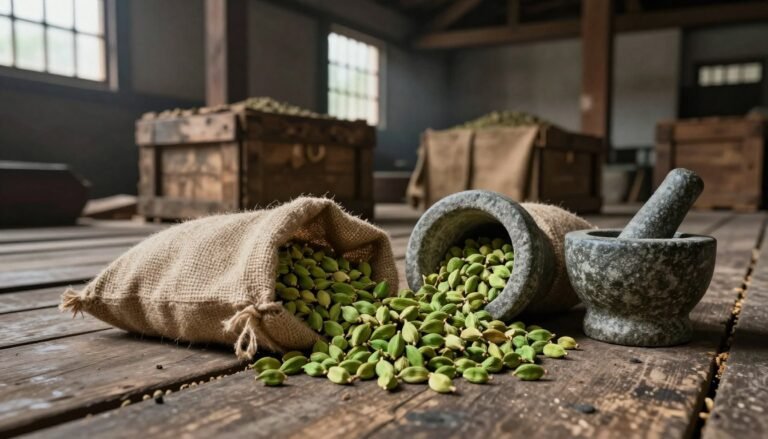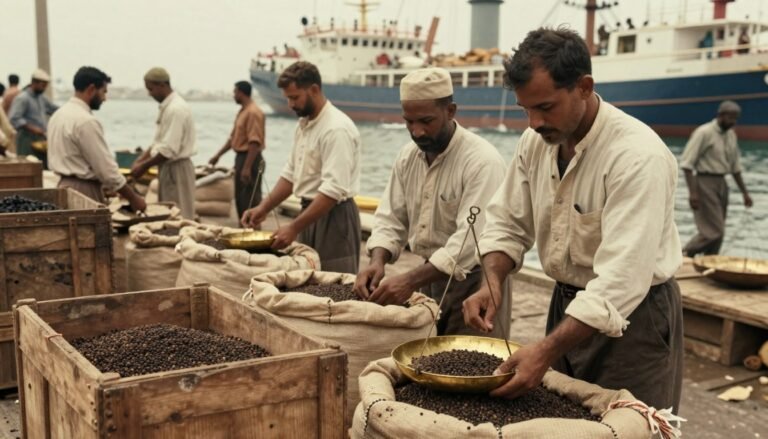
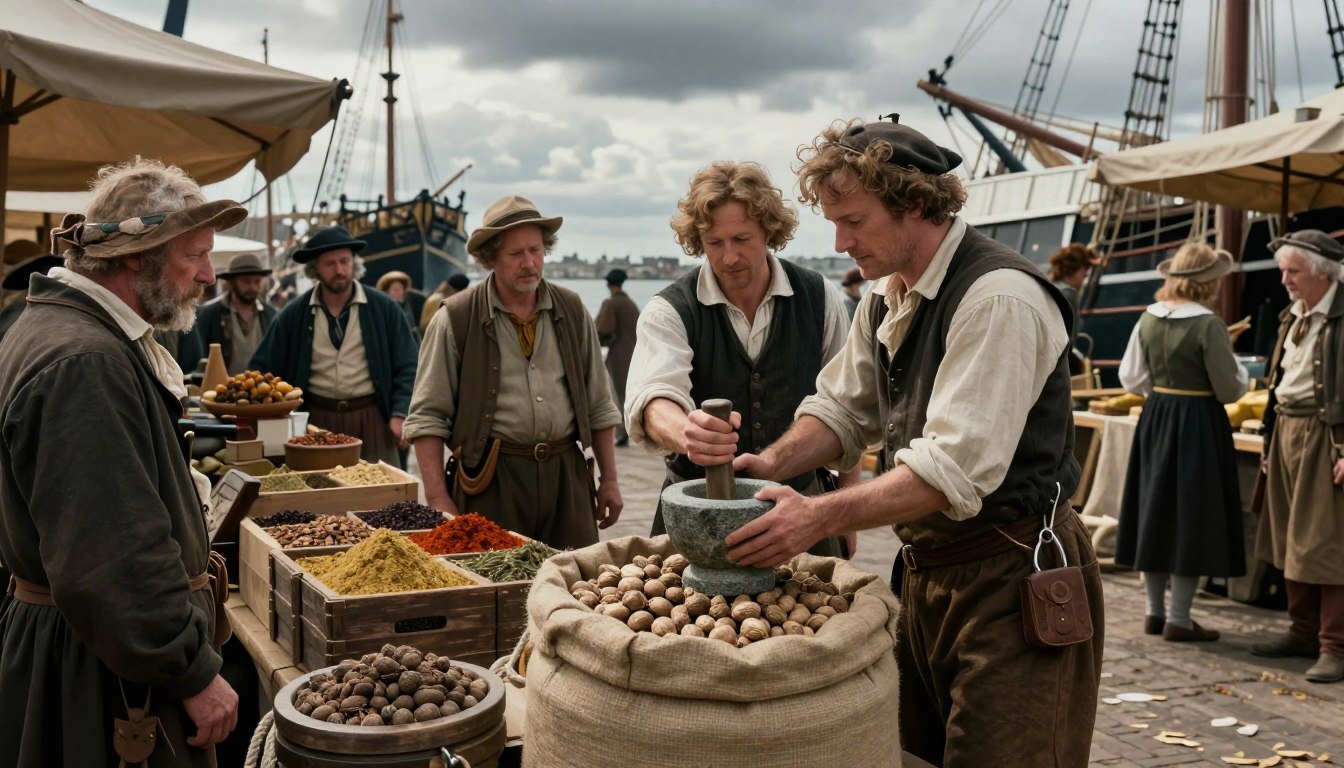
In the hold of an East India Company ship, the air smelled of tar, salt and something warm and woody. A royal physician cracked a seed and ground it over a dish, and the scent spread through the dark like smoke from a hearth. Nutmeg had arrived.
On a crowded European dock, a sealed sack of these seeds cracked open and the whole crowd leaned in. In medieval Europe, this spice was once worth more than its weight in gold. A pinch in warm wine marked a rich man’s table, while the sailors who hauled the cargo went hungry.
Behind that flavor lies a harder story of cartels, invasions and slavery. Before 1621, the Banda Islands were home to 13,000-15,000 people, and few of them lived to see the empire their harvest built.
To understand that violence, the story starts where the seed actually grew and how it first began to travel.
Key Takeaways
- Nutmeg grew only on the Banda Islands of eastern Indonesia for most of its early history.
- Arab middlemen hid the true source of the spice for centuries.
- The Dutch East India Company (VOC) seized the islands by force in 1621.
- Only about 1,000 Bandanese survived as enslaved workers.
- The Treaty of Breda traded the island of Run for Manhattan.
- Smuggled seeds ended the Dutch monopoly.
- Today a pinch is safe in food, but large amounts can harm you.
From Banda Groves to Medieval Banquets
The oldest known nutmeg traces are about 3,500 years old, and they sit on a pottery shard from Pulau Ai, a tiny island in the Banda Islands. People there were cooking with nutmeg long before any European knew the islands existed.
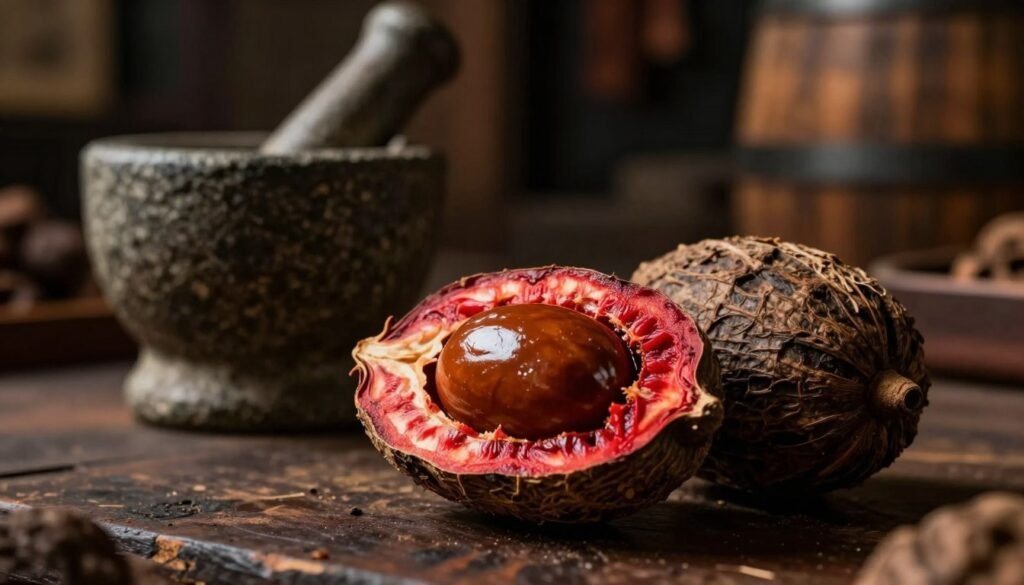
Nutmeg comes from Myristica fragrans, an evergreen native to the Banda Islands in the Maluku (Spice Islands) of Indonesia. The nutmeg tree can bear fruit for 60 years or longer, so one grove fed trade for generations. The ripe, lemon-yellow fruit splits open to show a seed wrapped in mace, the scarlet, lacy covering that is dried into a separate spice.
The route from that fruit to a European table took centuries. Here are the milestones:
- About 3,500 years ago: nutmeg residue left on pottery on Pulau Ai.
- 6th century: Arab merchants bring it to Constantinople.
- 1191: Henry VI has Roman streets dusted with nutmeg before his coronation.
- Late 14th century: Chaucer mentions it in the Canterbury Tales.
Romans had burned the spice as incense and carried it in scented bags. The Persian physician Ibn Sina called it jansi ban around 1000 AD. Its European name comes from the Latin nux muscatus, “musky nut.”
Arab middlemen guarded one secret above all: where it grew. They kept the true island source hidden for centuries, which helped push prices sky high.
For centuries, Europeans bought nutmeg without knowing where it grew. The secret was the real source of its price.
Wealthy travelers carried pocket graters, and some plague doctors packed spices, nutmeg among them, into their masks. The seed was status and medicine at once. What would happen when Europeans decided to take the source for themselves?
The History of Nutmeg and the Fight for the Banda Islands
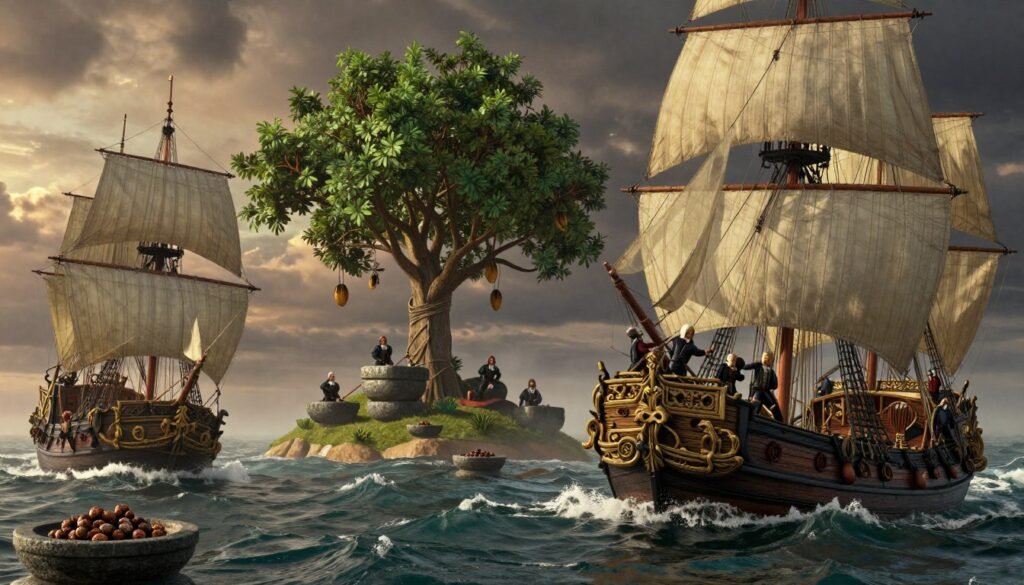
The Dutch took the islands by force in 1621, ending a long scramble among European powers. The Dutch East India Company (VOC) then held a violent monopoly that lasted until the 19th century.
Portuguese, Dutch and English Rivalry
The Portuguese and the Dutch kept prices high by limiting supply. English and French merchants wanted a way around them, and the French looked for seedlings they could grow elsewhere. The 17th century conflicts over the spice islands are known as the Spice Wars.
| Power | Role | Aim | Outcome |
|---|---|---|---|
| Portuguese | Early buyers | Keep prices high | Shared high prices with the Dutch |
| Dutch | Invaders | Monopolize trade | Seized Banda |
| English | Held Run | Share the trade | Traded Run for Manhattan |
| French | Outsiders | Grow their own | Sought seedlings |
The 1621 Conquest of the Banda Islands
In 1621, Jan Pieterszoon Coen led the VOC in an invasion of the Banda Islands. His forces killed, expelled or enslaved nearly all of the 13,000-15,000 people who lived there. About 1,000 Bandanese survived, and they survived as enslaved laborers.
Trading Run for Manhattan
The English still held the tiny island of Run. In the Treaty of Breda in 1667, the Dutch kept Run, and England received Manhattan, then called New Amsterdam. Historians at Fordham’s Early Modern History project describe how far the Dutch went to protect the monopoly. An island of seed trees was swapped for what is now New York City.
The Dutch now owned the groves but had few people left to work them. Who would pick the harvest?
Slavery and the Perkenier System
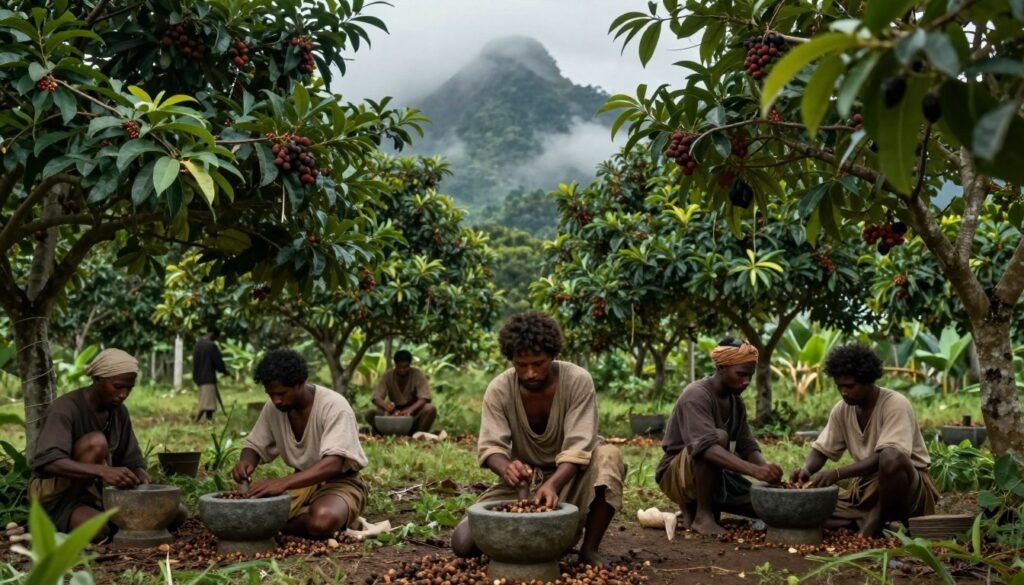
About 1,000 Bandanese survived out of up to 15,000, and the Dutch built a new order on those survivors. The perkenier system ran nutmeg plantations with hundreds of enslaved workers each, and the VOC and the planters shared the profits.
How the Plantation Order Worked
Each plantation was called a perk, and its owner was a perkenier. The Bandanese were spread across the islands on purpose, because they knew how to grow the trees. Public slaves, called perkenslaven, were handed out by quota, while planters also owned private slaves. Some planters even had them grow food for their own households.
The company and the planters were hard to tell apart. The company set prices and quotas, and the planters ran the groves. The system lasted into the 1860s, when indentured laborers joined the workforce. A scholarly study of Banda’s labor, 1850-1860 counts 759 enslaved people in 1850 and a workforce of 5,519 by 1853.
Who Was Enslaved and Where They Came From
Bandanese made up just over one tenth of the enslaved workers. Many others were trafficked from across the Indonesian archipelago through deals with local rulers. A boy named Januari was sold at Surat in 1766, then sentenced in 1769 to hard labor in Banda.
This was unlike Caribbean or US plantation slavery. Anthropologist Phillip Winn notes it as one of very few cases of Asian slaves on European-owned plantations. Today Bandanese call their culture orang campur, “mixed,” a lasting trace of people gathered from many places.
The Dutch guarded the trees fiercely. Yet a few seeds were about to slip out of their hands.
Breaking the Monopoly and Nutmeg Today
The Dutch dipped nutmegs in lime to sterilize them, so no buyer could plant them. In 1770 the French smuggled plants and viable seeds to Mauritius, and prices crashed. The British later brought the tree to Grenada, and it spread across other regions and the Caribbean, ending the Dutch monopoly in the 19th century.
Indonesia and Grenada are now top producers. Grenada makes morne delice jam from the fruit rind, and Indonesia makes manisan pala, a candy. Cooks grate the seed into sauces, desserts and drinks. Here is how regions use it:
- Netherlands: speculaaskruiden, a spice mix for cookies.
- India: garam masala.
- France: quatre epices, and béchamel sauce.
- United States: eggnog and pumpkin pie.
- Grenada: morne delice jam.
Spinach-stuffed pasta also leans on it. Grating a whole seed just before use keeps the flavor, because ground nutmeg loses it fast.
Nutmeg benefits are modest: flavor and traditional use, not cures. The seed is rich in myristicin, which is psychoactive in high doses. Large amounts can cause nausea, dizziness or hallucinations, so a pinch in a dish is plenty. Anyone with health concerns should ask a doctor.
A single pinch flavors a dish. Much more than that is not wise.
So the story ends with a spice in every pantry. What did that flavor cost?
Conclusion
One grated nutmeg carries the smell of the islands where it first grew. That scent once had a hidden human cost, paid by people who never tasted the profit.
The empire that guarded this spice fell to a few stolen seeds. A flavor that was once locked behind violence now sits in a jar for a few dollars.
To taste that story, buy a whole nutmeg and a fine grater, and breathe in the aroma as the first shavings fall.