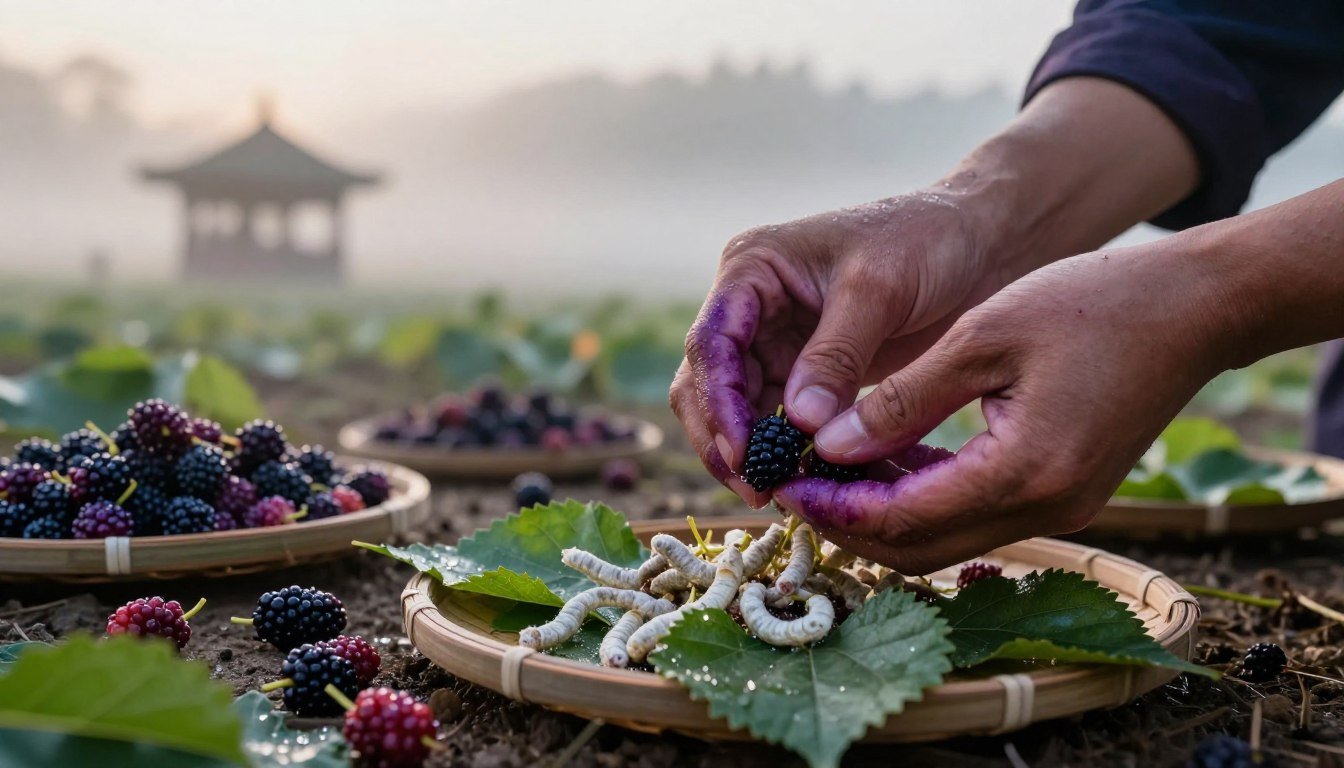
Dawn light touches a mulberry tree, and a picker’s fingers turn purple as she pulls down the dark berries. Beside her, trays of silkworms chew leaves with a sound like soft rain. The history of edible silk mulberry starts on this one branch, where worms and people eat from the same tree.
The mulberry tree is native to East Asia, especially China. Chinese writing mentions growing it and eating both the fruit and the leaves as early as 700 BC. That is a long time for one tree to work as a silk factory and an orchard at once.
The tension is simple. Every leaf the worms eat is a leaf the tree cannot use to feed its fruit, and every berry picked is a bit of the tree’s strength spent. The story follows that tug-of-war from China to Rome to England, and it begins with a legend about a cup of tea.
Key Takeaways
- The mulberry tree fed silkworms with its leaves and people with its fruit.
- Sericulture, the raising of silkworms on mulberry leaves to produce silk, began in China.
- The white mulberry suits the worm; the black mulberry suits the table.
- England’s silk plans failed largely because planters chose the wrong species.
- Bark became paper, and pupae became food, so little went to waste.
- Silk costs more because thousands of cocoons make one kilogram.
The History of Edible Silk Mulberry Begins in Ancient China
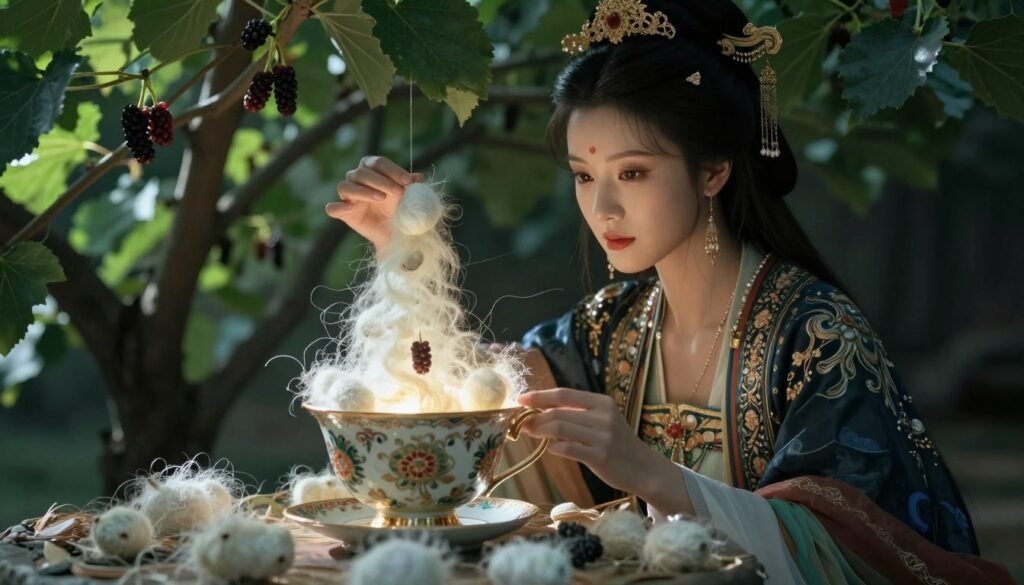
Legend says that around 2700 BCE, Empress Leizu sat sipping tea under a mulberry tree when a cocoon dropped into her hot cup. The cocoon, the silk-bearing case, softened and unraveled into a shimmering filament. She is said to have pulled it out and seen a thread of great length. This is a story, not a documented fact.
The tale hides a real partnership. Sericulture in China dates back more than 5,000 years, and the silkworm, Bombyx mori, feeds almost exclusively on white mulberry leaves. The white mulberry, Morus alba, is native to China, so the worm and its food grew up in the same place.
The silkworm cannot live without the white mulberry, and it no longer survives in the wild at all.
That last point is what most summaries miss. Centuries of breeding made Bombyx mori fully domesticated. Left outdoors, it cannot find food or defend itself, so every silkworm alive depends on a keeper with a basket of mulberry leaves.
Early farmers also saw other uses. Mulberry leaves went to the worms and into medicine, while the berries went to the kitchen. Scholars trace this long story in a Springer chapter on mulberry silk sericulture, which covers its spread from China to India, Japan and Europe.
China guarded the craft closely, and the secret stayed inside its borders for almost 4,000 years. A secret this valuable could not stay in one valley forever.
How the Mulberry Traveled the Silk Road to Persia and Rome

The mulberry spread along trade routes, and it split into two paths: a leaf tree for worms and a fruit tree for the table. Cultivation moved from China to India, Japan and Persia, and mulberries likely reached Europe along Silk Road routes. By the 13th century, Italian traders had carried silk into Europe.
Picture a caravan plodding west, with cuttings wrapped in damp cloth and sacks of dried fruit swaying on a camel’s flank. Each stop gave the tree a new job.
- China: the white mulberry fed silkworms and guarded a state secret.
- India and Japan: the tree carried sericulture into new villages.
- Persia: the black mulberry became popular for its rich fruit.
- Rome and Italy: Romans are believed to have cultivated mulberries, valuing the fruit, and Italian traders later brought silk west.
The contrast matters. Morus alba suits the worm, while the black mulberry, Morus nigra, was valued mainly for its tart-sweet fruit. Morus nigra is native to western Asia, in places such as Iran, Turkey and Syria, so it was already at home near Persia.
There is one more twist. The fruit tree spread widely even where silk never took hold. A gardener in a cool, silkless village could still plant a mulberry and enjoy the harvest.
So the tree won its place long before silk did in many lands. Once it stood in a yard, people had to decide what to do with the berries, the leaves and the rest of the tree.
What Ancient Cooks and Healers Did With Mulberries
People ate mulberries fresh, dried, or cooked into jams, tarts, pies and drinks. A market stall piled with dark berries would stain every hand that touched it. Mulberries come in red, white and black, and the color depends on the species, though all share a sweet-tart flavor.
Cooks turned the fruit into jams and herbal tonics, and people brewed the leaves as herbal tea. Traditional healers believed the berries had health benefits, but these are old beliefs, not medical promises. Today they remain part of folk practice in many places.
The worm fed people too. In many cultures, cooks fry silkworm pupae and eat them as a high-protein food. A keeper who raised silkworms could therefore sell thread, eat the pupae and bring fruit to market from one small orchard.
Almost nothing on the tree or the worm went to waste. White mulberries taste milder than black ones, so cooks often chose the berry by the dish. Dried fruit kept well for winter, much like raisins.
The tree had still more to give. Under its leaves and fruit lay bark, and that bark held a fiber that could become something entirely different.
From Bark to Banknote: Mulberry Paper and Sericulture Compared
Mulberry bark became paper, and mulberry leaves became silk. Picture the thud of mallets pounding inner bark into pulp. Workers mixed the pulp with water, spread it thin and dried it into sheets. Ancient China used this paper, especially in the Han Dynasty (206 BCE – 220 CE), and mulberry fibers even went into early paper money.
Silk works differently. Sericulture is the raising of silkworms on mulberry leaves to produce silk. Workers boil or steam the cocoons to soften sericin, the gummy coating, and then reel the filament. Silk contains fibroin and sericin.
| Part of tree | Product | Process | Use |
|---|---|---|---|
| Leaves | Silk | Worms eat leaves, spin cocoons, cocoons are reeled | Fabric and thread |
| Bark | Paper | Inner bark pounded, mixed with water, dried | Writing and early money |
| Berries | Food | Eaten fresh, dried or cooked | Jams, tarts, drinks |
| Pupae | Food | Fried | High-protein snack |
One cocoon spins a single continuous filament of roughly a kilometer or more. That unbroken length explains why silk feels so smooth. Short fibers, like those in many plant materials, leave tiny ends that catch the skin.
Still, Bombyx mori on white mulberry is only one chapter. Other worms, feeding on other leaves, made very different silks.
Wild Silks and Regional Strains Beyond the Mulberry Worm
Not all silk comes from the mulberry worm. A golden skein of muga from Assam shows how different silk can look. Wild and regional silks vary in source, color and feel, as this short list shows.
- Mulberry silk: Bombyx mori on Morus alba leaves, smooth and fine.
- Tussah: wild silkworms on oak and other leaves, shorter, coarser fibers with a golden-brown tone.
- Muga: from Assam, naturally golden, once reserved for royalty.
- Eri: soft and woolly, sometimes called peace silk.
Many people view muga as the rarest-feeling of the group, though that is a general view, not a ranking. Peace silk lets the moth leave the cocoon, but it yields less silk for more labor.
Even mulberry silk comes in more than one color. In China, selective breeding created a white-cocoon Bombyx mori that dyes evenly. Cambodia, Thailand and Laos kept yellow-cocoon strains whose threads range from soft yellow to deep gold. Both are true mulberry silk, because the worms ate mulberry leaves.
These regional choices show that silk was never one product. Far from Asia, a king wanted to make his own, and he picked the wrong tree.
King James and the Black Mulberry Mix-Up in England
England never became a silk power because its planters chose the wrong tree. Picture an old, gnarled black mulberry leaning in a quiet garden, its branches propped by wooden crutches. King James I (1566-1625) urged landowners to plant mulberries for a domestic silk industry. The effort failed largely because the black species went into the ground instead of the white one.
Silkworms can eat black mulberry leaves, but quality silk favors Morus alba. Other challenges added to the trouble. Elizabethan nobles had also planted black mulberries on their estates as status trees, which made the black species familiar.
The mistake left three lasting results.
- The English silk industry failed to take off.
- Black mulberry trees survive in old gardens, still bearing fruit.
- Colonists carried mulberries to North America in the 17th century, planting white mulberries for silk with limited success.
There is a quiet irony here. The failed plan left thousands of fruit trees behind, and some still feed visitors today. Meanwhile, silk itself kept drawing hard questions about how it is made.
Why Some Vegans and Critics Question Silk
Yes, in traditional reeling the pupa inside the cocoon is killed. Producers boil or steam the cocoons before the moth emerges, so the moth does not survive. That harvest moment is the core of the vegan objection.
Peace silk offers another path. It lets the moth leave about ten days later, but it costs close to double. The thread is also shorter and less uniform, since the moth breaks the filament.
Others point to livelihood. Sericulture supports families who grow mulberry, raise worms, reel thread and weave. The work is often seasonal and home-based, and it matters especially for women.
Silk is about 0.2% of global textiles, so the debate involves a small corner of the fabric world. There is no single version of silk: some is reeled, some is peace silk, and some is wild. Each reader can weigh these facts against their own values.
That debate shaped how people think about silk and mulberries today, from price tags to jam jars.
Why Quality Silk Became Prized: Grades, Weight and Cost
Silk costs more because it takes roughly 5,500 cocoons to make a kilogram of raw silk. Each cocoon must be raised, sorted and reeled by hand or careful machine. Labor and cocoon count drive the price far more than fashion does.
Quality silk is graded on a scale from C, B, A through 2A to 6A, the highest. Grade measures filament length, uniformity, cleanliness, tensile strength and color. Momme measures weight instead, and one momme is about 3.75 grams per square meter.
Here is the mistake to avoid: high momme does not mean high grade. A heavy silk can still be made from poor thread. Bedding silk usually runs 19-25 momme, but a 25 momme fabric can be low grade.
Strand type matters too. Long-strand silk uses the unbroken filament, while short-strand silk uses broken fibers. Silk is a protein fiber, closer to hair and skin than cotton, which is a plant fiber.
Knowing these terms turns a price tag into a story. With that story in hand, anyone can enjoy this heritage in the present.
Carrying the Story Into the Present
“Here we go round the mulberry bush” is an old nursery rhyme, and it keeps the tree alive in children’s memory. Echoes of the mulberry show up in many places today.
- Nursery rhymes that name the bush.
- Silk scarves and bedding sold around the world.
- Jams and baking that use mulberry fruit.
The Cultural Echo: Cinema, Music & Modern Table
A good way to see the story on screen is the 2012 BBC documentary series Silk Road? No: the safer pick is the book The Silk Road: A New History by Valerie Hansen, which traces the trade routes in plain prose. The nursery rhyme still turns up in school songs and playgrounds.
Mulberry silk fills a modern collection of scarves, pillowcases and robes. At the table, red, white and black mulberries are available fresh or dried in many places. Cooks bake them into pies and tarts or simmer them into jam.
Bringing the History Home
Try mulberry jam thumbprint cookies. Mix 1 cup flour, 1/2 cup butter and 1/3 cup sugar, press a dent into each ball and fill it with jam. Bake at 350°F (175°C) for 10-12 minutes.
Care for silk the old way too. Wash it cool, no more than 30°C (86°F), with mild detergent, and never use a tumble dryer. A wooden spoon, a glass jar and a cool sink are all the heritage tools a home needs.
All of this leads to one idea about a single tree.
Conclusion
The mulberry tree has outlived empires, and it still stands in gardens from Assam to England. It served the worm, the kitchen and the paper mill at once, which makes it one of the most useful trees people ever planted.
Two things stand out. The tree was dual-purpose from the start, feeding silk and people. And one species mix-up shaped England’s story, leaving fruit instead of fabric.
Next, taste a fresh mulberry, or visit an old mulberry tree near you and look closely at its leaves.