
In a Phoenician trading port, golden afternoon light falls on sailors bartering over small bundles of red threads, and the history of saffron comes into view. Each bundle carries a price that only kings and temples can pay.
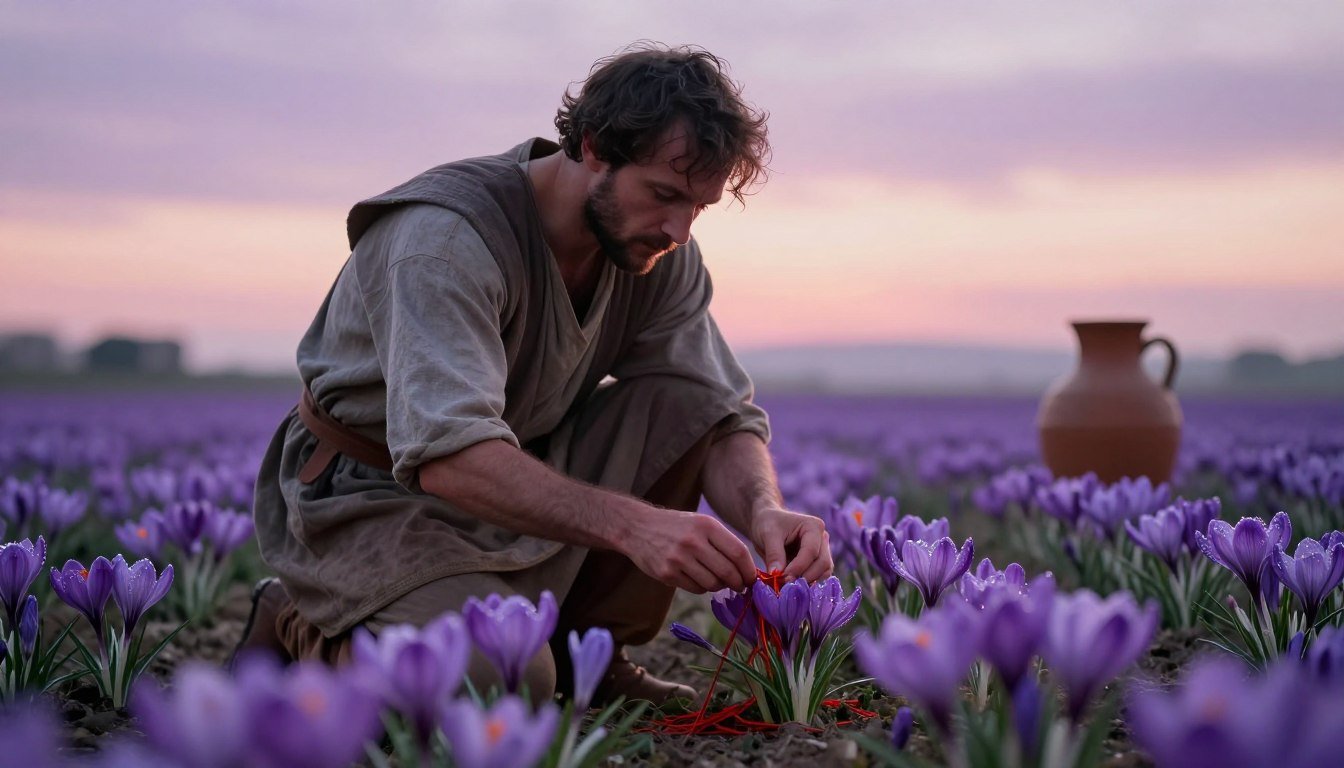
Go back further, to a Bronze Age harvester kneeling in a purple field of Crocus sativus at dawn. Cold air bites her fingers as she plucks red threads from open blooms before the sun can wilt them.
Now jump to a modern spice aisle, a world away from that field, where the same threads sit in a tiny jar. Retail saffron often sells for several dollars per half gram, and people have prized the spice for roughly 3,500 years. The story runs through origins, myths, medicine, royal tables and the modern kitchen.
It starts with the flower itself, which humans had to invent.
Key Takeaways
- Saffron comes from Crocus sativus, a sterile flower that people have spread by hand for about 3,500 years.
- Minoan art, Mesopotamian texts and the Bible all record saffron long before it reached Europe.
- Ancient doctors used it as a cure-all, but modern proof of benefits is still thin.
- Its color, bitter taste and aroma come from three compounds: crocins, picrocrocin and safranal.
- Hand labor of roughly 370-470 hours per kilogram keeps the price high and fraud common.
- Cooks get the best results from whole threads, steeped in hot liquid before they go in the pot.
A Flower Humans Made: From Wild Crocus to Crocus Sativus
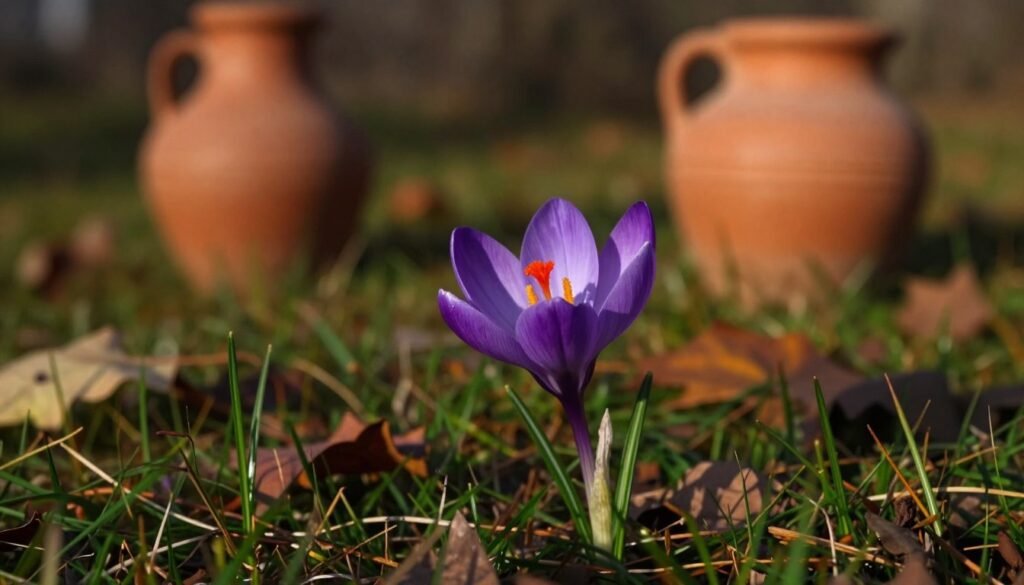
No saffron crocus has ever grown from a seed. Crocus sativus is sterile and makes no fertile seeds, so every plant is a clone moved from field to field by hand.
That movement happens through the corm, an underground stem, similar to a bulb, from which Crocus sativus is planted and propagated. Every saffron plant alive today is a clone that people carried and replanted. A corm can take up to 2 years to begin flowering, and each one yields 1-3 purple flowers.
Saffron is not a wild spice that people simply gathered. Without human hands moving corms, the plant would have vanished.
The flower is easy to picture. It has purple petals, three red stigmas and a bloom that opens in autumn, while the long, slender, grass-like leaves belong to the iris family, Iridaceae. The genus Crocus has about 85 species, and only sativus is widely used as a spice.
Its story is one of human selection. Crocus sativus descends from the wild Crocus cartwrightianus, and early cultivators picked out specimens with exceptionally long stigmas. Evidence points to early Greece, most likely Attica, as the place of domestication, and a 2022 study of genetics and ancient art supports a date around 1700 BCE. Researchers at the Plant Humanities Initiative at Dumbarton Oaks follow plants like this one through texts, images and trade.
The common mistake is to imagine ancient people walking into a meadow and gathering a ready-made spice. The plant they gathered was already a human project, and the first people to leave a picture of its harvest did so in paint.
The History of Saffron in Minoan Crete and Santorini
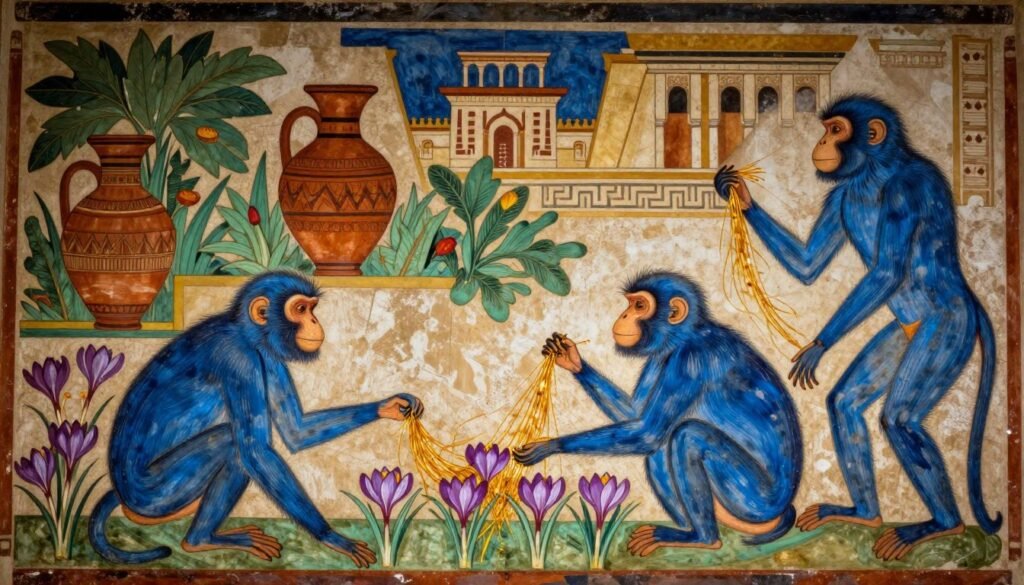
Blue monkeys pick saffron in a Minoan fresco from 1600-1450 BCE. The animals gather red threads from crocus flowers as if they were farmhands, and the scene is among the oldest pictures of saffron work.
The oddness is real, not a trick of restoration. Minoan artists loved nature scenes, and they painted monkeys, flowers and gatherers with the same care. The art shows that people picked saffron and prized it, but not what they did with the harvest.
At Akrotiri on Thera, now Santorini, a saffron fresco dates to around 1500 BCE. Gatherers bend over the blooms, and the work looks important enough to fill a wall. At the Palace of Minos in Knossos, Crete, a harvester appears in pottery and frescoes from 1700-1600 BCE.
Across the Aegean Bronze Age, from 1700 to 1500 BCE, the crocus returns again and again as a motif. The first signs of cultivation date to about 1700 BCE, so the history of saffron crocus sativus can be told through paint and pottery rather than recipes. Nothing here proves the Minoans invented saffron cooking.
Written records tell a different part of the story. Farther east, a city took its name from the spice itself.
Sargon’s City of Saffron: Mesopotamia, Egypt and the Bible
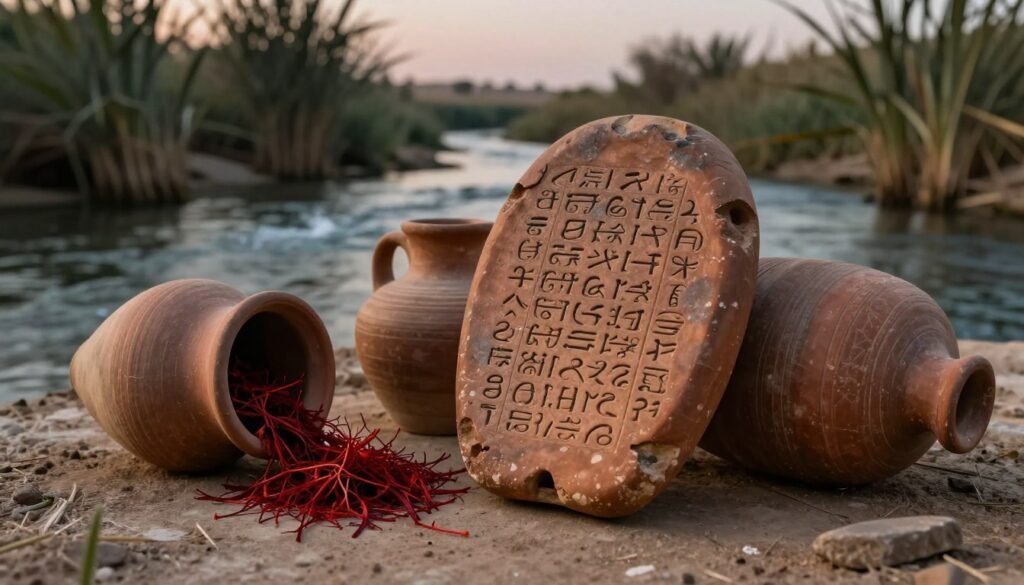
A Mesopotamian legend places the birth of an emperor in a city of saffron. In the Legend of Sargon, from the Akkadian empire around 2300 BCE, the birthplace is called Azupirano, near the Euphrates.
Early texts name saffron by word only, so scholars read them beside the art. The table lines up the main records of the spice across the ancient Middle East and the Aegean.
| Date | Place or text | Mention |
|---|---|---|
| 2300 BCE | Akkadian empire, Legend of Sargon | Birthplace called city of saffron (Azupirano) near the Euphrates |
| 1700-1600 BCE | Knossos, Crete | Harvester shown on pottery and frescoes |
| About 1500 BCE | Akrotiri, Thera | Saffron fresco |
| 10th or 9th century BCE | Song of Songs 4:14 | Saffron called karkon in Hebrew |
| 668-633 BCE | Assyria under Ashurbanipal | Botanical dictionary lists azupiranu as saffron |
Egypt also left a trace. The Ebers papyrus lists saffron as an ingredient in a remedy for kidney problems. Sumerian remedies, and later the Assyrian and Babylonian courts, used wild “historic saffron” long before farmers fixed the cultivated plant.
What does the Bible say about saffron? It appears once, as karkon in the Song of Songs 4:14, in a list of fragrant plants in a garden. Phoenician traders linked the workshops to the palaces, and they supplied saffron-dyed textiles to Assyrian kings.
Soon the spice moved into the Greek world, where the flower gained a name and a myth.
Krokos: The Greek Myth of the Boy Turned Flower
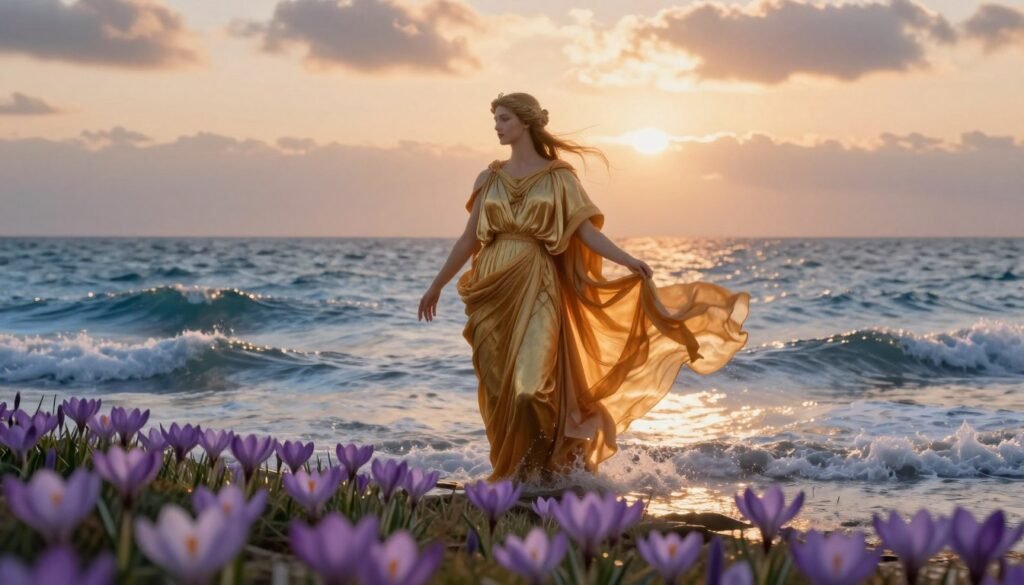
Homer’s Dawn rises from the River of Ocean in a saffron robe, a line in Book 19 of the Iliad. The Greek word for saffron was krokos, and it appears in the epic as a color of light.
Myth gave the plant a human face. Krokos, lover of the nymph Smilax (Esmilax in some retellings), was turned into the saffron plant by Hermes. The history of saffron in Greek storytelling shows that color and scent mattered long before cuisine did.
The stage had its own take on the aroma. In Clouds, staged in 423 BCE, Aristophanes plays on the dried spice’s “sensuous smell.” Audiences clearly knew the scent well enough to laugh about it.
The name outlived the myth. The genus Crocus still carries the Greek word, and the Latin crocus likely traces back to an ancient Sanskrit word for saffron. Time has worn down the story of the boy, but the name remains on every botanical label.
Greek writers also left something more practical than poetry. Their physicians prescribed the same spice.
Saffron as Medicine: Ancient Cures and Modern Curiosity
Pliny the Elder credited saffron with near-universal healing powers. In the ancient world, healers in Egypt, Greece and Rome treated the spice as a general remedy.
For thousands of years, saffron was medicine first and food second. Ancient prescriptions are not evidence that saffron works, and these old claims are history, not health advice. The treatment lists below show what people believed.
Egypt and Greece: Digestive Aids and Kidney Remedies
Hippocrates, Theophrastus and Galen regarded saffron as an appetite stimulant and a digestive aid. Their view shaped Greek medical practice for centuries.
In Egypt, the Ebers papyrus lists saffron in a cure for kidney problems. It is one of the earliest written medical uses of the spice.
Rome: Pliny’s Cure-All and Celsus’ Prescriptions
Pliny credited saffron with general panacea properties, a cure for nearly everything. In the first century CE, the Roman physician Celsus prescribed it for abdominal distress, lethargy, cataracts and poisoning.
Older European pharmacology went further. It credited small doses with sedative, expectorant, stimulant, stomachic, antispasmodic and aphrodisiac effects. Doctors prescribed it in fevers, melancholia and enlarged spleen. In some cases it was used as an abortifacient, a darker side of its reputation.
Ayurvedic and Persian Remedies, and What Saffron Benefits Still Mean
Ayurvedic and Persian traditions used saffron for gastrointestinal and genitourinary distress, asthma and respiratory congestion, fever and pain. They also turned to it for eye and mental illness and for infertility.
Modern researchers are now exploring the functional properties of the stigma and of other plant parts. The interest is real, but the evidence is still developing, and saffron benefits remain unproven. Anyone thinking about a supplement should ask a doctor first.
One use of saffron needed no belief at all, and that was its color and scent.
Perfume, Dye and Royal Robes: Saffron as Luxury
Roman streets were reportedly sprinkled with saffron when Nero entered the city. That single gesture shows how scent and color turned the spice into a sign of wealth.
Saffron-dyed textiles were rare, very expensive and royal status symbols. A dye spreads only when people can afford it, and saffron never was affordable. That kept it elite.
The crocins give the color, and they dissolve in water, which made the dye easy to use but costly to make. The luxury uses fell into a few clear groups:
- Royal mantles, such as the saffron mantle of the kings of Ireland and the textiles of wealthy Indian officials
- Saffron-dyed cloth that Phoenicians supplied to Assyrian kings
- Halls, courts, theaters and baths, where Greeks strewed the spice
- Nero’s procession, with saffron sprinkled along the road
- Perfume and incense, including Zaafran Attar, a Middle Eastern oil made from saffron and sandalwood
Saffron tincture is still used in some perfumes and incense. The dye trade did not last. Synthetic dyes replaced saffron dye because of cost, and the old yellow-gold cloth faded from the world’s wardrobes.
These uses built a second kind of value, the meaning that people attached to the color.
What Saffron Symbolizes: Sacred Orange, Wedding Gold and Dawn
Saffron symbolizes sacredness, status and sunrise, depending on who is asked. Across cultures, the spice has also stood for luxury and sensuality, and the color often carries its own meaning.
The saffron color and the saffron spice have separate stories. Four meanings stand out:
- Sacred in Hindu practice, where saffron is one of the most sacred colors and is sometimes applied as a red dye to the forehead
- Marital in Rome, where saffron colored the marriage robe
- Renunciation in Buddhism, shown by the saffron-colored robes of monks
- Sunrise in Greek poetry, which links saffron to dawn
The common error is to assume the monks’ robes use real saffron. Buddhist monks wear saffron-colored robes, but they are not dyed with the plant. The shade took its name from the spice, not the other way around.
Those meanings crossed borders because the spice did. Trade routes carried both the threads and the ideas attached to them.
How Saffron Traveled West: Romans, Arabs and the Road to Spain
The word saffron works as a map: Persian, Arabic, Latin, French, English. The Arabic za’faran gave the Medieval Latin safranum, then French safran, then the English word.
The older roots are just as telling. The Persian zarparan means gold strung, and the Arabic root is linked to becoming yellow. Corms travel only when people carry them, so every new field marks a deliberate act. The route ran in these steps:
- Greece and Mesopotamia, where early cultivation and use took hold
- Roman Britain, since the Romans introduced it to Great Britain
- Arab Spain, where the Arabs brought it and where it was likely introduced for cultivation in 921 CE
- Medieval England and Russia, where it grew hundreds of years later
- China, reached through trade routes commonly tied to Mongol-era commerce
International trade brought saffron from the Middle East and the Mediterranean to Spain. Over the centuries it became a crop of many climates, from damp English fields to dry Asian plateaus. Each step needed a farmer willing to dig up corms and take a risk.
By the Middle Ages, saffron had reached the markets of Europe, and there the cost became the story.
Medieval Europe’s Costly Obsession
In the fifteenth century, the royal house of Navarre paid eight times as much for saffron as for pepper, itself a costly spice. That gap made saffron one of Europe’s most expensive spice purchases.
Trade moved it through the ports, and for centuries it sat at the top of the price list. Cooks wanted it for color as much as for taste. Saffron colored and flavored medieval dishes such as spiced rice, and some people still bought it as medicine.
High cost kept it in rare dishes rather than daily cooking. A cook might save the threads for a feast, a wedding or a holiday. The habit survives in saffron cakes and in Swedish holiday breads.
The spice reportedly fell out of favor in the 19th century, possibly because of its cost. Today it shows signs of a quiet revival, and old recipes are getting new fans.
Any prize this costly invites a temptation, and the temptation is fakery.
Counterfeit Saffron: The Oldest Fraud in the Spice Trade
Turmeric is often sold as Indian saffron, and that is only one trick. Saffron is described as the most adulterated spice in history, because its high price rewards cheaters.
Adulterated saffron comes in several forms. The common fakes include:
- Turmeric, often mislabeled Indian saffron
- Yellow stamens, low in flavor, added to bulk up the threads
- Safflower, sold as counterfeit saffron
- Calendula petals, dried and passed off as the real thing
- Pigments from Gardenia jasminoides
Real saffron threads are intensely red, and whole threads are safer than powder. Powdered saffron is easier to fake, so grinding threads at home is the cheapest check. Real threads are the dried stigmas, thin strands with a trumpet-shaped tip.
Judging by color alone is a mistake, because dyes imitate it well. A buyer should look for whole red threads and expect the aroma to be strong and sweet.
So why does the real thing cost so much? The answer lies in the chemistry and the harvest.
Red Gold in the Chemistry: Color, Bitterness and Aroma
Fresh saffron smells far weaker than dried saffron. Drying creates the aroma, and three compounds shape the spice’s color, taste and smell.
| Compound | What it gives | Detail |
|---|---|---|
| Crocins | Color | Water-soluble carotenoids, the main source of the yellowish-red hues |
| Picrocrocin | Bitter taste | Found only in saffron, a precursor of safranal |
| Safranal | Aroma | Forms during drying from picrocrocin, the main aromatic compound |
Drying removes about 80% of the stigma’s weight. Dried saffron’s color and bitterness are about five times more concentrated than in the fresh stigma. The Spanish tradition roasts the stigmas gently over charcoal embers.
Saffron has 0.3-0.8% volatile oils and more than 150 volatile components. People describe the aroma as honeyed, floral and sweet, with a metallic note. Cooks, on the other hand, call the taste hay-like and bitter. Aroma and color are the two key quality markers.
Heat and water release the color, because crocins dissolve. That is why a steeped thread turns a pot of rice gold. Behind every thread sits a great deal of labor.
Why Saffron Is So Expensive: A Harvest That Never Changed
One kilogram of dried saffron takes about 370-470 hours of hand labor. That labor, not the growing, sets the price. Anyone who finds saffron expensive is paying for hours.
| Stage | Figure | What it means |
|---|---|---|
| Flowers per kg of dried saffron | 70,000-200,000 | Roughly 150,000 is the usual working figure |
| Stigmas per flower | 3, about 2 mg each | Tiny yield |
| Picking | 45-55 minutes per 1,000 flowers | Done before the sun wilts them |
| Removing stigmas | 100-130 minutes per 1,000 flowers | Done by hand |
| Total labor | About 370-470 hours per kg | Sets the price |
The contradiction is simple. Saffron is not hard to grow, only to harvest. Blooms last only a few days in autumn, and workers pick them at dawn or mid-morning. Picked stigmas quickly lose color and flavor in the sun.
Machines have not replaced hands because the flower is small and fragile, and each stigma needs careful removal. In the history of saffron, harvesting methods are a case where tradition is the technology. As JSTOR Daily has noted in its coverage of food and plant history, old crafts often outlast newer tools. You can read more on JSTOR Daily.
Commonly cited prices run from about $40-50 a gram at retail, an older figure, to a wholesale level of 1500-2200 euros per kg. Grade, origin and form move the price. This labor happens in a handful of places around the world today.
Where Saffron Grows Today
Iran grows most of the world’s saffron, roughly 80-94% of world output. The crop is concentrated in a few countries, and cultivation is a small-farm business in each of them.
| Country | Share or rank | Growing region |
|---|---|---|
| Iran | About 80-94% of world output, over 160 tons a year | Khorasan and Fars |
| India | About 5% | Pulwama and Budgam, Kashmir |
| Spain | Second largest producer, quality of La Mancha prized | Castile-La Mancha |
| Greece | Smaller | Western Macedonia |
| Morocco | Smaller | Around Marrakesh and Taroudant |
In India the spice goes by kesar, its Hindi name, and it is tied closely to the fields of Kashmir. Afghanistan, Italy, New Zealand and Japan grow small amounts. Spain, Hong Kong and the United States are the largest importers in the global trade.
Saffron tolerates semi-arid land but suffers in extreme heat. A long hot summer delays flowering, which delays payment for small farms. Some farms add tourism to diversify, and visitors pay to watch the dawn harvest.
Once the threads leave the field, the work passes to cooks, who must handle them with care at home.
What Saffron Is Used For, and How to Cook With It
A few threads color and flavor a whole pot of rice. To use saffron well, cooks give it heat and liquid, because it releases flavor and color only in warm, wet conditions.
Saffron is poor as a finishing sprinkle. The steps are simple:
- Crush the threads with a pinch of salt or sugar in a mortar and pestle.
- Steep them in hot water, alcohol or vinegar, or steep powdered saffron in milk, for about 30 minutes.
- Add the golden liquid to the dish.
- Keep the simmering time in mind, since long cooking draws out more color and flavor.
- Skip the topping, and never sprinkle threads dry on a finished dish.
Whole threads work in risotto and bouillabaisse because of the simmering time. A few threads season most dishes. The spice is key to Spanish paella, French bouillabaisse and Italian risotto alla Milanese, along with English saffron cakes and Swedish holiday breads.
In Asia, saffron flavors North Indian biryani, Persian tachin and khoresh, and Indian kheer, ras malai, kulfi and zarda. Arab hospitality drinks combine coffee, saffron and cardamom, and Japan uses it on fish. These foods carry a culture with them, and that culture shapes how cooks treat the ingredient.
Saffron’s Living Legacy
A modern kitchen where a few threads bloom in warm water is the place where saffron’s story lives now. The spice has crossed more than 3,500 years of farming, trade and cooking, and it still arrives in a tiny jar. This is where the old harvest meets the stove, and where the history of saffron becomes something a person can taste. Its echoes also appear in books, film and verse.
The Cultural Echo: Cinema, Music & Modern Table
For reading, The Spice Route: A History by John Keay gives the wider trade story, and the Iliad offers the era-appropriate picture of dawn in a saffron robe. The Song of Songs 4:14, an ancient verse that names saffron, works as a kind of lyric echo. Readers can find more about food and culture at the Smithsonian.
For film, The Hundred-Foot Journey (2014) is a kitchen story about spice and heritage, not a saffron film. It captures how a dish can carry a family’s past, and saffron cooks know that feeling.
The best way to taste saffron’s past is to cook with whole threads and a little patience.
Bringing the History Home
The tools are old and plain. A mortar and pestle grinds the threads with a pinch of salt, and a wide paella pan or a clay pot gives the dish room to simmer. These are the heritage tools of a saffron kitchen.
For ingredients, cooks should buy whole threads rather than powder, such as Spanish La Mancha saffron. Good dishes to try are an Italian risotto alla Milanese, Persian rice with tachin and an English saffron cake. Each pinch of red ties the cook’s hands to the Bronze Age harvester kneeling in the crocus field at dawn.
Conclusion
Saffron’s value never came from the plant alone. The spice is a human invention, and it survives only because hands keep picking it, one flower at a time. Its myths, medicine and royal uses explain why it costs so much.
The next step is easy. Cooks can buy a small amount of whole threads, since saffron needs very little. Steep a few threads in warm water tonight and add them to dinner.