
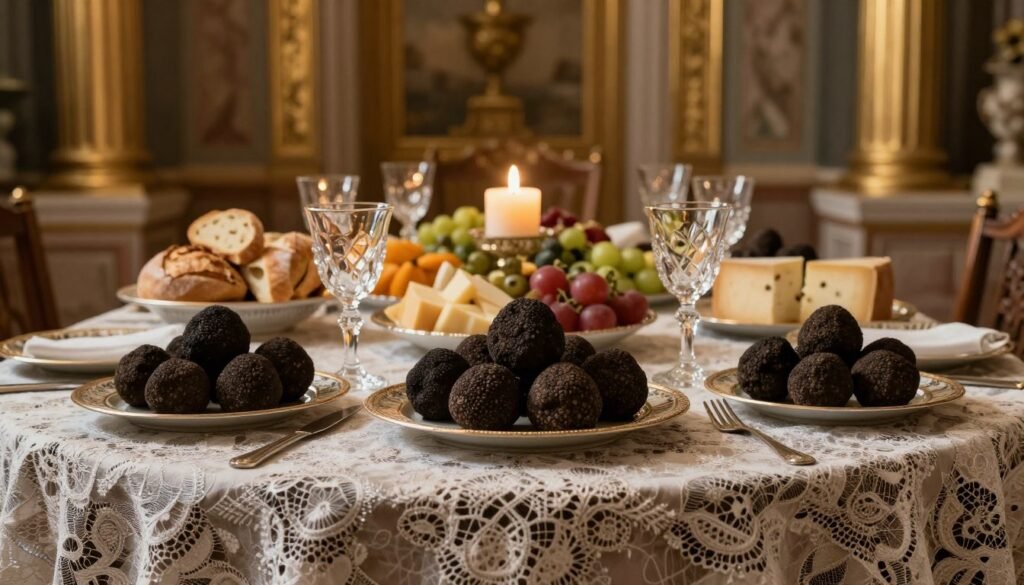
Candles gleam on silver in a Tsar’s banquet hall in St. Petersburg, and servants pour out endless streams of black truffles across the plates. The scene shows how far the history of black truffles runs, from muddy forest floors to imperial tables.
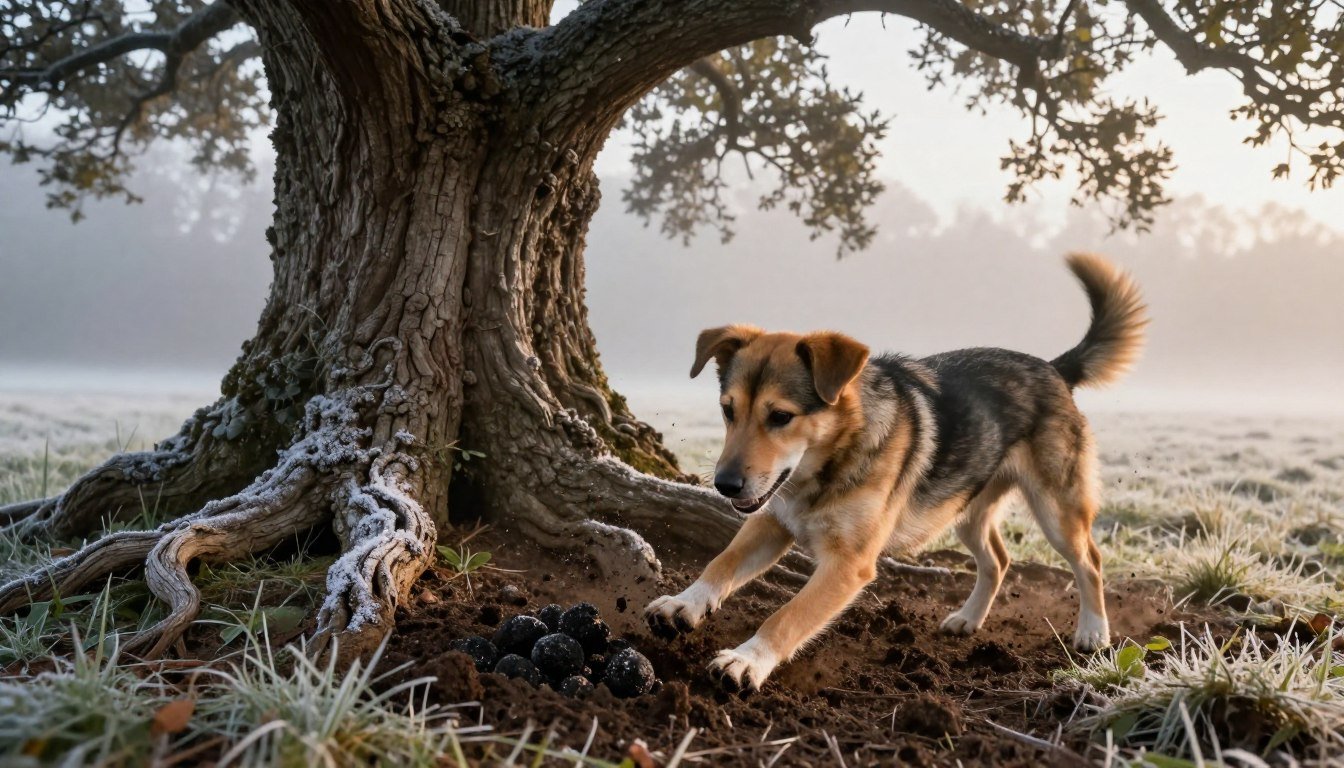
Now picture the other end of that story. On a frosty morning, a dog claws at damp soil under an oak, and a sharp, earthy smell rises into the cold air.
Roughly four thousand years of ritual, trade and mystery hang on that smell. The fungus grew unseen the whole time, so myths filled the gap. First, the reader needs to know what was being dug up.
Key Takeaways
- The black truffle is a fungus that fruits underground beside tree roots.
- Sumerians, Egyptians, Greeks and Romans all prized truffles, though early claims rest on tradition.
- The Middle Ages feared them, and Louis XIV brought them back to royal tables.
- Joseph Talon planted the first truffle orchards in the early 19th century.
- Spain is now the largest producer, and dogs do most of the finding.
- Fresh, shaved and added at the end is the best way to eat them.
The History of Black Truffles From Sumer to Rome
Roman writers believed that lightning created truffles. In fact, the black truffle (Tuber melanosporum), also called the Périgord truffle, is a fungus that fruits underground beside tree roots. It is not a true mushroom.
The word truffle traces to the Latin tuber, meaning outgrowth. That fits the lumpy, dark shape of a fungus that never sees the sun.
Sumerians in present-day Iraq are believed to be early truffle eaters. Egyptians are said to have served truffles coated in goose fat. These early claims are tradition more than firm records, so treat them as likely stories, not proof.
The earliest truffle tales rest on tradition. The Greek and Roman writers are where the written record truly starts.
The Greek writer Plutarch said truffles grew when lightning and thunder struck damp earth. Pliny the Elder called them a miracle of nature. Their taste was so strange that no one could say where they came from.
Romans turned the fungus into a luxury and an aphrodisiac at elite banquets. Nero is said to have called truffles the food of the gods. A rare delicacy that no one could farm became a sign of rank.
That enthusiasm did not last. As Rome faded, suspicion took over.
How Suspicion, Kings and Orchards Reshaped the Truffle
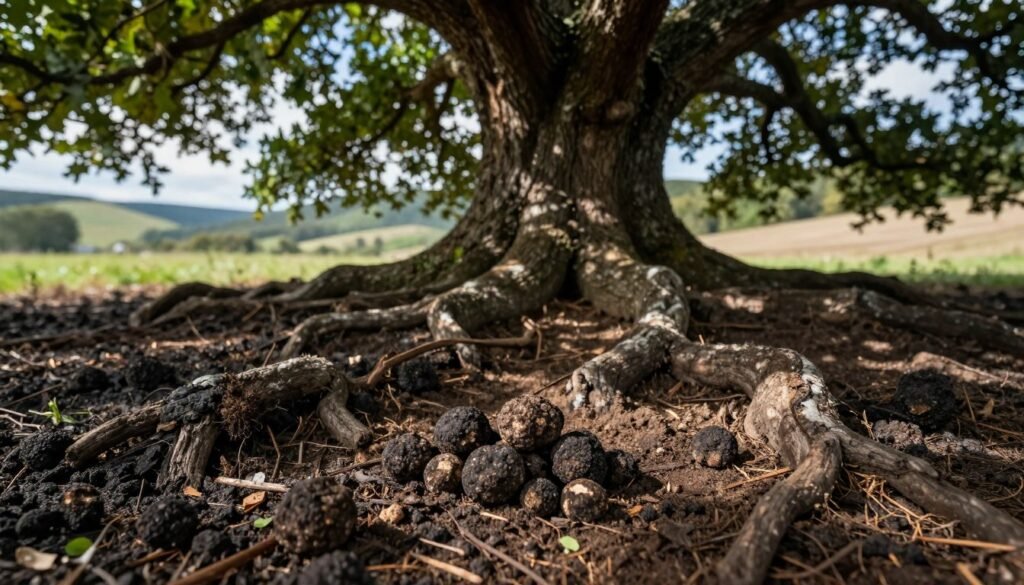
Picture a bare circle of scorched-looking earth around an oak. Truffles often leave such burnt patches around their host trees. The medieval church read that sign as witchcraft, and truffles fell under suspicion.
The patch has a plain cause. Mycorrhiza is the partnership in which a fungus’s threads wrap a tree’s roots and trade soil water and minerals for sugars. The fungus is tied to living trees, which is why farming it takes years.
Fear in the Dark Ages and Favor at Court
Louis XIV is credited with restoring truffles to royal tables. Napoleon Bonaparte is named as a fan. Fear gave way to fashion.
World expositions featured truffles starting in 1855. By then the fungus stood for French taste around the world.
Planting Oaks: Talon, Collapse and Global Farms
In the early 19th century, Joseph Talon planted acorns from truffle-bearing oaks in Périgord. He began the orchards called truffières. French harvests peaked in the mid-19th century at over 2,000 tons a year.
After World War I, rural depopulation and lost oak forests crashed yields. The first cultivated harvests came in the late 1970s and 1990s. Spain, especially Teruel around Sarrión, is now the largest producer, and farming reached New Zealand, Tasmania and Chile in the 1990s-2000s.
| Era | Status of black truffles | Driving force |
|---|---|---|
| Medieval Europe | Feared | Church suspicion of witchcraft |
| Louis XIV era | Royal delicacy | Court fashion |
| 19th-century France | Peak harvests, over 2,000 tons a year | Talon’s truffières and expositions |
| Post-World War I | Yields crashed | Rural depopulation, lost oaks |
| Late 20th century onward | Global farmed crop | Science and patient planting |
Even with orchards, the crop stays hidden. Animals still find it.
Truffle Hunters, Dogs and Pigs: Finding What Hides Underground
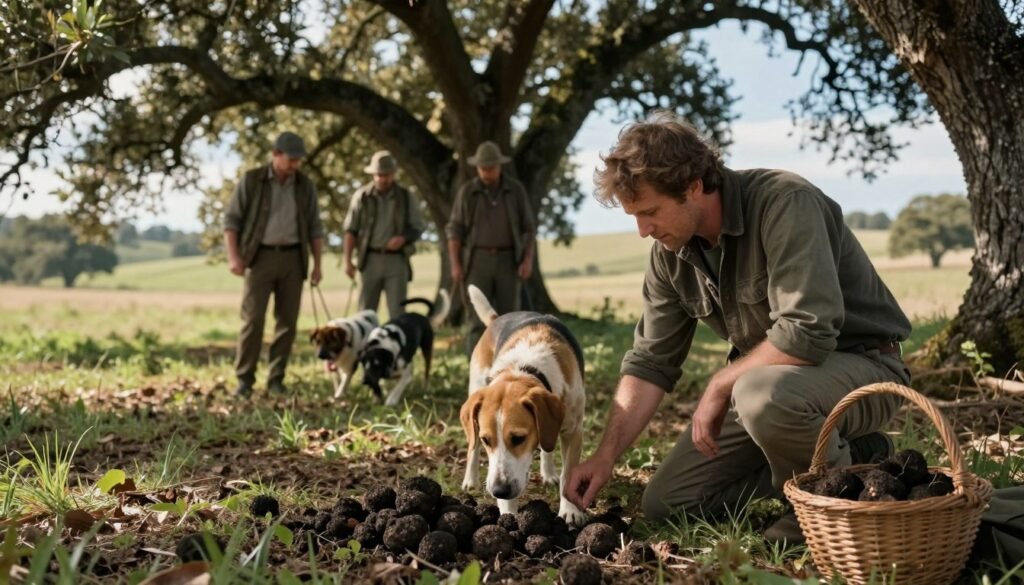
Dogs now do most of the finding. Truffle hunters rely on a dog’s nose to locate ripe truffles, as National Geographic explains in its report on truffle dogs and the scientists who study their finds.
Black truffles grow naturally in Spain, France, Italy and Croatia. Small farms exist in Northern California and Chile. Most sit about 1-6 inches below the surface near tree bases.
- Pigs were the traditional finders, but they often eat the truffle.
- Dogs are easier to train and less likely to eat the find.
- Truffles lie about 1-6 inches deep near tree bases.
- Hunting runs in the cold season, fall and winter.
Many people assume pigs are the modern choice. They are not.
A black truffle costs a lot for clear reasons. The work is hand labor, the soil needs are narrow, and a truffière waits years for a first yield. Demand also runs above supply. Price depends on grade, size, region and season, and out-of-season truffles can cost about double.
The largest recorded black truffle was about 4 inches wide and 2.8 pounds. All that effort leads to one question: what does the prize actually taste like?
The Cultural Echo and the Modern Table
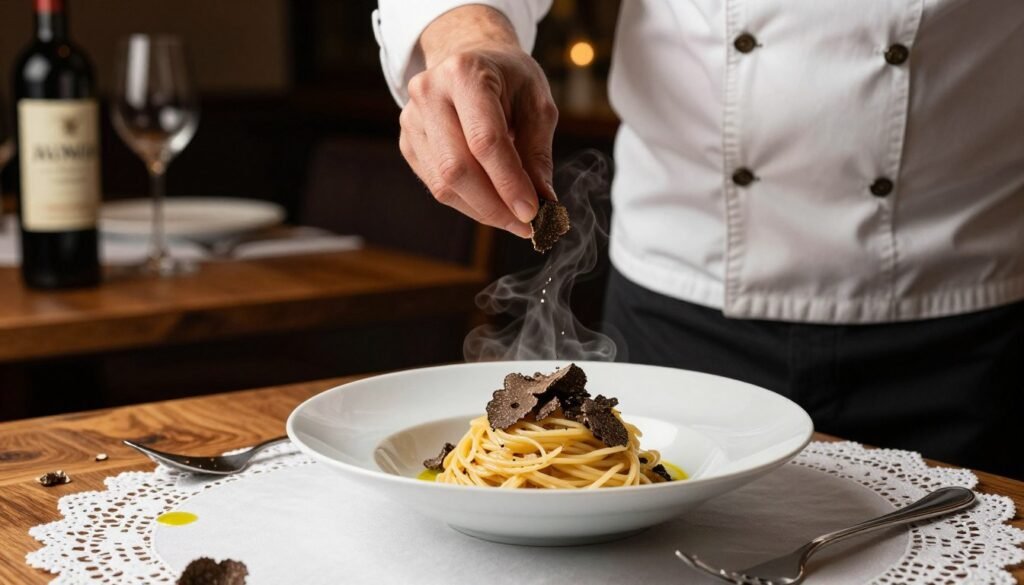
A freshly sliced black truffle smells of damp forest, cocoa and a garlic-like musk. The taste is earthy, musky and deeply umami, though words only hint at it. It pairs well with cream sauces, pasta, eggs, potatoes, beef and game.
Truffle is best fresh, shaved over finished dishes. Cooking it hard like a mushroom dulls the flavor, and that is the common mistake.
Cinema & Music
Truffles have long drifted from the table into culture. For a screen look at the hunt, the documentary The Truffle Hunters (2020) follows aging Italian hunters and their dogs in Piedmont. It shows a craft that still runs on secrecy and trust.
Bringing the History Home
Four choices bring the history to a modern kitchen. Each has a catch.
- Fresh shaved: the best flavor, but only in season.
- Truffle butter: butter blended with truffle pieces or flavoring, so the taste is mild.
- Truffle salt: stable out of season, but only a finishing touch.
- Truffle oil: much of it relies on the aroma molecule 2,4-dithiapentane.
With oil, sniff first. If the first smell is olive oil and not truffle, the oil is probably synthetic. For heritage tools, a fine truffle shaver and a pat of good butter are the old-fashioned way to start.
Conclusion
The truffle’s story is still underground. A fungus that nobody could plant became a world crop through patience and science, and that shift took generations of growers who kept trying.
The best truffle experience stays fresh, in season and simple. Buy a small amount of a fresh black truffle in season and shave it over eggs or pasta.