
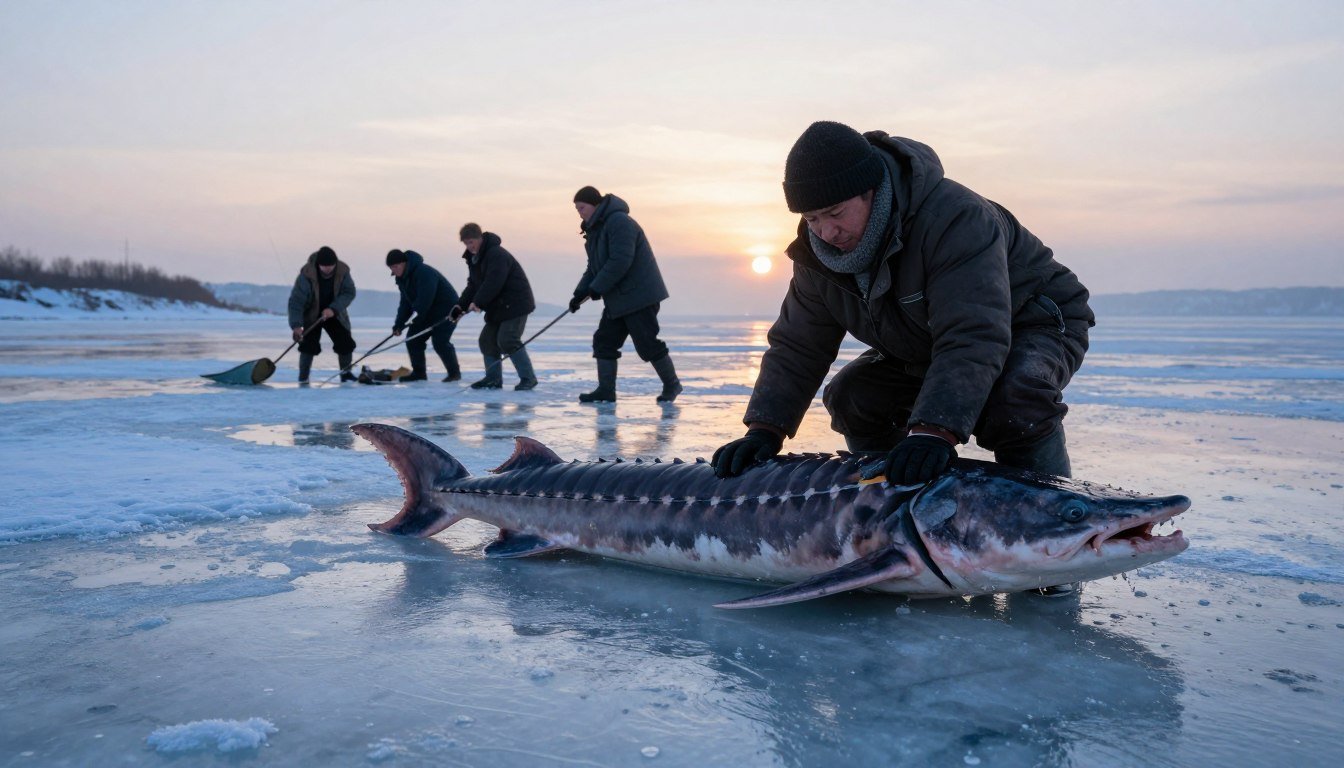
Dawn comes gray and bitter over a Caspian riverbank, and the men haul a giant sturgeon out of the shallows with ropes and hooks. Salt hangs in the air, the mud freezes under their boots, and the knife opens the fish to reveal glistening grey eggs. The history of beluga caviar starts with scenes like this one, far from any silver tray.
That history is darker than its glamour suggests. It follows three threads: royal privilege, dangerous harvests, and a species pushed to the edge.
The story of a food so rare begins with the first people who ate the roe.
Persians gathered sturgeon roe from river beds around the 4th century BCE. They called the fish mahi-e khayedar, which means egg-bearing fish.
Key Takeaways
- Persians collected sturgeon roe from river beds around the 4th century BCE.
- Early caviar was a survival food for ordinary people, not a luxury.
- By the 1600s, Russian rulers ranked beluga above all other roe.
- American producers once supplied about 90% of the world’s caviar.
- Beluga sturgeon females need 15 to 20 years to mature, so wild stocks collapsed.
- Wild beluga caviar cannot be imported into the United States today.
- Farmed and hybrid caviar keep the tradition alive.
Ancient Roots on the Caspian Shore
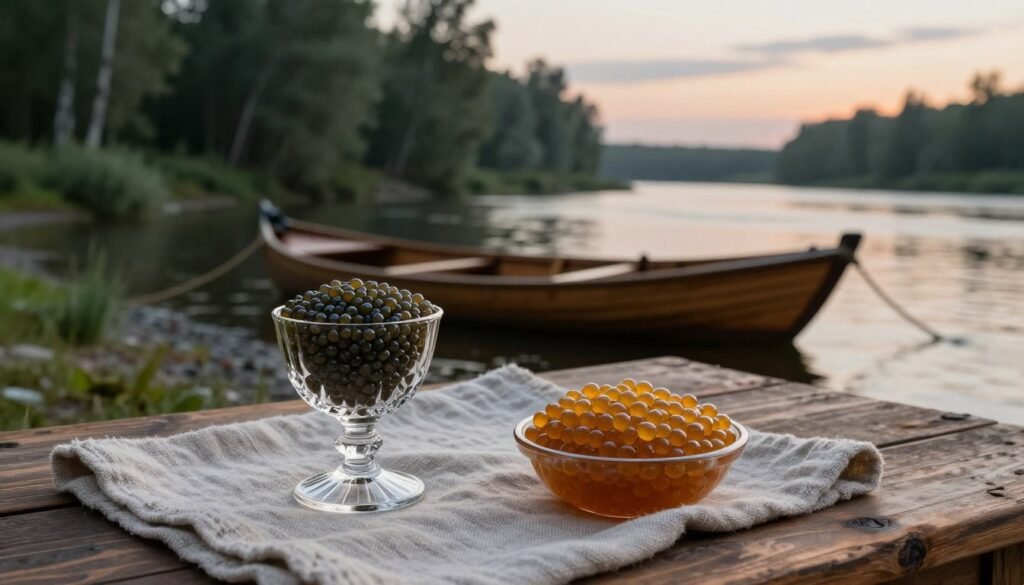
The earliest caviar eaters were practical people, not wealthy ones. They lived beside rivers full of sturgeon and needed food that would last, so they salted the eggs. Caviar began as survival food.
The word itself likely traces back to the Persian mahi-e khayedar, meaning egg-bearing fish. Traditional caviar is salt-cured sturgeon roe, and the Caspian and Black Seas were its early home.
- 4th century BCE: Persians collect sturgeon roe from river beds.
- Persian name: mahi-e khayedar, the egg-bearing fish.
- 13th century: Russian fishermen salt the eggs as protein for long voyages.
- Before industrialization: caviar is everyday food for ordinary people.
Caviar did not begin as a delicacy. It began as salted protein for people who needed to eat on the road.
The fish behind it is the beluga sturgeon (Huso huso), a prehistoric giant native to the Caspian and Black Sea basins. It can reach about 20 feet in length. A female takes roughly 15 to 20 years to mature, long before she gives any roe.
Caviar history in Russia reaches back to at least the 1200s, when the eggs fed common people. Nobody saw a treasure in a barrel of salted fish eggs. That was about to change as demand grew and industry arrived.
How the History of Beluga Caviar Made It a Symbol of Wealth
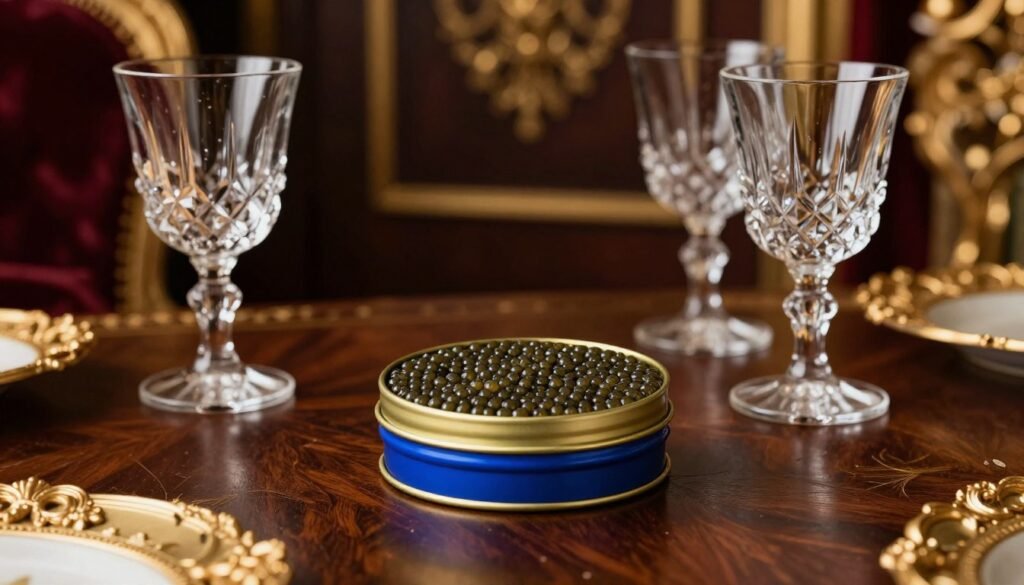
Rarity and rank, not flavor alone, made beluga a status symbol. By the 1600s, caviar signaled wealth and power in Russia. Rulers in Russia and Persia granted fishing rights to nobility and religious institutions, which kept the best catch in few hands.
The ranking was strict. Beluga was reserved for the Tsars, osetra went to the nobility, and sevruga went to foreign dignitaries and the upper bourgeoisie. The British called the fish the Royal Fish.
The price follows the fish. A beluga sturgeon can exceed 2,000 lbs and live over 100 years. It takes years of care and risk before any roe appears, so each egg carries a long wait.
Is beluga caviar the best? It is the most prized by tradition, though best is a matter of taste. The eggs are large and pearl-like, from light silver-gray to deep charcoal. They feel soft and then burst, with a buttery flavor, gentle brine and soft nutty notes.
The blue tin became a status marker too. Traditional beluga tins are blue, and the color told a dinner table what had arrived. Wealth had a color and a label.
Europe’s appetite for that blue tin soon drained the Caspian. Merchants looked for new rivers, and the trade crossed the Atlantic.
Industrial Hunger: From the Delaware River to Soviet Quotas

German immigrant Henry Schacht began commercial caviar on the Delaware River in 1873. His timing was sharp, because the river was full of sturgeon. Within a few decades, the United States made about 90% of the world’s caviar, and the trade changed who could buy it.
The American Caviar Rush
American sturgeon were plentiful, so American caviar sold cheaper than European roe. The west coast followed the east. Indigenous tribes had harvested shortnose sturgeon and their eggs for thousands of years, but never at this scale.
The irony was sharp. American caviar was shipped to Russia and relabeled Russian caviar. Then overfishing collapsed US sturgeon, and production halted.
Overfishing in the Caspian and the Limits on Wild Harvest
Beluga was taken in the Caspian through the 19th and 20th centuries. Greed did not act alone. A female matures after 15 to 20 years, so the population could not replace what the nets removed.
| Roe | Role in history | Rank | Status today |
|---|---|---|---|
| Beluga | Reserved for the Tsars | Highest | Critically endangered in the wild |
| Osetra | Food of the nobility | Second | Lesser Caspian roe |
| Sevruga | Served to foreign dignitaries | Third | Lesser Caspian roe |
| American paddlefish | Stand-in for sturgeon roe | Not ranked | Domestic alternative |
The Soviet Union and later international bodies set quotas and bans on wild harvest. The rules came late, after the stocks had already thinned. A crisis was now forcing governments to step in.
Is Beluga Caviar Illegal Today?

Wild beluga caviar is banned from import to the United States. In 2005, the U.S. Fish and Wildlife Service banned import of wild beluga caviar from the Black Sea and Caspian Sea. Farmed and hybrid products follow separate rules, so the reader checks species and origin on the label.
The ban reflects a hard fact: beluga is critically endangered in the wild. Caspian countries banned sturgeon fishing too, and later rules widened the restriction to the Black Sea basin.
Harvest has changed as well. The wild catch was dangerous and killed the fish. Aquaculture now raises sturgeon on farms across Europe and the Middle East. No-kill caviar is roe taken from a live, farmed female sturgeon so that the fish can be harvested again over its lifetime.
Beluga hybrid caviar is a legal option. Makers cross beluga sturgeon with species such as Siberian sturgeon, and the result mimics the large pearls of the original.
One mistake is common: assuming the word Russian on a tin means wild. Farmed roe can carry that name too. Next comes the question of how to taste this history at home.
Tasting the Past at the Modern Table
A mother-of-pearl spoon rests beside a blue tin, and the table is set for history. Serve caviar chilled, never frozen, and in small portions. Avoid metal spoons and the freezer, since both ruin the taste and texture.
The Cultural Echo: Cinema, Music & Modern Table
Caviar became shorthand for wealth on screen and in society. A spoonful in a film scene tells the audience that money is in the room. For a documentary, the 2010 film Mad Hot Ballroom does not apply, so readers may prefer Ian Fleming’s Casino Royale, where James Bond orders caviar as a sign of taste.
Modern menus keep the ritual. Tasting scenes now come with a small spoon, a calm pause and a glass of Champagne.
Bringing the History Home
Gather a few simple tools and ingredients, each with a reason:
- Mother-of-pearl or bone spoon: avoids metallic flavor transfer.
- Blini: warm, soft pancakes that carry the eggs.
- Crème fraîche: cool cream that softens the brine.
- Lightly buttered toast points: a crisp base.
- Chilled vodka or Champagne: a clean, cold finish.
Buy farmed or hybrid caviar from a reputable store, and read the label for species and origin. Keep unopened tins in the refrigerator, and remember that purists eat the caviar plain. A spoonful then becomes a taste of protected history.
Conclusion
The story of beluga is a story of appetite and restraint. A food that began as common fare became a symbol of power, and the hunger for it nearly erased the beluga sturgeon.
Farmed and hybrid production lets the tradition continue without stripping the rivers again. Before the next purchase, check the species and origin on the label.