
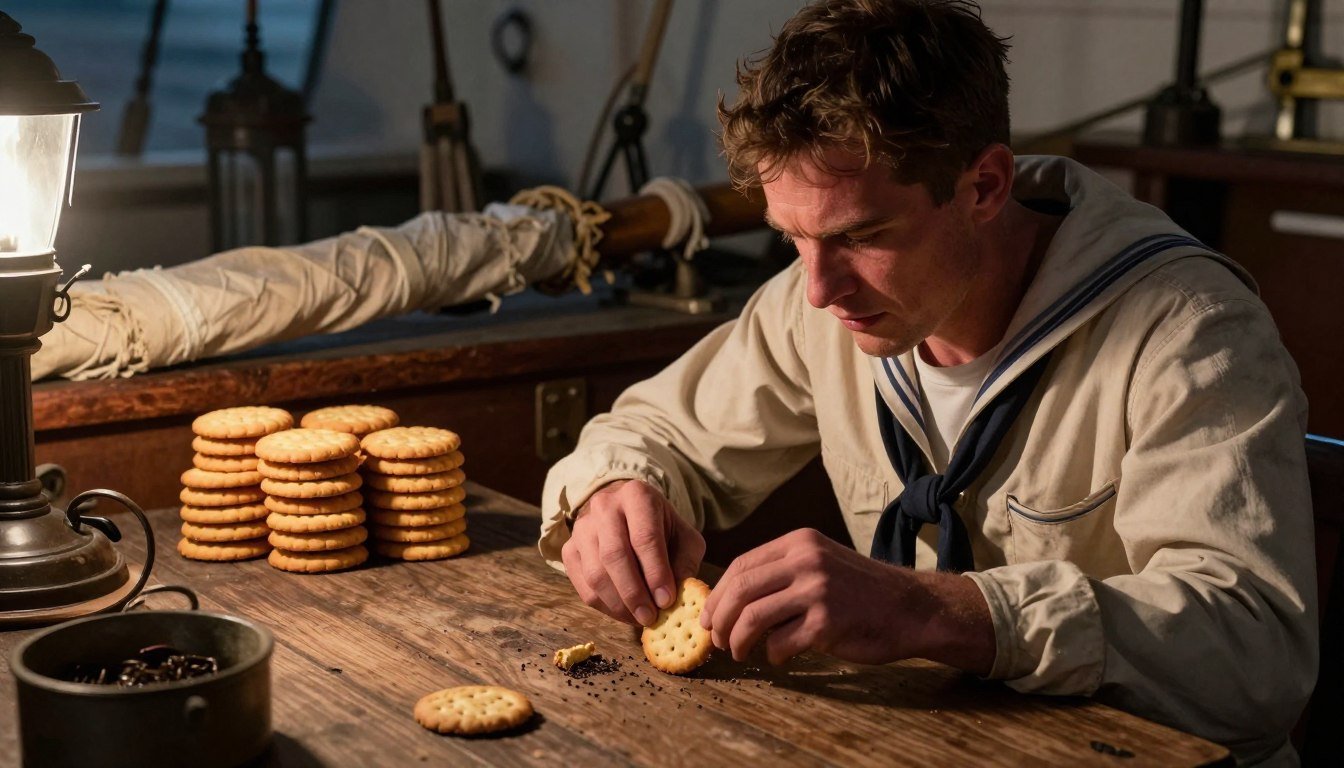
The messdeck was dim, and the only sound was a sharp knock of wood on wood. A sailor rapped his biscuit on the table in the lamplight, and small bodies fell out onto the boards. He picked off the last weevil and ate anyway.
The full history of ships biscuits begins with scenes like this one, on hungry ships where little else would keep. Sailors used biscuits as postcards, and one ship’s biscuit from 1784 is the oldest surviving biscuit of any kind. An empire’s reach depended on food that outlasted the voyage.
The story starts with the earliest recorded voyages and the names the biscuit carried.
Key Takeaways
- The biscuit was baked twice and dried hard so it could last months at sea.
- Hardtack, sea biscuit and ship’s bread are all names for the same food.
- Navy bakeries, called victualling yards, marked and tracked every batch.
- Weevils and mold were a constant problem, and sailors invented many remedies.
- Tinned meat and soft bread slowly replaced the biscuit, and the ration ended in 1907.
- Lifeboat packs still hold a descendant today.
The History of Ships Biscuits From Crusader Fleets to the Spanish Armada

The ship’s biscuit is also called hardtack, sea biscuit and ship’s bread. Before 1800 sailors often called it plain bread. Later the Navy used the term soft bread for baked loaves, to tell them apart from biscuits.
The idea is old. The Latin root panis biscotus means twice-cooked bread, and Romans carried a re-baked rusk that suited soldiers’ rations. Food history notes on cookies, crackers and biscuits trace this twice-baked tradition and its link to long voyages.
In 1190 Richard I sailed from England with ships stored with biskit of muslin, a mix of barley, rye and bean flour. By Tudor times hardtack was the best-known name. When the Armada sailed in 1588, each crewman had a theoretical daily allowance of 1 lb of biscuit plus a gallon of beer.
The biscuit and the beer were a fixed pair. A crew counted on both every day.
Victualling, the provision of food supplies to a ship or fleet, grew into a system under Samuel Pepys. He began organised victualling in 1667. His first full ration table called for a pound daily of good, clean, sweet, sound, well-baked wheaten biscuit.
A table like that needed bakers who could deliver on it. Next came the question of how they actually made the biscuit.
How Bakers Made a Biscuit That Could Survive Months at Sea
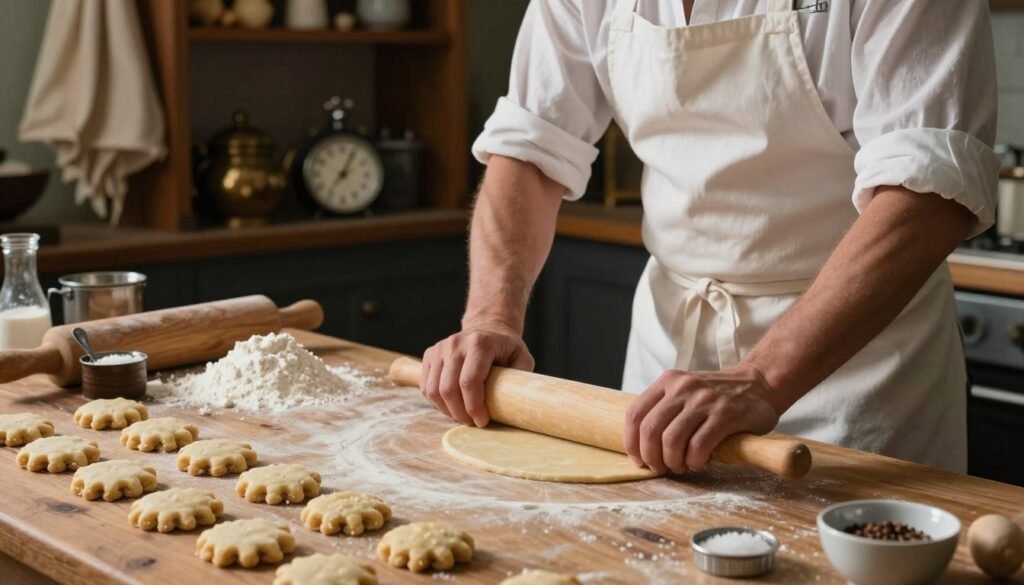
The flour was often gritty with more than wheat. Millers sometimes stretched it with gravel and mill-floor sweepings, a detail rarely mentioned. Even so, Navy flour was better than ordinary people could buy.
The historical ships biscuits recipe used three ingredients: stone-ground wholemeal flour called bisket meal, water and salt. The wheat grew on the Isle of Wight. No yeast and no fat went in, because both spoil. The 1805 method ran in five steps:
- Mix bisket meal, water and salt into a stiff dough.
- Rest the dough for about 30 minutes.
- Roll it to a thickness of about a centimeter.
- Dock it with a tool of nails.
- Bake at about 220 C (about 430 F) for half an hour, then dry.
The hole-punching tool, the docker, pierced the dough all over. The holes let moisture escape evenly, so the biscuit would not crack. After baking, the biscuits sat to dry and harden.
After 1805 each biscuit carried a ring pattern of 34 holes. That matched the 34 British ships at Trafalgar. Bakers made them by hand until 1829, when steam machinery arrived.
The machines changed the shape. The hexagon won because it wastes the least dough. Whatever the shape, the finished biscuit still had to face the damp, dark hold.
Weevils, Mold and Broad Arrows: Life With the Biscuit Below Deck
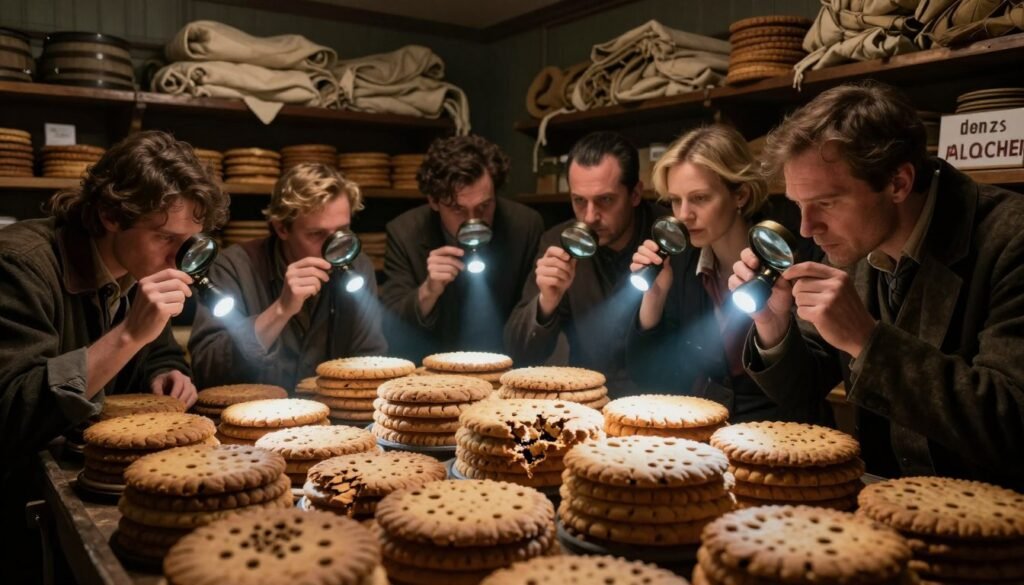
In 1741, shipwrecked men on the coast of Chile made soup from what they thought was a biscuit bag. It was a tobacco bag, and all of them were violently ill. Hunger made them careless, and the mistake shows how little the bags told a man by sight.
Biscuits sat in canvas bags inside barrels in the bread store. The space was poorly ventilated and rarely saw daylight. Pests and damp were the biscuit’s two great enemies, and sailors tried four remedies:
- Rapping the biscuit on the table to shake out weevils.
- Re-baking it on board, as Captain Cook did.
- Laying a dead fish over it so maggots moved into the fish.
- Storing it in tin-lined cases, later sealed metal containers, which gave us the biscuit tin.
Marks told the Navy where a batch came from. The broad arrow, also called the Pheon, marked government property. Letters named the victualling yard: W for Royal William Yard in Plymouth, V for Royal Victoria Yard in Deptford, C for Royal Clarence Yard in Portsmouth, and M for Malta. The Clarence site once held a house named Weevil House.
Sailors also pushed back. A painted biscuit in the Royal Museums Greenwich collection (AAB0005) carries a Lord’s Prayer line mocking Admiralty food. No description of the taste survives better than the complaints. How the Navy kept so many bags filled across the world is the next part of the story.
How the Biscuit Supplied Navies and Empires

In 1805 an East Indies voyage was stocked for 8 months, while English Channel Squadron ships carried 4 months of supplies. The biscuit had to survive tropical heat and polar damp. Without a food that lasted months, long voyages were impossible.
The yards at Plymouth, Deptford and Portsmouth, plus Malta for Gibraltar and the Mediterranean Fleet, worked as a supply chain years before modern logistics. The table shows how it changed.
| Year or Case | What Changed | Why It Mattered |
|---|---|---|
| 1805 Channel Squadron | 4 months of supplies carried | Short cruises near home |
| 1805 East Indies ships | 8 months of supplies carried | Reach across oceans |
| 1829 steam shift | Machines replaced hand baking | Faster, larger output |
| 1847 tinned beef | Preserved beef issued officially | First rival to salt meat and biscuit |
| 1907 end of ration | Biscuit requirement dropped | Bread baked on board took over |
Canned meat was first marketed in 1813, and soft bread became a Navy issue item in the mid-1850s. The biscuit stayed a staple on land too. In the American Civil War, square hardtack fed Union and Confederate soldiers alike.
When the ration ended in 1907, the biscuit did not vanish. It simply moved to quieter places, and some of them are close to home.
Where Hardtack Survives Today
Every modern lifeboat ration pack holds a descendant of the ship’s biscuit. A green foil packet of biscuits, with holes, sits inside the emergency kit. The design has barely changed because the job has not.
Lifeboat Rations and Operational Ration Packs
Military operational ration packs use biscuits when soft bread is unavailable. Ships biscuits for sale also appear at specialty food stores and reenactment suppliers. Pricing varies by seller and quantity, so check the seller.
Cooking and Eating Hardtack at Home
A modern home recipe uses flour, water and salt. Roll the dough about 1/2 inch thick, dock it, and bake in a low oven, about 250 F, for hours. Water makes the dough, and plain salt keeps the taste.
To learn how to eat ships biscuits safely, never bite them dry, since they can crack teeth. Soldiers once broke Civil War hardtack with a rifle butt, and sailors softened it in brine, grog, coffee or tea. Four easy ways today:
- Dunk it in tea or coffee.
- Soak it in soup or stew.
- Crumble it into chowder.
- Fry it in bacon fat.
The beer that once rode beside it has mostly dropped out of the meal. The biscuit’s afterlife now lives in stories, screens and kitchens.
Conclusion
The cracker outlasted the fleets it fed. Its history shows that empires ran on dull, dependable food, and that people will trust almost anything that keeps their crew alive and moving.
The best next step is simple. Bake a batch of hardtack this weekend and share it with a history-minded friend.
The Cultural Echo: Cinema, Music & Modern Table
For a look at the world these biscuits fed, watch the film Master and Commander: The Far Side of the World (2003), set in 1805. Its messdeck scenes show the knock, the weevils and the grumbling.
Bringing the History Home
Good tools make the batch feel right. Choose stone-ground wholemeal flour and sea salt, which match the old bisket meal and plain seasoning.
A hand docker or a plain fork works for the holes. Bake on a cast iron baking sheet, which holds steady heat through the long, slow drying.