
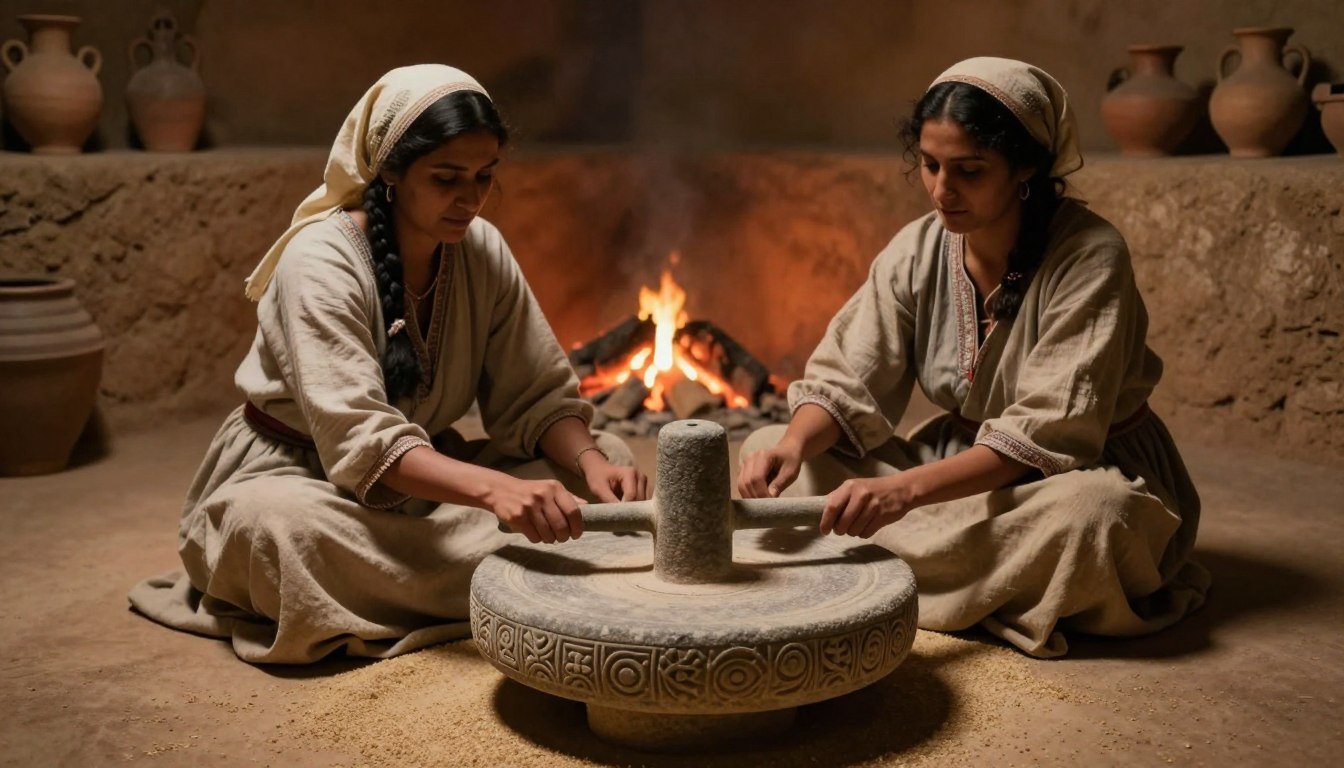
In a smoky roundhouse kitchen, a wooden handle knocks and stone hisses against stone. The history of quern hand mill work starts with that sound, and with the ache it left in the arms. In 1800, the traveler Garnett saw two women in Scotland sitting on the ground with the quern between them.
One woman fed the grain into the stone while the other turned it. They relieved each other and sang Celtic songs to keep the pace. The stone was about twenty inches across, usually grit or granite.
For thousands of years, the quern was the household’s daily bread machine. It turned hard grain into flour, one slow turn at a time. This guide follows it from Neolithic saddle stones to wartime hiding places in the forest. First, the question of where the earliest grinding stones appeared.
Key Takeaways
- The oldest known quern is about 11,000 years old and comes from Syria.
- Two motions, rocking and rotating, separate saddle querns from rotary querns.
- Basalt, a rough volcanic rock, made the best quern stone.
- Querns ground bread flour, but also pigments, spices, medicines and ore.
- Landlords, millers and invaders tried to control or ban querns.
- Querns are still in use today, from Indian chakkis to Nepali janto.
The History of Quern Hand Mill: From Neolithic Saddle Stones to Rotary Grinders
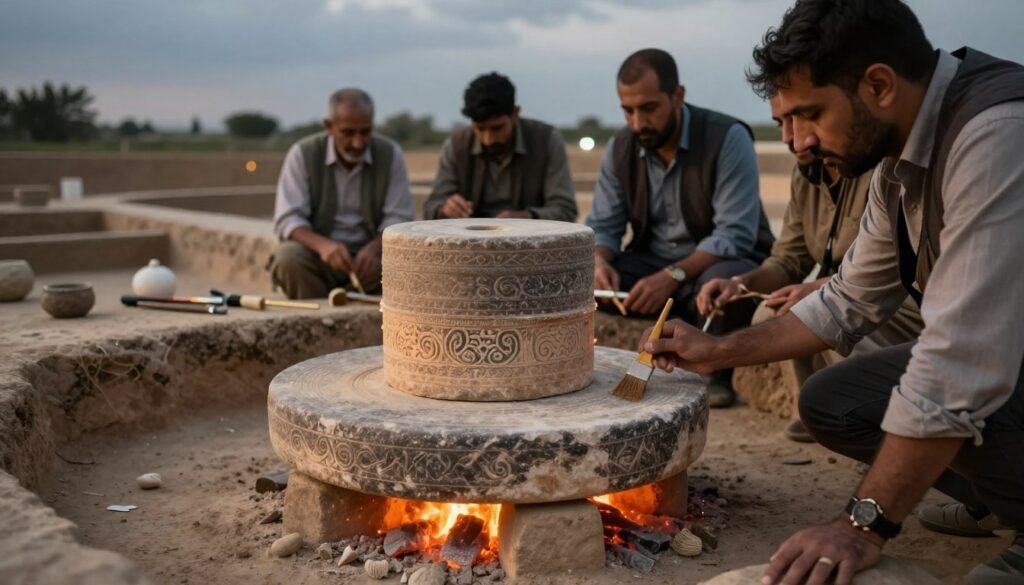
The oldest known quern is about 11,000 years old and comes from Abu Hureyra, Syria, dated to about 9,000 BCE. Older grinding stones exist elsewhere. People used them to process plant food across Europe at least 30,000 years ago.
A prehistoric quern dated to 23,000 BCE turned up at Longwangchan, Shaanxi, China, in 2007. Querns became a household staple with the Neolithic shift to farming and grain diets, between about 10,000 and 3,000 BCE. The Britannica entry on the quern confirms this early Neolithic start.
Rotary querns did not arrive everywhere at once. Each region has its own date.
Saddle querns appear in ancient Egypt, Bronze Age Britain and Harappan ruins. In northern Britain, rotary querns replaced them around the 5th to 4th century BC. In Europe as a whole, the saddle quern gave way to rotary types during the 1st millennium CE.
In China, rotary stone mills appeared in the Warring States Period. In Norway, the earliest rotary fragment dates to about 200 CE, as a study of the Stavanger museum collection reports. The British Museum holds many querns from these periods.
Rome pushed the idea further. Cato the Elder described a 2nd-century BCE mill with a concave lower stone and a convex upper stone, turned by two donkeys. Many large ones survive at Pompeii. How the hand types actually differ is the next question.
Saddle, Beehive and Disc: How the Types of Quern Work
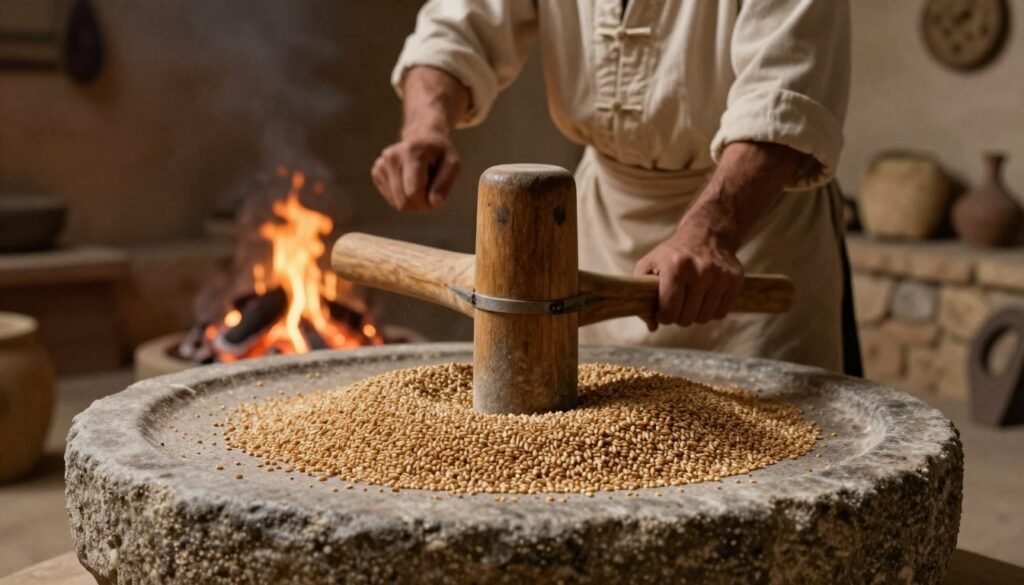
Two motions, rocking and rotating, separate all querns. A saddle quern rocks a small stone back and forth, while a rotary quern turns one stone over another. The saddle quern crushes grain rather than grinding it.
Saddle quern: the rocking muller
The upper stone of a saddle quern is the muller. It is roughly cylindrical for two hands or hemispherical for one hand. The cook pushes it across grain on the lower stone.
Many people assume the muller grinds, but it crushes. That suits malted grain well. Making flour from unmalted grain this way is hard.
Rotary quern: beehive and disc designs
A rotary quern has a heavier upper stone, and it grinds unmalted grain. Grain enters the hopper, the dish on top, and falls through the eye, the central hole. The beehive type has a bun-shaped upper stone, a conical hopper and a pivot into the lower stone.
A side socket holds a wooden peg handle. Beehive querns are the earliest rotary type in the British Isles, arriving about 400-300 BC. Disc querns are two flat stones with a spindle hole in the lower one. In Ireland they dominated from 500 to 1500 CE and usually measured 30-60 cm across.
| Type | Motion | Stone shape | Region or period | Best use |
|---|---|---|---|---|
| Saddle | Back and forth | Cylinder or half-sphere muller | Neolithic onward | Malted grain |
| Beehive | Rotating | Bun-shaped upper stone | Britain, 400-300 BC | Unmalted grain |
| Disc | Rotating | Two flat stones | Ireland, 500-1500 CE | Daily flour |
| Miniature | Either | Under 200 mm (8 in) | Many regions | Seeds, herbs, minerals |
Miniature and snuff querns
Miniature querns under 200 mm (8 in) ground seeds, minerals or herbs. Snuff querns measured about 9 inches (23 cm). In Shetland, people ground tobacco to snuff on them, sometimes turning the stone with a lamb’s horn.
The family lives on. The chakki and silbatta in India, the janto or jato in Nepal, and the metate and mano in Mexico all descend from these designs. Each one depends on the stone it is cut from.
Basalt, Lava and Millstone Grit: Choosing Stone for a Quern
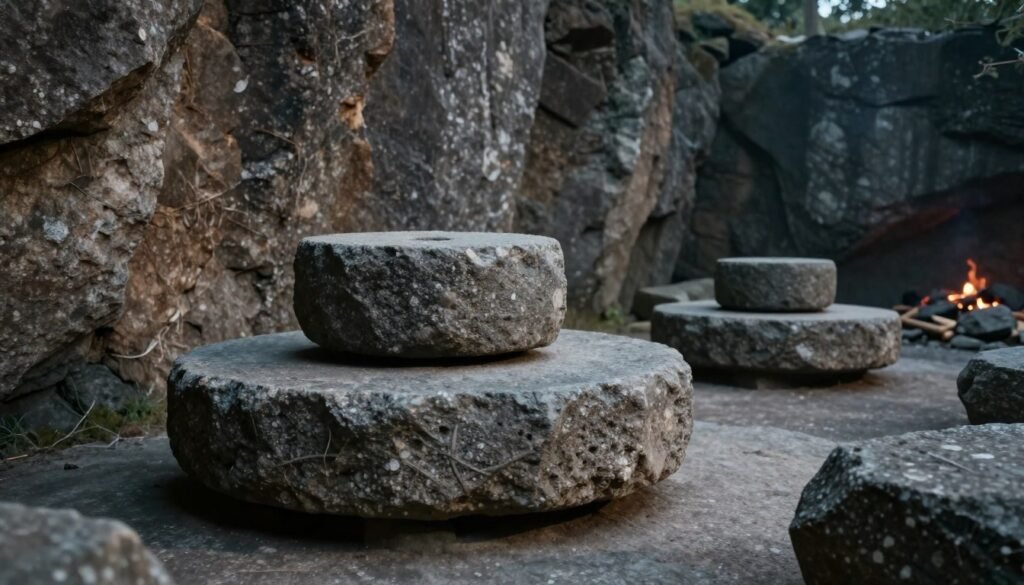
The best quern stone was a rough volcanic rock, basalt. Its rough surface keeps grain from detaching from the stone, so the flour stays free of grit. Where basalt was missing, people used what the land offered.
- Basalt: rough, hard, and grit-free in the flour
- Sandstone or millstone grit: common and easy to shape
- Granite: very hard, used in many Scottish querns
- Limestone: soft, so it wore quickly
- Lava: introduced to Britain by the Romans
Basalt querns traveled far in the southern Levant, which suggests they carried status. Quartzite and schist also served. Scotland developed regional styles of its own.
Place names keep the trade alive. Quernmore Crag near Lancaster, and Whernside and Great Whernside in the Yorkshire Dales, are named for quern quarrying. A worn-flat stone was not thrown away. Its grinding faces were pecked with a pointed tool to renew them.
The stones were not limited to wheat, either.
What Querns Ground Beyond Daily Bread
A single stone might grind bread flour in the morning and pigment by evening. Querns handled nuts, seeds, fruit, herbs, spices, meat, bark, pigments, clay and temper. Wheat was only one job among many.
In Mesoamerica, the Maya used nixtamalization, the process of boiling maize in water and lime before grinding it into dough. The result, nixtamal, was ground on a metate into dough for unleavened flat cakes. In China, rubbing wheat into flour by hand took several hours.
Miners used querns too. They crushed ore before smelting, widely in ancient gold mining. Polish peasants used the żarna for coarse rye and wheat bread when millers were too costly or distant.
Trace elements on some stones suggest medicines, cosmetics or dyes. A stone used for pigments carries different trace metals than a bread stone. Archaeologists read those traces like a diary of the tool. Such a useful object soon drew the attention of lords, priests and soldiers.
Querns in Law, Belief and War
In 1274, the abbot of St Albans, lord of Cirencester, had townspeople’s querns seized. He won in court and paved his parlour with them. Law, belief and war all touched this humble tool.
Scottish tenants owed payment to the baron’s mill, called thirlage. Millers could legally destroy querns used in defiance. Thirlage was formally abolished on 28 November 2004. The last English prerogative case came at Wakefield in 1850, when the town bought out Soke Mill for 20,000 pounds.
Belief shaped stones too. A Dunadd quern carries a carved cross, perhaps to protect flour from ergot. The Clonmacnoise quern became the tombstone of Sechnasach, who died in 928 AD. The Mauchline Quern in Nennius’ wonders of Britain ground constantly except on Sundays. Judges 9:53 has a woman crush Abimelech’s skull with an upper millstone.
War made querns dangerous. German occupiers of Poland outlawed them in 1939 to enforce food quotas, smashing and burning them. Possession could mean death, so women hid querns in forest undergrowth and pits. Polish ration allotments were about 654 calories a day.
A tool that makes a household’s flour also makes it hard to tax or starve. That is why rulers feared the quern.
The Cultural Echo: Cinema, Music & Modern Table
The documentary series Edible History, or the BBC’s Victorian Farm, shows period milling. Neither is needed to feel the topic, though. A simple flatbread from freshly ground wheat or a bowl of fresh tortillas brings the same story to a modern table.
Bringing the History Home
Heritage tools are easy to find. A hand-turned stone grain mill, a Mexican metate and mano, or a Nepali jato each lets a cook feel the old motion. Each one rewards slow, steady work.
Whole wheat berries and rye make honest flour. Dried maize with lime gives real nixtamal for tortillas. The stones still turn in parts of the world today.
Conclusion
The quern outlasted empires. Rome fell, water mills spread, and still the small stone sat by the hearth. Its lasting meaning is simple: it gave households control of their own bread.
That control is why landlords taxed it and invaders smashed it. A quern in a local museum shows how much effort a loaf once took. Better still, grind a handful of wheat berries between two stones and feel it.