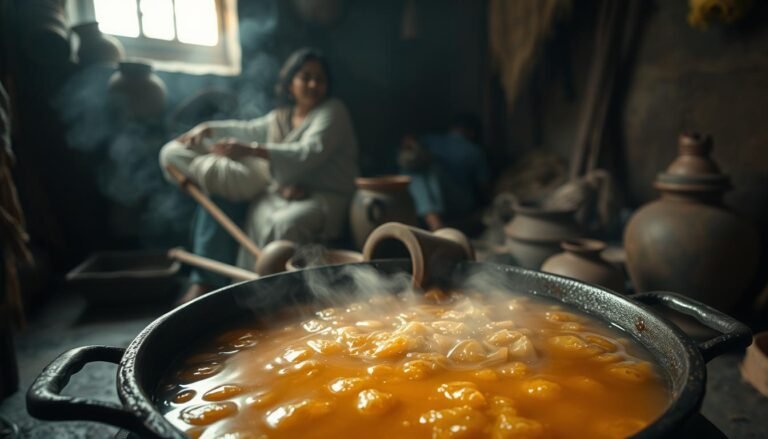
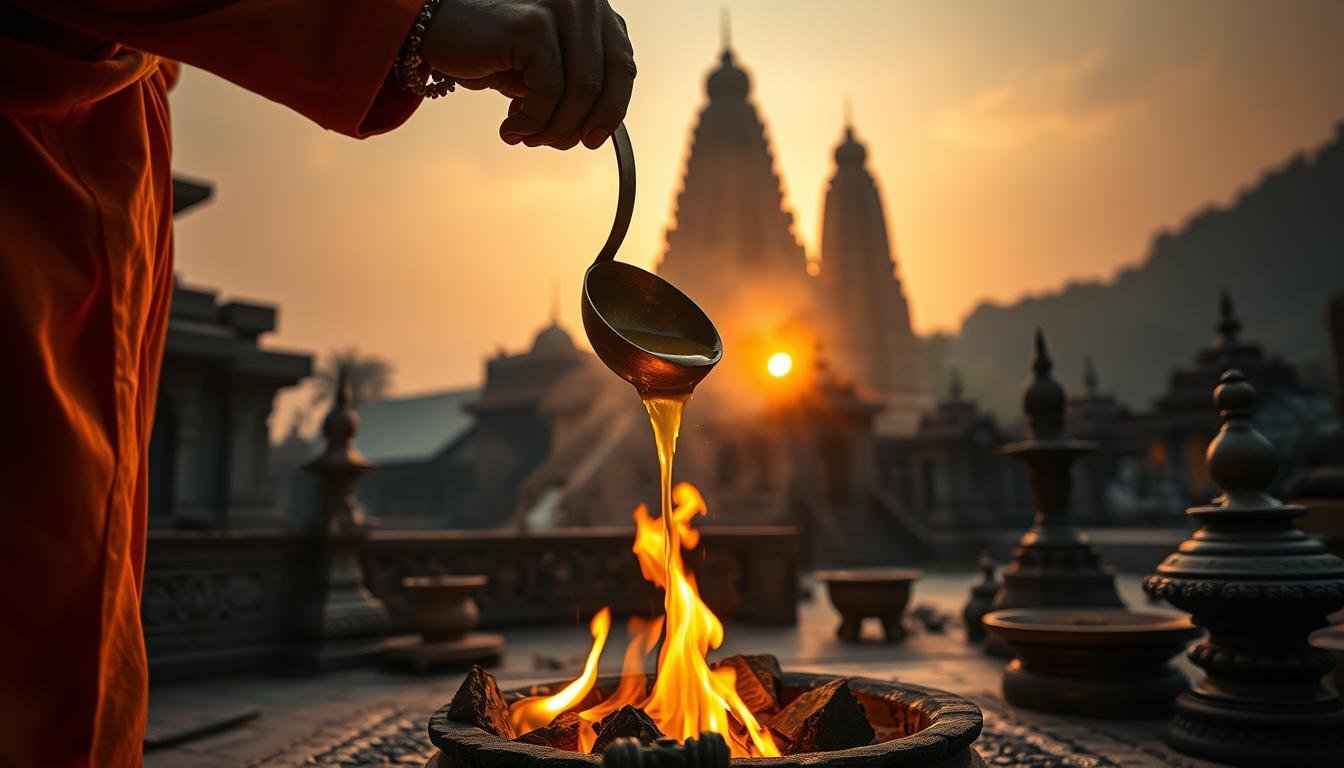
At dawn, a priest tips a long ladle, and thick golden fat slides into the flame with a hiss. The fire flares orange, the smoke smells of toasted nuts, and a chant rises over the crackle. This is the history of ghee in a single moment, and it has looped for about 3,000 years.
Hymns in the Rig Veda mention it from about 1500 BCE. Priests still pour it into sacred fires at weddings and funerals today.
Here is the odd part: a plain cooking fat was once treated as an offering fit for gods. The story runs from Vedic altars to a modern kitchen counter. It starts with a simple question, though, about where this fat came from.
Key Takeaways
- Ghee began as a way to keep butter from spoiling in hot weather.
- Its origins sit roughly between 1500 and 500 BCE in ancient India.
- Ghee became the main offering in the Vedic fire sacrifice (yajna).
- Trade carried it to the Middle East, Egypt and Ethiopia.
- It is a saturated fat, so moderation matters.
- A small home batch needs only butter, a heavy pot and muslin.
Where Did Ghee Come From, and Why Did India Choose It Over Butter?
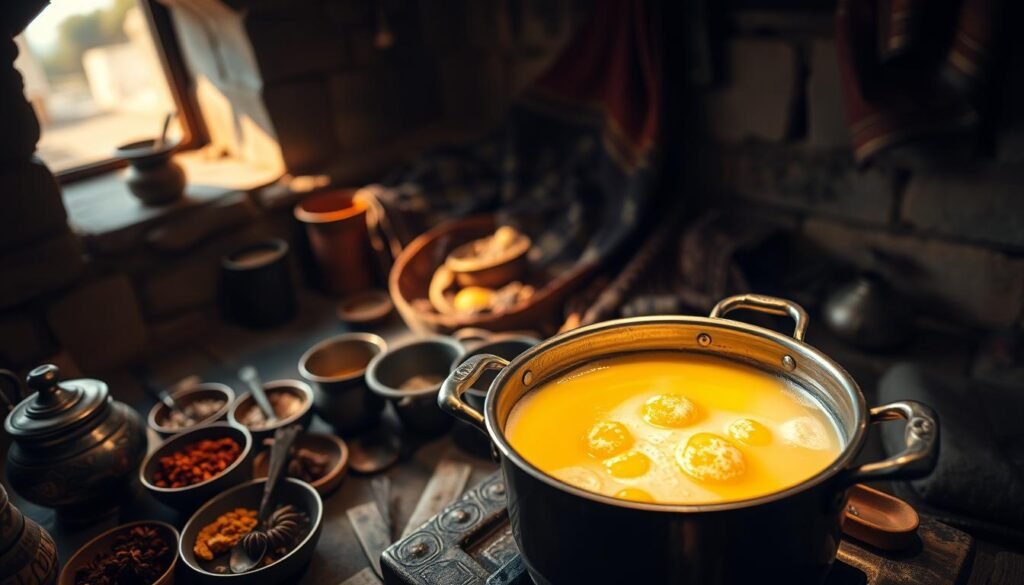
Ghee began as a hot-climate preservation trick in the cattle-keeping plains of ancient India, roughly between 1500 and 500 BCE. Heat made fresh butter spoil fast. Cooks simmered it until the water boiled off and the milk solids separated, and the result kept without a refrigerator.
That is why Indians use ghee instead of butter: removing the water and milk solids lets the fat keep for months in the heat. Ghee is usually made from cow or water buffalo milk. In the Ayurvedic method, cooks first turn yogurt (dahi) into butter by churning, then simmer that butter.
Ghee lasts because the water and milk solids are gone. Without moisture, spoilage has little to feed on.
Ghee is not the same as French clarified butter. Ghee simmers longer, so the milk solids brown, and the fat turns golden with a deeper nutty flavor. Both are a form of clarified butter, but only ghee takes that extra time.
The names show how far the fat traveled:
- Ghee: English borrowed it from Hindi, which took it from Sanskrit ghrita, meaning “sprinkled”
- Ney: the Tamil name
- Thuppa: the Kannada name
- Nitar kibe: the Ethiopian cousin
A fat that survived summer was already precious in cooking. Soon it was precious in a different way.
The History of Ghee in the Vedic Fire Sacrifice
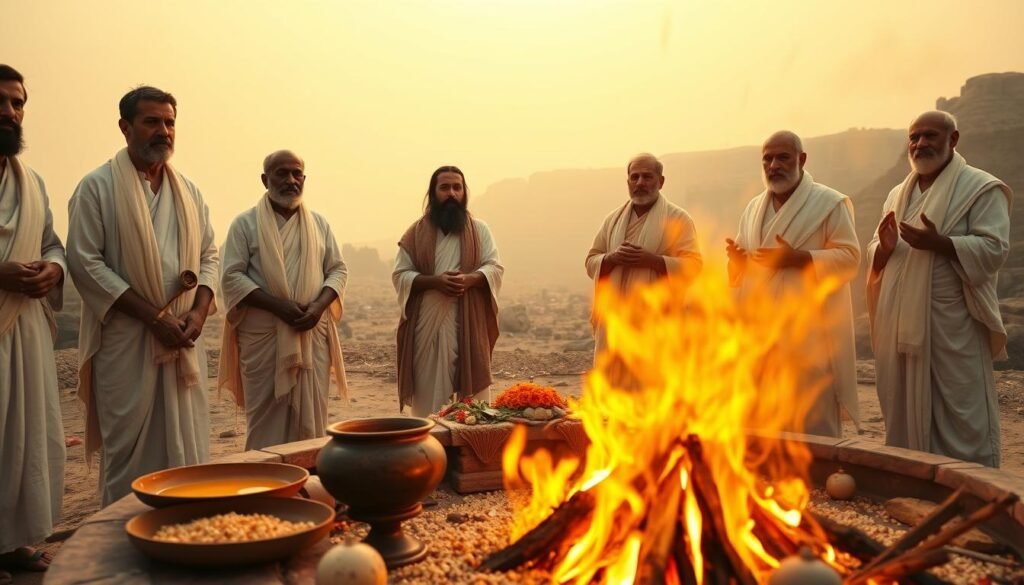
Ghee became the central oblation of the Vedic fire sacrifice (yajna) because it is pure, clear and burns bright. A yajna is a Vedic fire sacrifice in which offerings, above all ghee, are poured into a consecrated flame while hymns are recited. The fat feeds the flame without muddying it, so the fire leaps when the ladle tips.
Agni, the fire god, carries each oblation up to the other gods. The sacrifice works only if the flame stays strong, and ghee keeps it so. No other offering turned the fire into a messenger so cleanly.
Prajapati, Agni and the First Batch
Prajapati, lord of creatures, rubbed his hands together and made the first ghee. He poured it into the flames and created his children. The myth ties ghee to creation itself, not just to food.
The history of ghee, in this telling, starts with a god and a fire. The mortal priests only repeat what he did.
Ghee in the Rig Veda and Sacred Texts
The Rig Veda praises ghee from about 1500 BCE. Law verses called the Dharmasutras mention it, and so does chapter 9 of the Bhagavad Gita. A good encyclopedia overview of ghee lists its uses in Vedic fire rituals and other Hindu worship.
Vedic cooks even sorted food by it. Food cooked in ghee was called pucca, and food not cooked in ghee was kacha. Pucca food was considered richer and safer to share.
That respect never faded. It lives on in wedding fires and in small lamps.
How Ghee Spread Across the World and Into Medicine
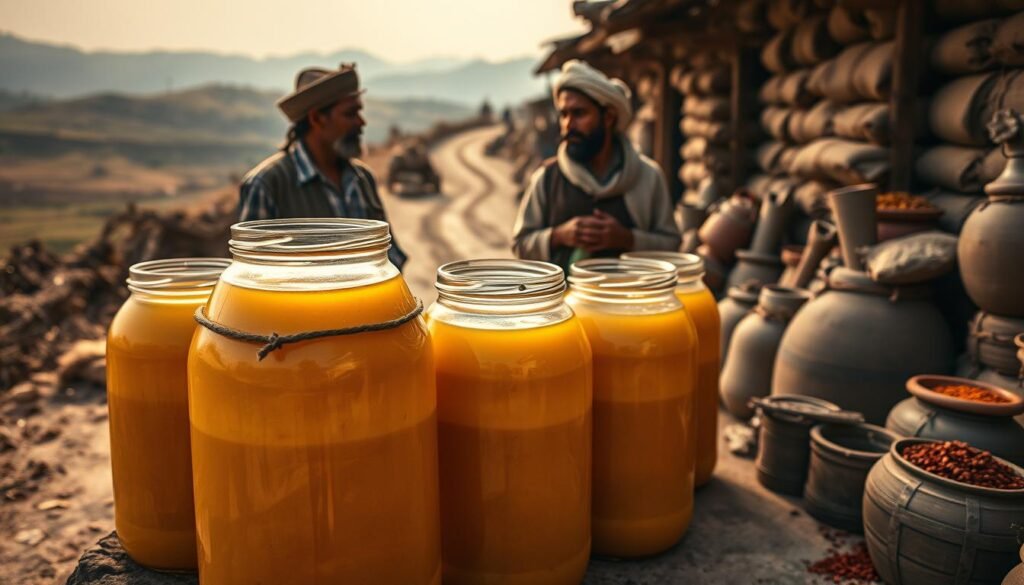
Ghee spread by trade, and it went into medicine as well as meals. Picture a trader’s caravan with sealed jars packed on camels, since the fat could survive weeks of travel. Through such trade, ghee reached the Middle East, Egypt and Ethiopia, and each place gave it a local name.
The novelist R.K. Narayan wrote in a 1955 New York Times piece that ghee is “like a genius born to a dull parent.” The line fits a fat that turns plain butter into something richer.
| Region | Local name | Role |
|---|---|---|
| India | Ghee | Cooking and ritual |
| Egypt | Sa | Cooking fat |
| Ethiopia | Nitar kibe | Spiced butter in stews |
| Tamil Nadu | Ney | Ritual and food |
Tradition lists many ghee benefits. K.T. Achaya’s A Historical Dictionary of Indian Food notes it as a cooling food and a digestive aid. Ayurveda uses it as a salve for burns, a moisturizer for skin and hair, and a carrier that moves herbs deeper into the body.
Commonly stated nutrition facts are plainer. Ghee holds vitamins A, D, E and K, and clarifying removes most lactose and casein. Its smoke point is about 250 C. It is still a saturated fat, so it suits moderate use. Anyone considering it for medical use should ask a doctor.
Today the story sounds in films, songs and kitchens.
Ghee in Culture and at Home Today
Ghee lives on in culture and in home kitchens, where cooks still make it by hand. Its smell, nutty and warm, is part of how many families remember a meal. Anyone can taste that history with one pot and a block of butter.
The Cultural Echo: Cinema, Music & Modern Table
Picture a film kitchen where ghee sizzles in a pan. Satyajit Ray’s Pather Panchali (1955) is a food-rich Indian film, and it shows how everyday meals sit at the heart of family life. R.K. Narayan’s 1955 essay shows the same fat in the literary imagination.
Music carries the thread too. Temple chants still rise beside lamps filled with ghee, so the sound and the smell arrive together.
Bringing the History Home
Start with unsalted butter, ideally cultured or grass-fed. For the traditional churned method, use cultured yogurt and a wooden churn in the bilona style. Simmer on low heat until the milk solids turn golden-brown and settle, and the aroma turns nutty.
The one mistake to avoid is scorching. Burnt milk solids turn ghee dark and bitter, so keep the heat low and strain at once. These basics cover a first batch:
- A heavy brass or steel pot
- Muslin cloth for straining
- A clean, dry glass jar
- Unsalted butter
A first batch takes a little patience, and the smell alone is worth it. Try one and taste the old fire.
Conclusion
The flame still waits for its ladle. Ghee shows how a sacred practice can grow out of a practical need: a cook wanted butter to last, and a priest found the perfect offering.
That arc runs from a hot plain to a temple altar to a jar on a pantry shelf. This week, make a small batch of ghee with a half pound of unsalted butter, and watch it turn gold.