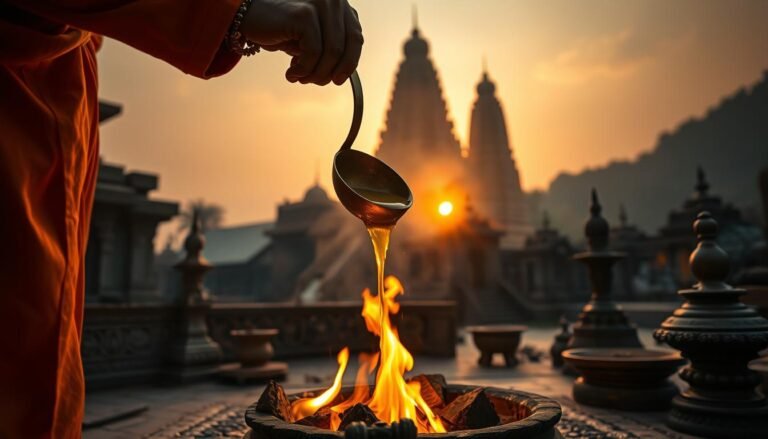
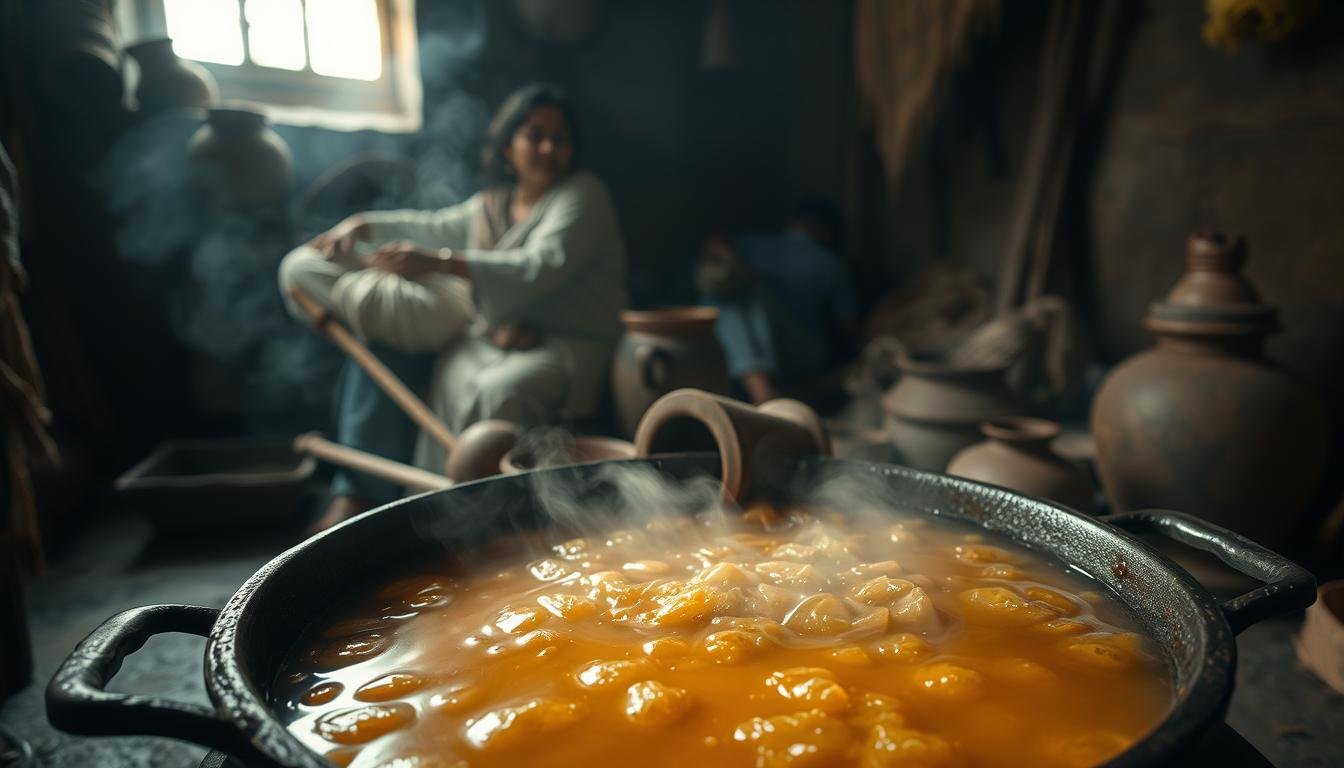
Steam lifts from a wide iron pan at dawn, and the air smells of caramel and wood smoke. A cane press turns nearby, and its juice runs green-gold into the pan. Two workers skim the foam and stir with long ladles, and the history of jaggery is right there in the steam.
The scene has barely changed in thousands of years. The juice boils over an open fire, and the whole job, from cane to block, takes about 4-6 hours. India still makes over 70% of the world’s jaggery, much of it in pans like this one.
Behind that pan stand farming communities, old texts and a sweetener that crossed oceans. To understand the pan, the reader must go back to the earliest written mentions.
Key Takeaways
- Jaggery is a non-centrifugal sugar: its molasses is never spun out, so crystals and dark syrup stay together as one mass.
- The Sanskrit words guda and gur appear in texts about 3,000 years old.
- Boiling turned a perishable cane harvest into a food that stores well and travels.
- Jaggery has a dozen names around the world, from panela to gula melaka.
- It sits at the center of Indian festivals and Ayurvedic practice.
- It keeps trace minerals but is still sugar, so small portions make sense.
The History of Jaggery Begins in the Vedic Texts

The word gur is among the oldest sweet words in Sanskrit literature, and it is roughly 3,000 years old or more. Early texts also use the form guda for a boiled cane product. Jaggery is a non-centrifugal sugar, meaning a sugar whose molasses is never spun out, so the crystals and the dark syrup stay together as one mass.
Sugarcane itself began far away. It was first grown in New Guinea around 8,000 BCE and spread west through Southeast Asia into the Indian subcontinent. The Atharvaveda and Rigveda are cited for boiling cane juice into a sticky substance. Boiling mattered because fresh juice spoils within hours, while a boiled block keeps for months.
Boiling turned a perishable harvest into a food that could be stored, carried and traded.
Farming communities learned to cook juice into forms that were easy to store and move. A surplus harvest became a trade good. The Charaka Samhita and Sushruta Samhita, the Ayurvedic classics, prescribe jaggery for digestion, blood purification and respiratory complaints. A scholarly chapter on jaggery as an ancient Indian open-pan sugar reviews these early references.
The word trail reaches into English. The Persian shakar likely comes from Sanskrit sharkara, the root of the English word sugar. A parallel idea appeared elsewhere: in Mesopotamia and Egypt, date palm sap was reduced into cakes, with palm sugar evidence along the Euphrates as early as 2,500 BCE.
Dates in this era are approximate, since scholars work from texts copied and revised over centuries. What stays clear is the pattern: a sweet, durable food that merchants soon carried out of India.
How Jaggery Traveled the Spice Routes and Beyond
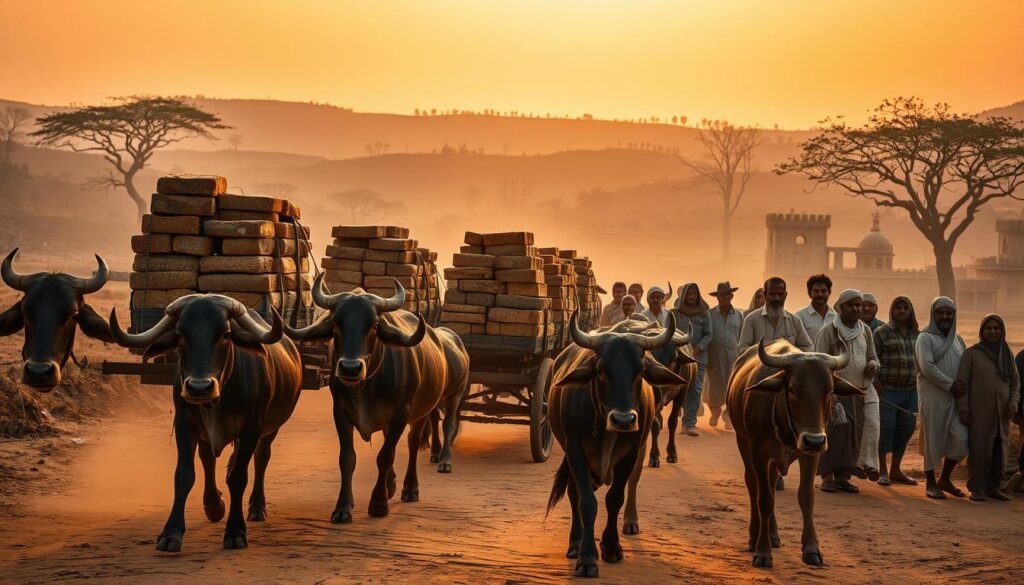
One sweetener has a dozen names because trade carried it to many languages. Around 500 BCE jaggery reached Persia and then the Middle East. Arab traders later carried sugarcane to Africa and Spain, and each region named the product in its own tongue.
Jaggery in English comes from the Portuguese word for it, and it means the same as gur. An encyclopedia entry on jaggery traces the word through Tamil or Malayalam back to Sanskrit sharkara. In the US, shoppers often find it sold as gur, panela or piloncillo.
Southeast Asia built its own cane and palm traditions in Thailand, Sri Lanka, Myanmar, Bangladesh and Indonesia. In the 15th and 16th centuries, Portuguese and Spanish colonizers brought sugarcane to West Africa and the Americas. Plantations there made Latin America a major home of the sweetener.
The raw material also splits the family in two. Sugarcane jaggery starts with sugarcane juice. Palm jaggery starts with palm sap, as in nolen gur, a winter date palm liquid jaggery of Bengal and Odisha, and karupatti, made from the Palmyra palm of Kerala.
- Gur: India (vellam in Tamil, hakur in Sri Lanka)
- Panela: Colombia and Latin America
- Piloncillo: Mexico
- Rapadura: Brazil
- Gula melaka: Malaysia (gula jawa in Indonesia)
- Kokuto: Japan
Abroad, the sweetener became a local food under a local name. In India, it never left the festival table.
Why Jaggery Sits at the Center of Indian Ritual and Medicine
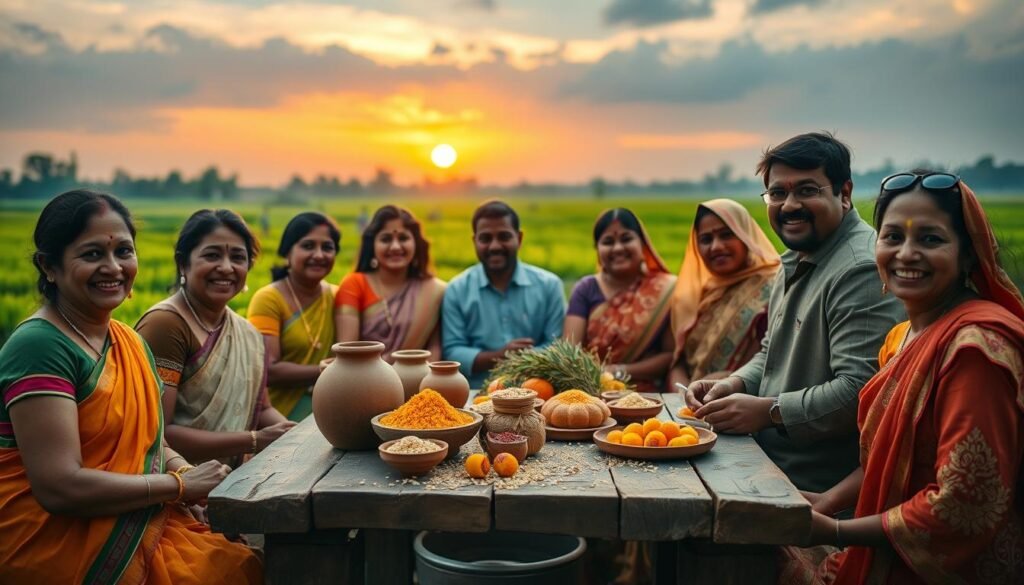
Gul dya, god bola means “offer jaggery, speak sweetly,” and Marathi speakers say it at the start of any good undertaking. In India, jaggery is a blessing as much as a sweetener. At Makar Sankranti, families swap til-gur, sesame-jaggery sweets.
At Pongal in Tamil Nadu, newly harvested cane juice is boiled into jaggery as an offering to the Sun. It also appears at Ganesh Chaturthi, Lohri and weddings as a sign of prosperity. Across these festivals, jaggery marks good fortune and shared harvests.
Ayurveda classes jaggery as ushna, or warming, and as a balance for the Vata and Kapha doshas. It holds that jaggery supports digestion and breathing comfort. Rural laborers received jaggery and water against heat and fatigue into the 20th century. These are traditional views, not medical promises.
Traditional pairings follow the same logic:
- Jaggery with ghee, for strength
- Jaggery with sesame, for warmth
- Jaggery with fennel, after meals
- Jaggery with ginger or black pepper, for coughs
- Jaggery in plain water, against heat
On jaggery vs sugar, the fair view is modest. Because it is non-centrifugal, jaggery keeps iron, magnesium, potassium and calcium, but it is still sugar, so people eat it in small amounts. Anyone managing blood sugar should ask a doctor first. Industry and the sugar mill soon reshaped much of this world.
From Village Pans to Sugar Mills and Jaggery Powder
A sugar mill roars with machines, while a family pan murmurs over a wood fire, and that gap shaped the modern story. In colonial times, refined sugar spread, and British-era policy in India promoted sugar mills. Mills grew through the 19th and 20th centuries, yet jaggery stayed popular in rural areas for its low cost and simple methods.
Today India makes about 10-12 million metric tonnes of jaggery a year, mostly in small cottage units. Roughly 20-30% of its sugarcane goes to jaggery, which supports about 2.5 million livelihoods. The main cane states are Uttar Pradesh, Maharashtra and Karnataka.
Jaggery powder rose from the 1990s as a convenience product. Makers mill dried blocks or spray-dry syrup. Powder measures like sugar and dissolves quickly, which suits modern kitchens.
| Type | Processing | Texture | Handling and use |
|---|---|---|---|
| White sugar | Refined and centrifuged | Uniform crystals | Measures easily; baking and tea |
| Block jaggery | Boiled and molded | Hard and uneven | Needs grating; sweets and cooking |
| Jaggery powder | Milled or spray-dried | Free-flowing | Measures like sugar; drinks and baking |
Organic jaggery reached health-food shelves in the UK, USA, Australia and Europe around 2005-2010. Indian jaggery exports more than doubled between 2015 and 2024. Check that a label reading organic jaggery carries real certification.
The same natural sweetener now sits in both village sheds and supermarket aisles, and cooks must decide how to use it.
How the Past Still Shapes Today’s Kitchen
In many kitchens, a block of jaggery is cracked with a hammer and the pieces fly across the counter. That small act repeats a very old habit, and jaggery still works in chai, in tamarind and lentil dishes, in sesame sweets and as a swap in baking.
The Cultural Echo: Cinema, Music & Modern Table
The documentary Bitter Sweet is not about jaggery, so a better pick is the novel Sea of Poppies by Amitav Ghosh, set in the sugar and opium world of 19th-century India. It shows how cane and empire shaped lives along the Ganges.
Harvest songs and festival sweets keep the tradition alive. In US kitchens, jaggery shows up in chai and in sesame sweets, and jaggery powder stands in for sugar in drinks.
Bringing the History Home
Buy block jaggery from a regional variety at an Indian grocery. Heritage tools help: a heavy iron or brass kadai, a wide pan, plus a wooden spoon and a grater or knife for the blocks.
Make til-gur with sesame seeds, or a simple jaggery syrup with fennel seeds and ginger. Try a cane and a palm variety side by side, and taste each plain first. The kadai on your stove is a small cousin of the pan at dawn.
Conclusion
The pan from the opening scene is still boiling today, in village sheds from Uttar Pradesh to Karnataka. Each block of jaggery carries three thousand years of craft: a harvest saved by fire, a word that became “sugar,” and a sweet that marks every festival.
That history is easy to taste. Buy a small block of jaggery and break off a piece. Taste it plain, then stir it into a cup of tea.