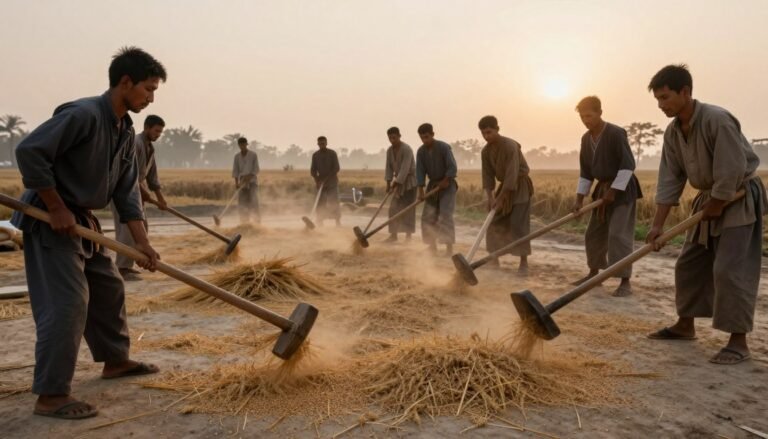
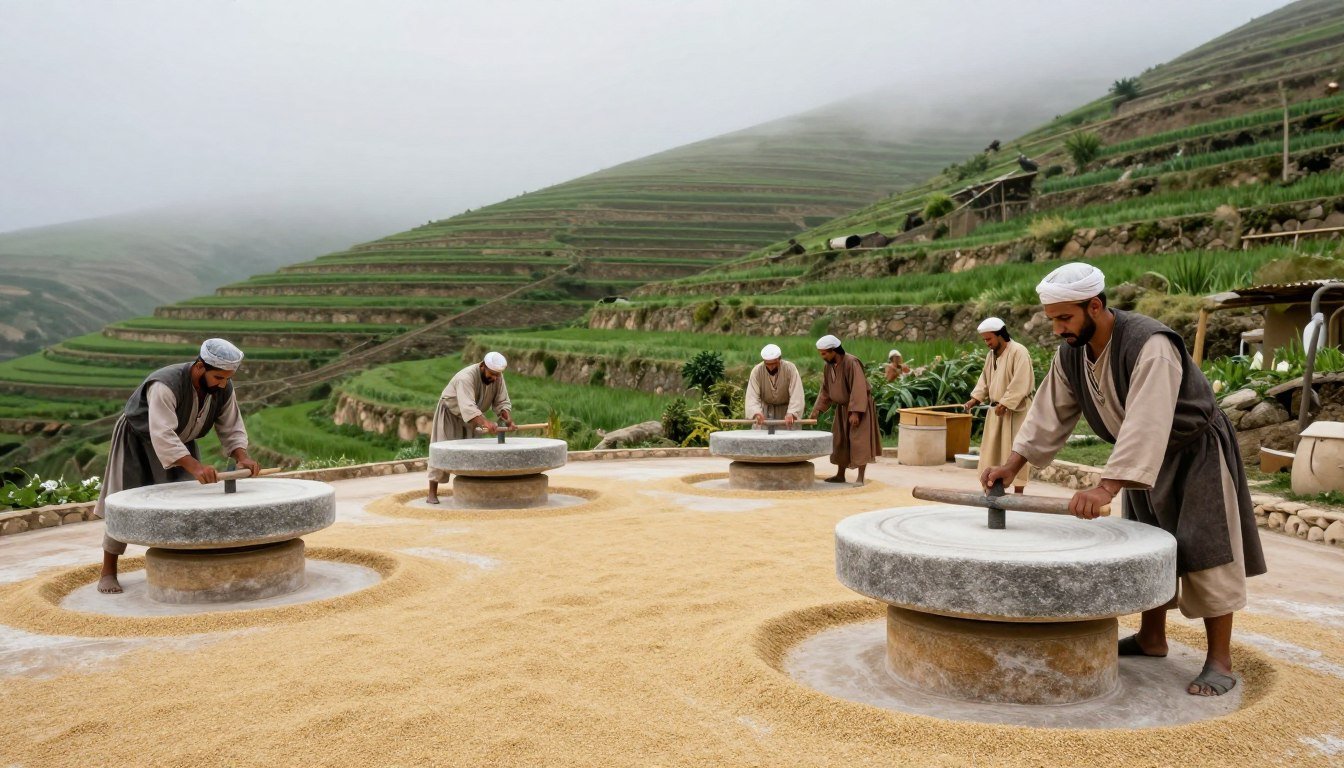
The history of barley begins in grit. Stone dust hangs over a terraced hillside in the Fertile Crescent as workers grind coarse flour, and bristly awns rasp against sickles at the end of a dry spring. Nearby, toasted grain smells of smoke at a hearth.
This bristly grass, Hordeum vulgare, was tamed about 10,000 years ago. It is one of the founder crops of Old World agriculture. It went on to feed bakers, brewers, soldiers and herds across the world.
The name tells part of the tale: Hordeum comes from the Greek for bristly, and vulgare means common, found everywhere. The trail runs from the Fertile Crescent to Sumer, the Mediterranean, Britain, the Americas and the table today. It starts with one question: where exactly were the first fields?
Key Takeaways
- Barley was domesticated about 10,000 years ago in the Fertile Crescent from wild barley, Hordeum spontaneum.
- DNA points to a single domestication, with wild populations in Israel and Jordan the closest match.
- One mutation made the rachis tough, so the grain stays on the ear at harvest.
- Barley lost the bread table to wheat but still thrives on cold, dry, salty and high ground.
- More than two-thirds of the world’s barley now feeds livestock, and most of the rest becomes beer and spirits.
- Wild relatives help breeders restore the genetic variety the crop lost.
The History of Barley Begins in the Fertile Crescent
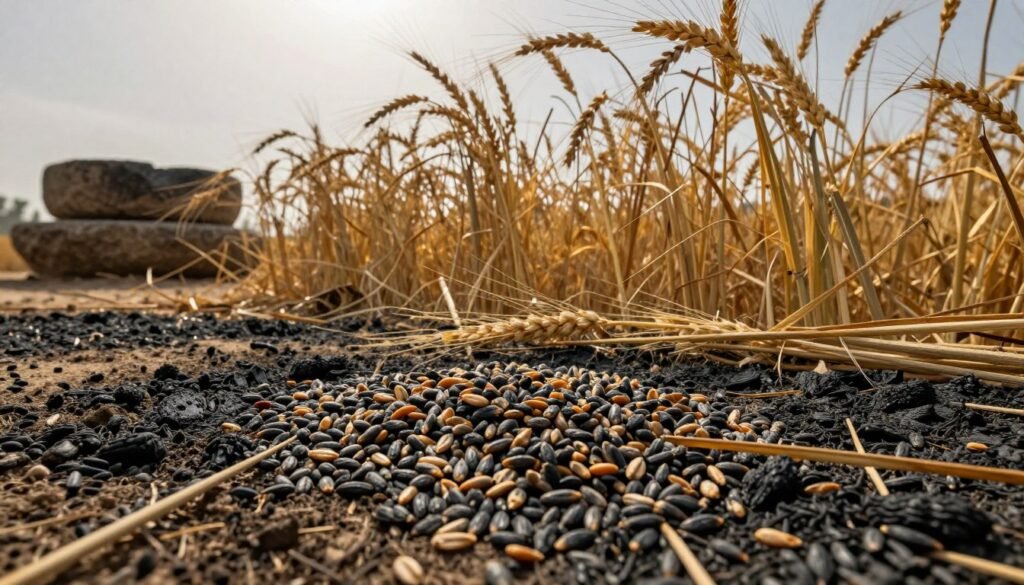
Barley was first domesticated about 10,000 years ago in the Fertile Crescent, from a wild grass called Hordeum spontaneum. The Fertile Crescent is an arc of land that runs from the Jordan Valley north through Syria and southern Turkey, then east to the Zagros Mountains. Charred grain at ancient sites there shows that barley was a food of hunter-gatherers about 12,000 years ago, eaten in larger amounts than wheat.
DNA adds a second clue. A genetic study of barley domestication in Molecular Biology and Evolution compared 400 variable markers in 317 wild and 57 cultivated lines. The wild populations of Israel and Jordan are the closest match to the cultivated gene pool. Genetic distance from the crop grows from the southern to the northern Fertile Crescent.
Barley’s DNA points to Israel and Jordan, and the cultivated lines cluster as one group. That pattern fits a single domestication.
The method works because wild populations differ by region and have changed little since farming began. Their genetic diversity acts like an address label. The same approach had earlier located the origin of einkorn wheat.
One gene variant shows the link clearly. Allele I of the homeobox gene BKn-3 is found almost only in Israeli wild barley. Yet it is widespread in western landraces, the old farm varieties, and in modern varieties.
The result can be trusted because of one careful step. Wild plants sometimes cross with cultivated barley, which blurs the signal. So the team discarded 50 of 367 wild accessions before the analysis began.
That clean map still leaves a question about the crop itself: what actually changed in the plant when people tamed it?
How a Wild Grass Became a Crop: What Domestication Changed
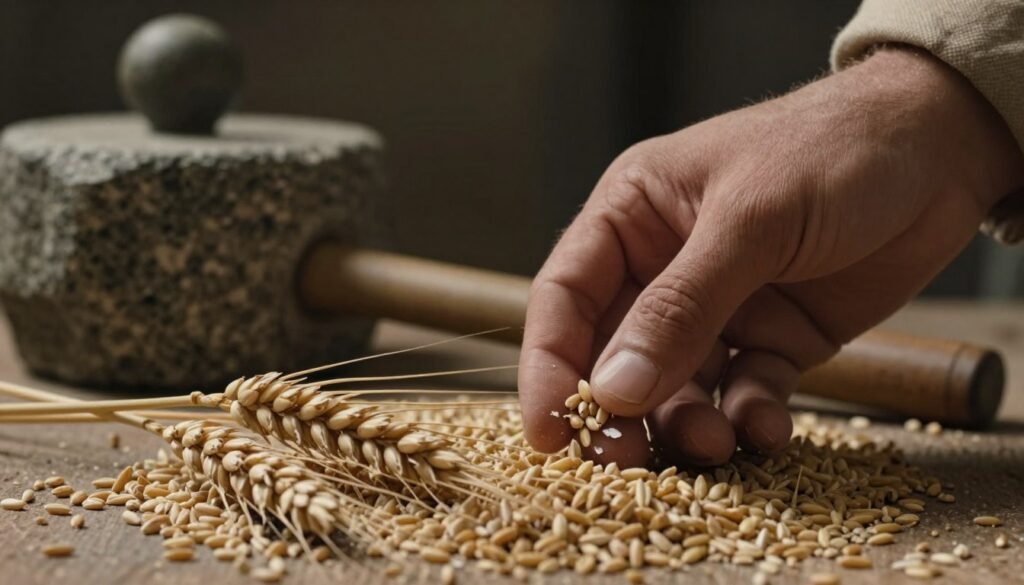
Touch a ripe ear of wild barley and it shatters, spilling grain on the ground. The rachis, the central stalk of the ear to which the grains attach, snaps apart when ripe in wild barley. In the crop, a single mutation makes the rachis tough, so the seeds stay on the ear.
A tough rachis wins in a harvest basket. Seeds on ears with that mutation were more likely to be carried home, and farmers sowed them again. The history of barley seeds is a story of grain that stopped scattering.
| Trait | Wild barley (Hordeum spontaneum) | Cultivated barley (Hordeum vulgare) |
|---|---|---|
| Ear stem (rachis) | Fragile, snaps apart | Tough, holds seeds |
| Stem height | Taller | Shorter |
| Leaves | Narrower | Broader |
| Grain | Smaller | Larger |
| Ear rows | Two | Often six |
The table shows the differences in plain view. Cultivated barley also has shorter awns and a shorter, thicker spike. Wild and cultivated barley have the same two sets of chromosomes and cross freely, so some biologists treat them as one species.
The plant’s story is one mutation chosen over and over, and it carries an exception. The mutation can flip back, so cultivated barley can produce weedy forms that behave like wild barley. That back and forth probably continues worldwide, and weedy descendants of the crop still turn up in fields. These are the marks of domestication barley carries today.
In a field, barley is an annual cool-season grass about 2-4 feet tall, with hollow, jointed stems. The spike is about 3/4 to 4 inches long. Awns can reach 6 inches, though some varieties have none.
Before flowering, two overlapping leaf appendages called auricles clasp the stem. They tell barley from wheat, rye and oats. Six-rowed barley shows three kernels on each side of the rachis, while two-rowed barley develops only the middle kernel of each cluster. Two-rowed kernels are usually the larger ones.
Barley’s story did not stay in one place. Its seeds were already moving east, toward the high valleys of the Himalayas.
The Himalayan Branch: Tibet, India and the Highland Staple
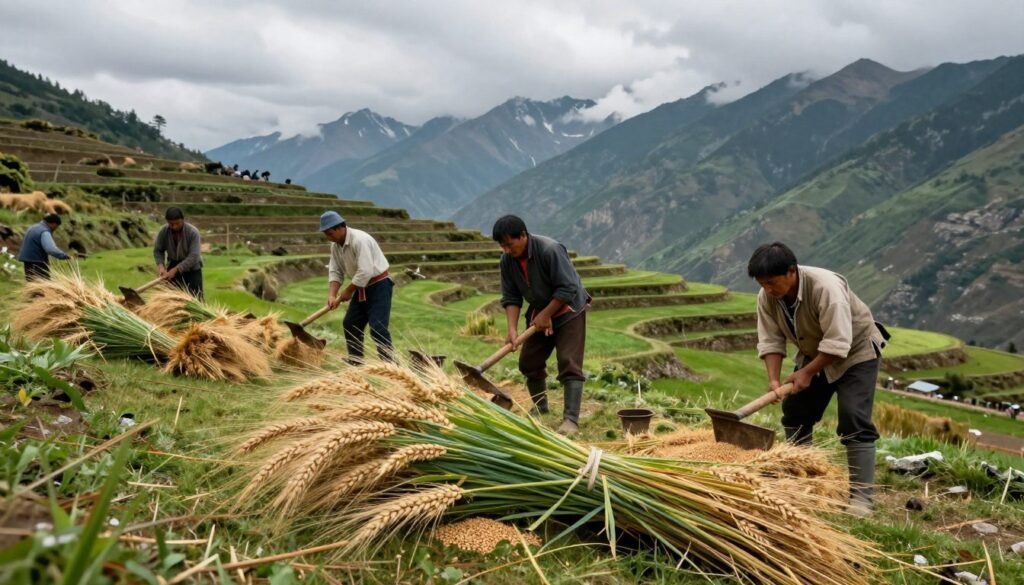
In Hindi, barley is jau, a word that comes from the Sanskrit yava. That word is a living link to old Indian grain culture. Barley reached South Asia as it moved east from the Near East, and its genes changed along the way.
In Himalayan and Indian landraces, a different allele, IIIa, of the BKn-3 homeobox gene dominates. This shows a gene swap during barley’s migration from the Near East to South Asia. The Himalayas are therefore a region where domesticated barley diversified.
Hordeum agriocrithon was discovered in Tibet in 1938, and some researchers saw it as a closer ancestor of cultivated barley. The Himalayas, Ethiopia and Morocco have each been proposed as separate centers of domestication. The DNA points to one origin with later diversification, so the debate stays unsettled. That later spread added genetic diversity to the crop.
Barley grows at high elevations with short seasons. That is why it is a human staple in the Andes of Peru and on the high plateaus of Tibet. Himalayan barley is usually the hull-less type, because it grinds easily into flour for bread or porridge. Barley is still a daily food in many places:
- Tibet: roasted hull-less barley ground into tsampa
- Himalayan villages: flatbread and porridge
- India: the home of jau
- Morocco: a common everyday grain
- Ethiopia: a common everyday grain
- The Peruvian Andes: a human staple at high elevation
From these crops of the high country, the story turns west and south, to the first written records of barley, in Mesopotamia.
Barley in Sumer, Egypt and Rome: Beer, Bread and Written Advice
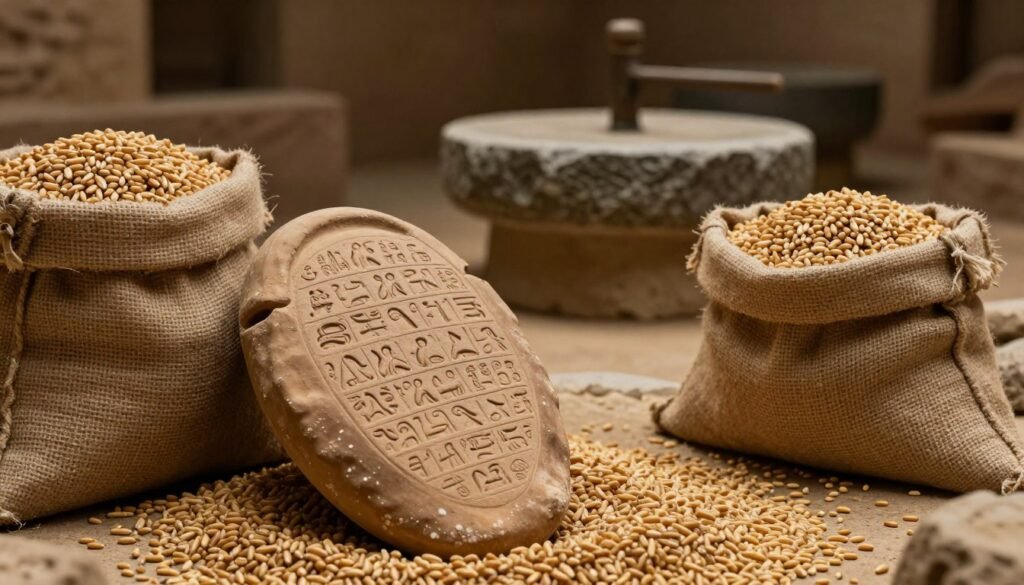
Picture the clay tablet from Nippur, its wedge-shaped lines telling farmers when to water their barley. In Sumer and Egypt, this cereal was the daily ration. It fed people as bread, porridge and beer.
In Egypt barley also served as payment and to settle taxes. Barley was both food and money. Rome left a trace in its language: gladiators were called hordearii, “barley men,” because barley fed their energy.
The Nippur Tablet: The Oldest Farming Advice
A clay tablet from about 3,700 years ago was found at Nippur, about 100 km (62 miles) south of Baghdad. It tells farmers how often to water their barley. It also warns of rusts, the fungal diseases of cereals.
It is the oldest known piece of agricultural advice. Farmers today still plan irrigation and fight rusts, so the same crop problems have lasted 3,700 years. No tablet gives a modern-style yield figure, so the written evidence shows practice, not measured output.
The Hymn to Ninkasi and the First Written Beer
The Hymn to Ninkasi comes from around the same time. It is the world’s first known written recipe, and it describes barley beer. Ninkasi is the Sumerian goddess of brewing.
The hymn works as a recipe-poem. Brewing probably predates it by centuries, so beer is older than writing. After the clay tablets, barley turns up in scripture, where it stands for the food of ordinary people.
What the Bible Says About Barley: Poor Man’s Bread and Sacred First Fruits
In Israel’s fields, the barley harvest is the first sign of spring. Barley ripens before wheat, so its cutting opens the grain season, as in the barley harvest of the Book of Ruth. In the Bible, barley is a common crop and the staple of poorer households.
Wheat was the more prized grain. Barley loaves are dense and coarse, so rich households preferred wheat. The text shows barley in five roles:
- Staple bread of the poor
- First-fruits offering: the first sheaf of the barley harvest, offered near Passover (Leviticus 23)
- The five barley loaves of a boy in the feeding of the five thousand (John 6)
- Fodder for horses and pack animals (1 Kings 4)
- Ritual meal offering (Numbers 5)
Readers often see barley as a symbol of humility and provision for the poor. Its early ripening ties it to the first harvest of the year. The written evidence is clear that these grains fed ordinary people for a long time.
That humble bread was once everywhere. How did it slip from the center of European tables?
Barley vs Wheat: How the Humble Grain Lost the Bread Basket
Barley lost the bread table to wheat’s gluten, but it kept the harsh land wheat cannot farm. Barley has little of the gluten that makes wheat dough rise into a loaf. Bakers in the West moved to wheat, and barley’s greatest modern use is feed and malt.
Barley was the main bread and brewing grain of Western Europe until the 16th century, before wheat and rye took over. Today barley ranks fourth among world grains, behind maize, wheat and rice. Western eaters now prefer wheat.
| Trait | Barley | Wheat |
|---|---|---|
| Salty or alkaline soil | Thrives, used to reclaim saline land | Less tolerant |
| Short season or high altitude | Ripens quickly and grows in the Andes and Tibet | Needs a longer, milder season |
| Winter cold | Dies below 17°F | Hardier through winter |
| Bread | Little gluten, dense flat loaves | Strong gluten, risen loaves |
Barley grows better than any other small grain in highly alkaline soils. It is more prone to winterkill than wheat. Yet it is one of the few cereals that handle high elevations and short growing seasons.
That trade explains the map. Barley loses as bread but wins on difficult land, which is why it persists exactly where wheat fails. This adaptation kept it alive in the cold, dry and salty places that other crops avoid.
In northern Europe, barley held on for another reason, and Britain’s island bere shows it best.
Barley Across Europe and the Scottish Isles: The Bere Barley Story
In an Orkney June, the sky stays pale at midnight, and barley ripens under almost endless days. Barley reached Europe with the early Neolithic expansion, and Neolithic farmers brought it to the British Isles. The crop has stayed in northern fields ever since.
Bere barley was long restricted to Orkney, Shetland and some Western Isles, where summer days are long but the season is short. There barley is the only cereal that grows. Its genetics set it apart: bere is distinct from other British barleys and closer to Scandinavian varieties.
Some think bere came with Viking raiders in the 8th century. That remains a theory. The origin may be older, since bere has probably grown there continuously for more than 3,000 years.
The name is a trap. Bere and barley share a root meaning, while beer comes from Latin bibere, to drink. So bere is a form of barley, not a spelling of beer. A short growing season, not warmth, is what makes it work.
Four zones show barley’s range across the continent:
- Mediterranean and Balkan landraces: local types kept by farmers
- Central Europe’s old varieties: the base of regional farming
- Scandinavia’s cold fields: barley grown near its northern edge
- The northern islands of Scotland: the home of bere
Barley is still grown from the Mediterranean to Scandinavia and Russia. Russia, Germany, France, Spain and the United Kingdom are among the major European growers. Brewers and distillers rediscovered bere and say it gives a fuller taste, so farmers outside the islands now grow it.
The next voyage waited beyond Europe’s western shore: barley crossing the Atlantic.
Barley Crosses the Atlantic: From Columbus to the American Southwest
Seed grain lay stowed in a wooden ship’s hold when Columbus sailed for the West Indies. Barley reached the New World by two routes: first the Caribbean, then the American Southwest. Spanish colonizers brought it there in the 17th century.
The USDA NRCS barley plant guide, a United States department agriculture reference, says barley is not native to the United States and exists only in cultivated areas. It sometimes volunteers in fields and along roadsides in disturbed ground. It does not persist outside fields.
Colonists planted barley mainly for conversion into malted drinks. So the American story of this crop started with beer. The grain served the thirst of new settlements before it served any bakery.
Seen whole, the history of barley runs from the Fertile Crescent to the Himalayas, the Mediterranean, Britain and the Americas. Its reach is global: it grows from the Himalayas to the Andes to the northern plains of North America.
Once harvested, the grain still needs work before it reaches a plate or a mug. What happens next depends on the use planned for it.
From Harvest to Hearth and Malt House: How Barley Grain Is Processed
Barley is harvested and threshed, then hulled, pearled or malted, depending on its job. The history of barley grain is a story of the hull. Traditional barley has a husk, or hull, around the grain that limits digestibility.
Hull-less barley threshes free of the hull and carries more digestible energy. It is also easier to grind into flour for breads or porridge. Hulled barley, with the husk fused on, must have the hull removed, or the grain goes to feed or malt.
From field to flour, the steps run in order: reaping, threshing, cleaning, then milling or malting. The differences between forms show up in the finished product:
| Form | What happens to the grain | Typical use |
|---|---|---|
| Hulled barley | Tough hull stays on after harvest, so it must be removed or the grain goes to feed or malt | Feed and malting |
| Hull-less barley | Hull threshes free | Flour, bread and porridge in the highlands |
| Pearled barley | Hull and outer layers polished off | Soups and stews |
| Malt | Grain sprouted and dried to turn starch into sugar | Beer and whisky |
For malting, grain is allowed to germinate, which converts starches to sugars. Yeast then turns the sugars into alcohol. Barley suits malting better than wheat or rye. Its intact hull protects the grain during germination, and its firmer kernel handles the high moisture.
Malting is the second largest use of barley, after livestock feed. Breeders develop varieties as either malting or feed quality, and feed types do not meet the malting standard. That cereal sorting happens long before the grain leaves the farm.
One mistake is common. Pearled barley is not whole grain, because polishing removes the bran. Label information deserves a careful read for that reason.
The hull explains the paradox: it is why barley malts well but digests poorly. So where does the world’s barley go now?
What Barley Does Today: Beer, Whisky, Feed and Soil
Most of the world’s barley never reaches a plate. Across the world, more than two-thirds of the harvest goes to livestock feed, and the remainder goes mostly into beer and spirits. In the United States, about 25% of barley grain is made into malted beverages, and the rest goes mainly into high-protein livestock feed.
Five uses keep this crop in fields:
- Livestock feed
- Malt for beer and whisky
- Early forage and silage, since barley can be planted sooner than wheat and uses water efficiently in drought
- Human food in highland regions
- Soil-protecting cover crop
As a cover crop, barley is plain-spoken and hard-working. Its roots can reach 6.5 feet deep, and it produces biomass fast. It can be grown farther north than other cereal grains. In an Ohio study, barley cover reduced yellow foxtail emergence by 81%.
There is one exception. A barley cover crop should be ended at least 14 days before corn goes in, or it can hold back the next crop. Most barley today feeds animals, while its cultural fame belongs to beer.
That success has a cost. The crop lost much of its genetic variety along the way.
Saving a Narrowed Crop: Wild Relatives and Genetic Diversity
Domestication made barley easy to harvest and harder to rescue. It narrowed the crop’s genetic diversity and reduced its ability to respond to new and difficult conditions. That narrowing is a late chapter in the history of barley, and scientists now work on the next one.
Researchers return to wild relatives to find useful traits. The story of barley seeds also continues in gene banks. One in Braunschweig, Germany, holds 5,842 barley accessions.
What Domestication Cost: A Thinner Gene Pool
Choosing seed that stays on the ear also discards other variation. Each season of selection kept the plants that held their grain. It dropped the rest, along with the gene variants they carried.
Wild populations still hold many of those lost variants. The genetics of the crop reflect a narrow choice, not the full range that wild barley offers.
Wild Relatives Return to the Breeding Field
New Morocco varieties tolerate heat and drought and resist common diseases. Their harvests were 10-15% higher than the best commercial varieties in use. Pre-breeding made that possible: it is the stage where wild genes are moved into plants that breeders can cross with existing varieties.
Only two wild relatives can be used in barley pre-breeding. One is Hordeum spontaneum, the direct ancestor, which crosses easily. The other is Hordeum bulbosum, which is too distant to cross easily, so most practical work leans on the direct ancestor.
The crop-to-weed reversion described earlier keeps wild genes flowing. Beyond the lab, the oldest rescue happens in kitchens, where barley’s past can be tasted.
Living Echoes: Barley in Culture and at Your Table
The folk song “John Barleycorn” tells the story of the grain in verse: barley cut down, malted and brewed. Barley’s past lives on in film, song and on the modern table. The song’s content follows the grain from field to mug.
Barley’s history is easiest to taste in a simple bowl or flatbread. A few heritage tools and the right grains do most of the work.
The story of barley is easiest to taste in a pot of slow porridge or a flatbread of bere meal.
The Cultural Echo: Cinema, Music & Modern Table
Robert Burns wrote a version of the “John Barleycorn” ballad in 1782. The band Traffic titled a 1970 album John Barleycorn Must Die. The tune has carried barley’s tale across more than two centuries.
For film, one pick fits: Gladiator (2000, directed by Ridley Scott). It is set in the Roman Empire, the world of the hordearii, the “barley men.” For a book, Patrick McGovern’s Uncorking the Past traces ancient fermented drinks.
The modern table has its own link. Some Scottish whiskies use bere barley, among them Bruichladdich’s Bere Barley bottling.
Bringing the History Home
Heritage tools make the past practical. A stone grain mill such as KoMo or Mockmill grinds flour at home scale. A heavy cast-iron or clay pot suits slow porridge, and a hand quern makes a fine display piece.
Premium ingredients complete the kit: Orkney bere meal milled by Barony Mills, hull-less barley, roasted barley flour for tsampa, and Bere Barley whisky from Bruichladdich for the glass. Bannocks, porridge and a barley broth all suit these grains. A flatbread of bere meal is the best first taste of this story.
Conclusion
Barley’s story is the story of agriculture itself. A wild grass was tamed once, about 10,000 years ago, and that cereal spread to nearly every farmed region of the world.
Its resilience is the reason it still matters: in beer, in harsh climates and in the breeding of future crops. The grain that fed Sumer’s workers and Rome’s gladiators now feeds animals, brewers and breeders.
One step brings the story home. Cook a pot of hull-less or bere barley this week, or find a local heritage grain farm or malt house to visit. Start with a pot of barley on the stove.