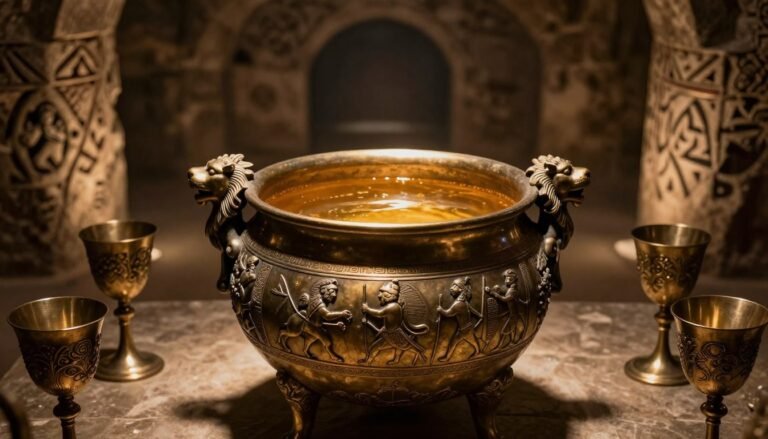
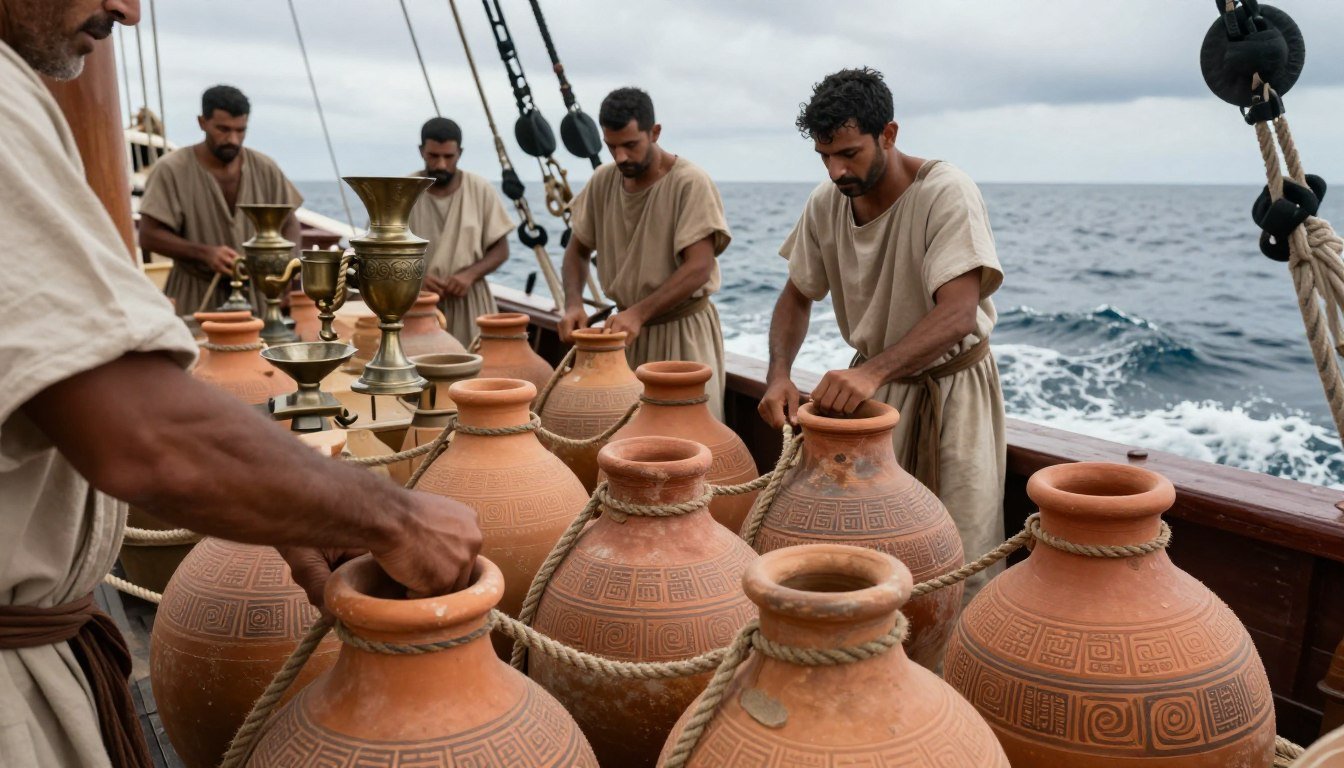
Fired clay scrapes against the planking, a dry, grinding rasp, as the crew lashes down the cargo. The history of ancient amphora wine begins with moments like this one, on a rolling deck smelling of pitch, salt and sour grapes. Each jar is full, sealed and heavy.
Sailors stand the jars upright or lay them on their sides, in as many as five staggered layers. They pack heather and reeds between the clay bodies so nothing cracks. Then they pass ropes through the handles to stop the load from shifting in rough seas.
The article follows the jar from Neolithic origins through Greece and Rome to today’s revival in the cellar. Every stop shows how winemakers, potters and merchants shaped a tradition that still pours. First, though, the jars need to be traced back to the ground they came from.
Key Takeaways
- Clay wine jars are far older than Greece and Rome, with traces in Georgia from about 6000 BCE.
- Potters built each amphora in stages, and a resin lining kept the wine from seeping out.
- Lighter Roman jars let a ship carry about 6,000 instead of 4,500.
- Stamps, painted labels and shipwrecks let scholars read the ancient wine trade.
- Barrels replaced amphorae in trade by the third century.
- Modern winemakers use clay because it breathes without adding oak flavor.
The History of Ancient Amphora Wine From Neolithic Villages to Greek Ships
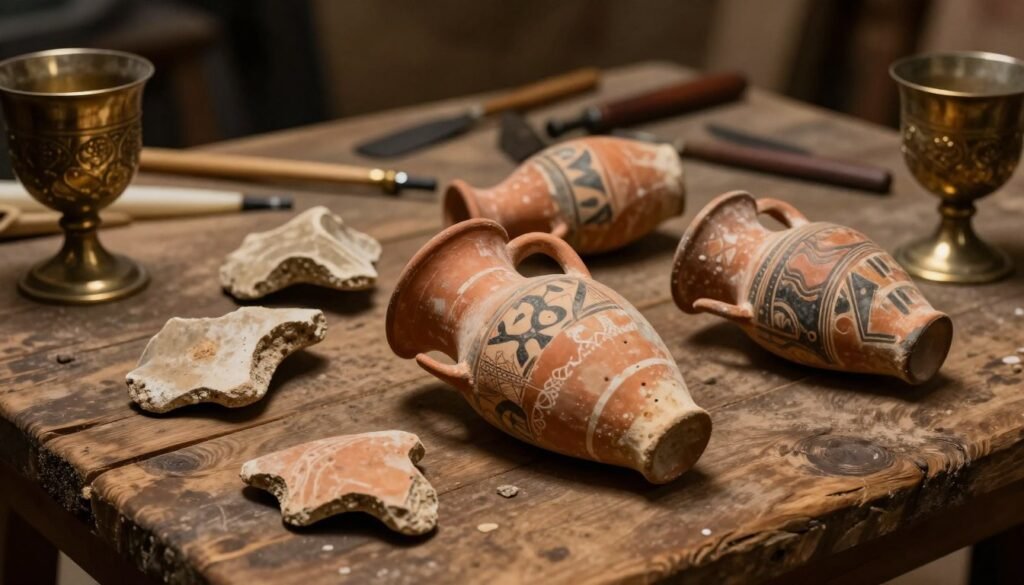
The clay wine jar is far older than Greece and Rome: the first traces of wine vessels turn up in ancient Georgia from around 6000 BCE. No single inventor or proven birthplace of wine exists. The record shows many villages reaching for clay at roughly the same long period of human history.
Ceramics in amphora shapes appear across Eurasia, from the Caucasus to China. Amphorae dated to about 4800 BC were found at Banpo in China, made by the Yangshao culture. Not every old jar held wine, since similar vessels also carried grain, oil and fish.
The oldest jars shaped like amphorae were not all wine vessels. Georgia holds the earliest firm traces of wine in clay, from around 6000 BCE.
Amphorae first appeared on the Phoenician coast at about 3500 BC. By the eighth century BCE, Phoenician sea jars were conical or bag shaped, with a pointed base and small handles joined to the neck. These were built for ships.
The Greeks took up the form. A Greek vessel from the Taman Peninsula on the Black Sea held bitumen dated to the fifth century BCE, which points to Greek trade with local peoples. Neck amphorae dominated early Greece, and one-piece amphorae gradually replaced them from around the 7th century BC.
Egyptians in the fourth century fermented wine directly in amphorae. Over the centuries the jar moved from village storage to ship cargo. But how did a lump of clay become a sealed, shippable wine container?
How Potters Built an Amphora and Winemakers Filled It
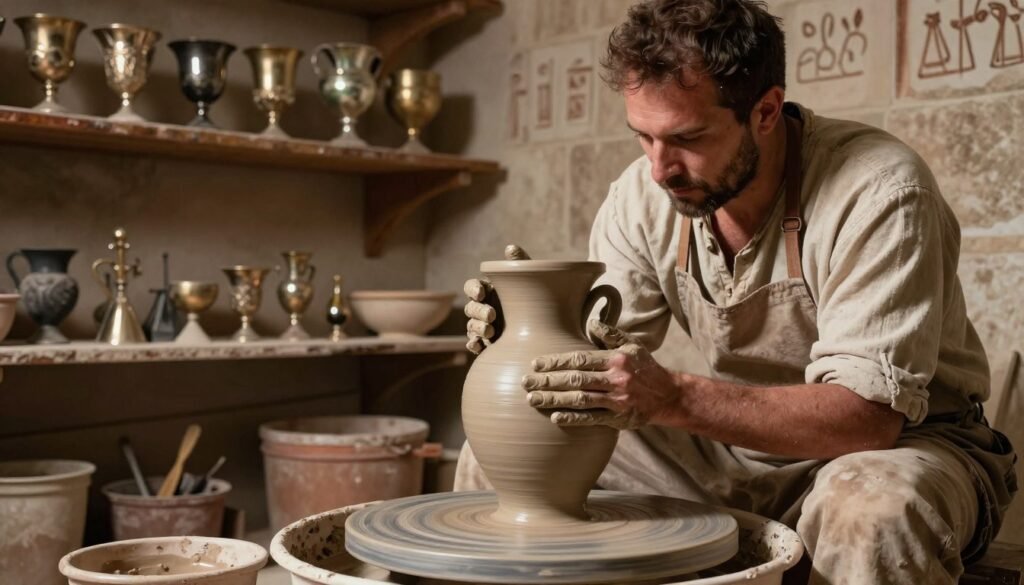
A potter began with the body and let it stiffen before adding the neck. This staged method is a reconstruction based on modern amphora making in parts of the eastern Mediterranean. A pithos, the very large clay storage jar holding between half a ton and two and a half tons, did the first job of fermenting and storing wine before it reached an amphora.
Throwing, Coiling and Sealing the Jar
Roman amphorae were wheel-thrown terracotta. The steps ran in a fixed order:
- Throw the body on the wheel.
- Let it dry partially.
- Add coils of clay to form the neck, rim and handles.
- Treat the interior with resin to stop liquids seeping through.
- Press a stamp naming the workshop (figlina) or its owner into the partly dry jar.
The resin lining was a working part of the vessel, not decoration. Without it, the porous clay would leak and spoil the wine. After filling, workers painted tituli picti on the jar to record weight and contents.
Fermenting in Pithoi, Shipping in Amphorae
In Greece, wine fermented in pithoi, and the size and quality of the clay affected flavor. An amphora held under half a ton of wine, typically under 50 kg (110 lb). Wine amphorae had narrow necks sealed with clay, wax or resin.
The long narrow body let sediment collect at the pointed base. Greeks usually diluted wine with water in bowls, while Egyptians and Syrians drew it through hollow reed tubes. A full jar was heavy, so the next question was how to move it.
How Amphorae Carried Wine Across the Mediterranean
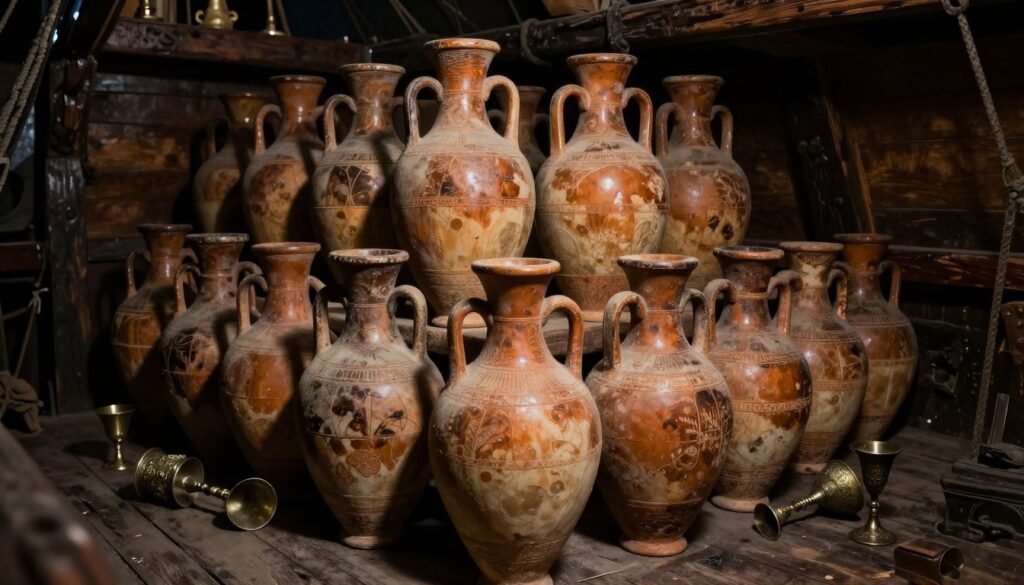
A Roman cargo ship could carry 6,000 lighter jars where only 4,500 heavier ones fit. A standard wine amphora held about 39 liters (41 US qt), which gave the amphora quadrantal its name as a Roman unit of volume. The unit itself equals about 26.2 liters, so the name and the jar were not an exact match.
About 66 distinct amphora types have been identified. Most stood about 45 cm (18 in) high, the largest 1.5 m and the smallest under 30 cm. Two types show how merchants gained space.
| Type | First appearance | Wall and fabric | Jars per ship |
|---|---|---|---|
| Dressel 1 | Late 2nd century BC, central Italy | Thick walls, red fabric | About 4,500 |
| Dressel 2-4 | Middle of the 1st century BC | Lighter, thinner | About 6,000 |
The largest known amphora cargo wreck, carrying 6,000 jars, lies off Kefalonia. In the Bodrum Museum of Underwater Archaeology, amphorae are displayed with a rack and rope device that shows how cargo was held in place. Merchants cared about shape because every cubic foot of hold meant profit.
The pointed base had a use on land too. Workers could sink it in sand to keep a jar upright, or grip it as a third handle for pouring. Yet a jar’s shape also told buyers where it came from, and the regions that supplied the wine each had their own.
Greek and Roman Wine Regions Read Through Their Jars
The silhouette of a jar told a dockhand where its wine was pressed. Distinctive shapes marked origin, an early form of branding. A dockhand could name a wine’s region from the jar alone. Four notable jars show how it worked:
- Rhodes: popular from the 3rd century BC, developed into the Camulodunum 184 form.
- Cos: made Dressel 2-4 imitations from the 4th century BC until the middle empire.
- Lamboglia 2: an Adriatic jar of the late 2nd to 1st century BC, later Dressel 6A.
- Pascual 1: a Tarraconensis jar shaped on Dressel 1.
Greek Islands and the Aegean
Chios, Lesbos and Samos were major Greek wine centers, while Attica and Corinth were major pottery centers. Rhodes jars became popular from the 3rd century BC. Cos copied the Dressel 2-4 form for centuries, and Cretan wine jars circulated from Augustan times to the 3rd century AD.
Italy, Gaul and Hispania
Lamboglia 2 carried Adriatic wine, and Spello amphorae were small wine containers in central Italy. In Gaul, Marseille workshops began typical local production in late Augustan times. Baetica and Tarraconensis were the main Spanish producers in the 2nd to 1st century BC.
North Africa and the Late Empire
Carthage’s tradition gave North Africa the neo-Phoenician jar, with small handles on the upper body. African I and II were widely used from the 2nd to the late 4th century AD. LRA 1 from Cilicia and Cyprus traded across the Mediterranean in the 5th to 6th centuries. Today these shapes help archaeologists trace the same trade.
What Stamps, Wrecks and Rubble Hills Reveal Today
In Rome, a hill 45 m (148 ft) high stands built from broken wine and oil jars. Monte Testaccio is a deliberate dump, not a ruin. Empty jars were too cheap to ship back, so workers broke them up at their destination and covered the shards with calcium hydroxide. The hill runs over 1 km around, beside the Tiber.
| Clue | Where found | What it tells |
|---|---|---|
| Workshop stamp | On the handle or rim of the partly dried jar | The workshop or its owner |
| Titulus pictus | Painted on the jar after filling | Weight and contents |
| Shipwreck cargo | Seabed, as off Kefalonia | Age of the ship and origin of cargo |
| Monte Testaccio | Beside the Tiber in Rome | Scale of the trade |
Stamps and tituli picti let historians trace trade routes. Some wreck jars still hold their original contents. Pompeii, buried by Vesuvius in 79 CE, yielded innumerable amphorae.
Heinrich Dressel built the first systematic classification after the Castro Pretorio deposit in Rome in the late 1800s, gathering almost 200 inscriptions. His table is still in use. Later names include Lamboglia (Adriatic, 1955), Maña (neo-Phoenician, 1951), Beltran (Spanish, 1970) and Laubenheimer (Gallic, 1989).
The jar’s trade role faded as amphorae met a rival. Wooden barrels began to overtake them in the 1st century CE and had replaced them in trade by the third century. The clay jar lost the trade but not the cellar, and winemakers later brought it back.
Why Winemakers Brought the Amphora Back
Clay returned because it breathes without adding flavor. Slightly porous clay allows micro-oxygenation at a rate comparable to wooden barrels, yet it adds no oak taste. Fermenting in clay keeps the grape variety’s flavors and aromas, and it is said to soften tannins and reduce bitterness.
Clay also holds temperature steadily, so fermentation needs no extra cooling. The egg shape creates a natural vortex that keeps the lees moving. Winemakers describe an earthy aftertaste.
Clay breathes like oak but adds no oak flavor. That one trait explains why winemakers returned to it.
The contrast is simple. Wood was first used by the Celts or Gauls, and barrels grew popular in the medieval period. Stainless steel and cement tanks arrived later, and steel stays neutral and sealed, while oak adds its own flavor.
The vessel has many local names: qvevri in Georgia, anfora in Italy, tinaja in Spain, talha in Portugal and karas in Armenia. A wine can ferment in amphora and move on, or age in it. A Spanish estate in Castilla-La Mancha uses amphorae dating to the 19th century, mostly 5,000 liter in round and egg shapes.
This is a choice of method, not a claim that one vessel makes better wine. The same heritage now shows up well beyond the cellar, in culture and at home.
How Amphorae Shaped Art, Language and Daily Habits
The prize for winning a footrace at Athens was a jar of olive oil. Panathenaic prize amphorae were given at the Panathenaic Games, which ran from 566 BCE to the third century CE. Each jar was filled with oil from a sacred grove and carried the inscription “I am one of the prizes from Athens.”
Winners likely kept the jars, and some may have reused them for wine. That is a guess, since the prize was the oil and the painted pot.
Plain trade jars and painted table jars were different objects. Table amphorae, with flat or ring bases, were painted by master vase painters. Tyrrhenian amphorae had oval bodies, while Nikosthenes of Athens (6th century BCE) made broad-shouldered jars with long necks.
The pelike, a belly amphora with its widest point low, stored perfume. Painted amphorae also served as grave markers and ash containers. A silver amphora-rhyton from about 500 BC survives in a Bulgarian collection. By the Roman period, vase painting had largely died out and plain jars were the main type.
The word itself comes from Greek amphiphoreus, meaning carried on both sides. The Linear B tablets of Knossos record a-pi-po-re-we. Cato the Younger is the first known Roman writer to use the word, and it still lives in culture today.
The Cultural Echo and Bringing the Past Home
The film Gladiator (2000) puts Roman wine and clay on screen, and it is a fine way into the period. The amphora still turns up in museums, on wine lists and in everyday words. The British Museum and the Ancient History Encyclopedia offer rich background on Greek and Roman vessels.
The Cultural Echo: Cinema, Music & Modern Table
- Watch Gladiator (2000) for a Roman setting where wine jars sit in the frame.
- Visit galleries at the Bodrum Museum of Underwater Archaeology, the Louvre, the Metropolitan Museum of Art or the Altes Museum in Berlin.
- Spot “amphora wine” on modern lists, often in the natural wine style.
- Hear the word live on in Greek and Latin, with glass amphorae existing from the Roman period.
Bringing the History Home
Heritage tools make the past tangible. An amphora stand or rack shows the shape, a reed straw copies the Egyptian way of drinking, and a clay pitcher suits the table. A museum visit gives the full scale, such as the 6,000-jar Late Roman wreck off Kefalonia.
For the table, pour an orange wine, made with extended skin contact and maceration, or a white amphora wine. Spanish blends in the natural style use grapes such as Macabeo, Verdejo, Airen and Tempranillo. Pair them with olive oil, aged cheese, honey or figs. Modern amphora wines differ from ancient resin-sealed wines, so expect a different taste.
Conclusion
The clay jar is the thread running through the whole story of Mediterranean wine. It shaped trade, art and language, then slipped back into the cellar when winemakers wanted a vessel that breathes. Each wreck and rubble hill adds another page to the history of ancient amphora wine.
The record still grows as divers and diggers pull new jars from the sea and the soil. Wine and clay have kept company for thousands of years, and the pairing is not done. Find an amphora gallery at a nearby museum, or taste one amphora-fermented wine alongside olive oil.