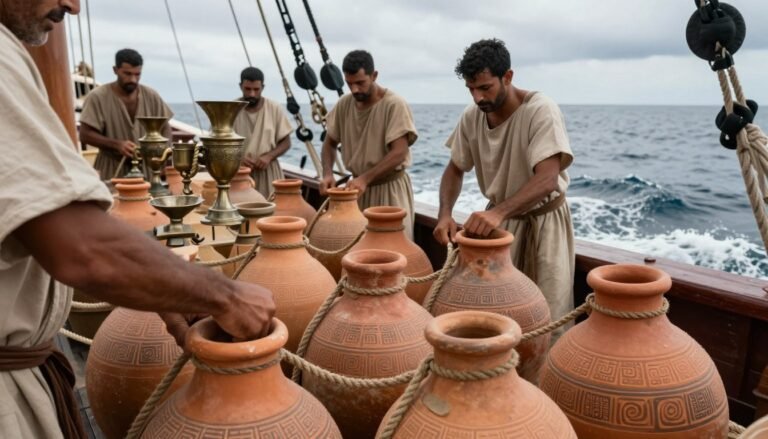
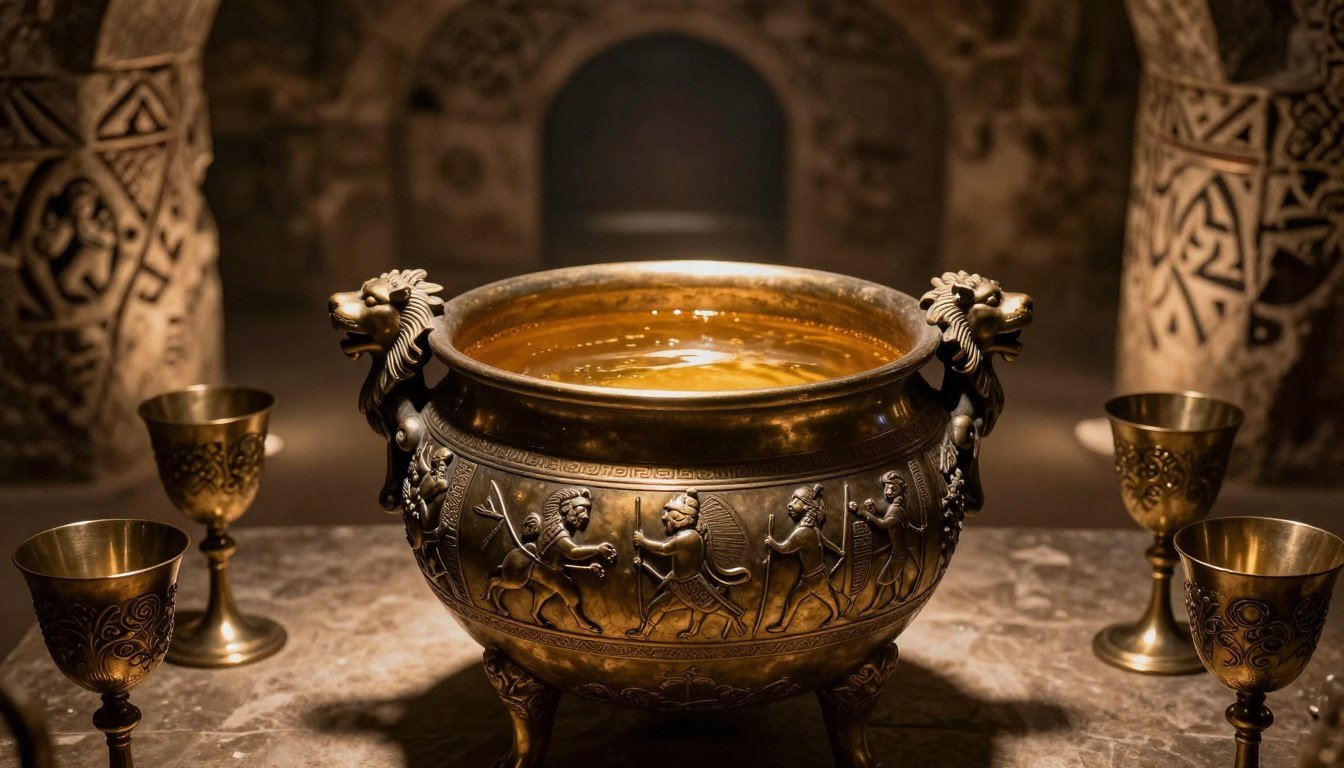
The cold of the burial chamber at Hochdorf, near Stuttgart, still hangs over a Celtic chieftain laid to rest around 600 BC. Beside his body stands a bronze cauldron with three lions along the rim, and drinking horns hang from the chamber wall. Residue inside showed it once held mead, and the cauldron could have held over 400 litres, so the history of mead begins in a grave fit for a feast.
Mead carried ritual, law and trade across continents. This route runs from prehistoric honey to the craft meaderies of today.
The story begins long before any hall, in a hollow tree.
Key Takeaways
- Chemical traces of mead in China are about 9,000 years old.
- Mead likely arose in many places, because bees and rain were everywhere.
- Greeks, Norse and Irish treated mead as sacred, and Irish law protected bees.
- Cheap cane sugar, grain farming and lost forests pushed mead aside.
- Mead ranges from bone-dry to very sweet, at about 3.5% to 22% ABV.
- Craft meaderies now bring it back with barrels, cans and fruit.
How Old Is Mead? Tracing the Oldest Alcoholic Drink
The earliest chemical traces of mead are about 9,000 years old. Residue in pottery from Jiahu in northern China, dated to about 7000 BC, points to a mixed drink of honey, rice and fruit. The encyclopedia entry on mead sums up this pottery evidence along with early written records.
Europe left its own clues. Beaker culture pottery, made about 2800-1800 BC, carried mead traces, including vessels in northern Scotland. In India, the Rigveda (about 1700-1100 BCE) holds early written mentions of mead. The oldest known honey-based drink predates the wheel.
Mead is among the earliest alcoholic drinks, and possibly the first, because honey ferments with almost no help.
Many call mead the oldest alcoholic drink. That claim rests on residue evidence and on how easily honey ferments, so the careful phrasing is “among the earliest, and possibly the first.”
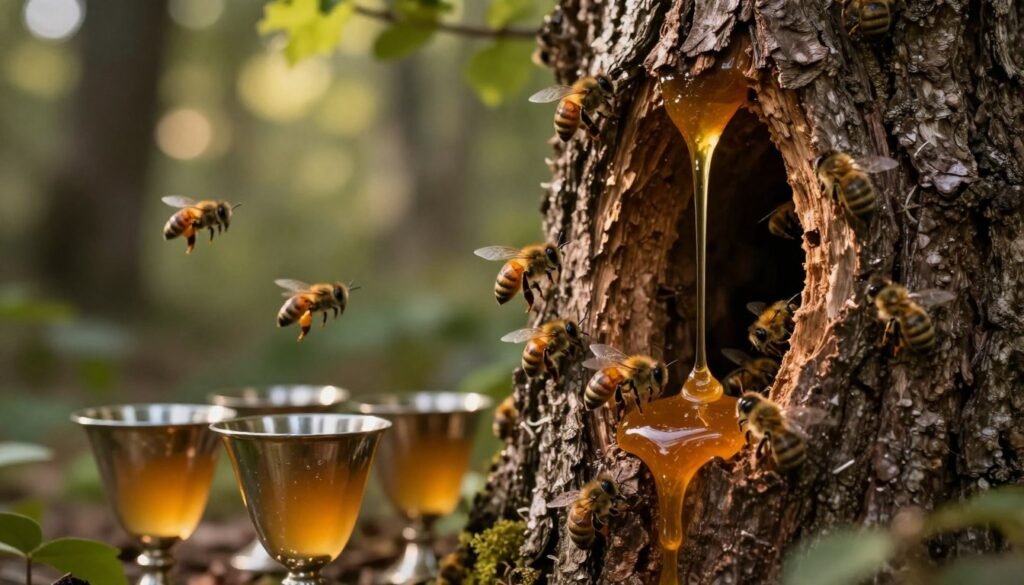
The discovery was likely an accident. Rainwater filled a hollow tree, thinned the honey, and wild yeast did the rest. Mead needed no grain malting and no grape pressing, and it needed no farming at all.
That explains why the history of mead in the world looks like parallel invention, not one source spreading outward. Wherever bees lived, someone tasted honey water that had turned. So how did such a simple drink become sacred to the Greeks, Norse and Irish?
The History of Mead in Myth, Mead Halls and Ritual
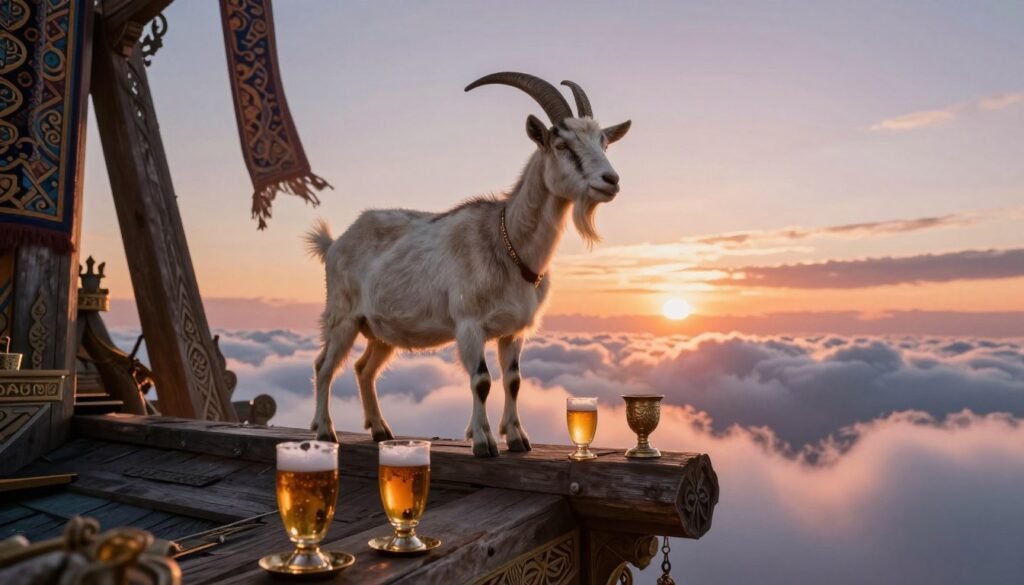
Heidrun the goat stands on the roof of Valhalla, chewing the leaves of the tree Yggdrasil. Her udders fill a barrel of mead each day for the fallen warriors below. In Norse myth, even the gods’ hall ran on honey.
Across cultures, mead marked the line between ordinary life and the sacred. Mead was a drink of gods, kings and loyalty. The poetic mead, made from honey and the blood of the wise Kvasir, gave wisdom and inspiration to anyone who drank it.
A short timeline shows how widely the drink spread:
- Greece: tradition called mead the nectar of the gods.
- Rome: people drank mulsum, wine sweetened with honey and spices.
- Norse myth: Heidrun’s barrel and Kvasir’s poetic mead.
- Heorot: the mead hall of King Hrothgar in Beowulf.
- Ethiopia: tej, a honey wine flavored with gesho.
Mulsum is often confused with true mead. It is wine with honey added, while mead is fermented honey and water.
Feast halls like Heorot were stages for loyalty. A lord poured the drink and handed out gifts, and warriors answered with oaths. Ireland took the same idea further, and there mead entered written law.
Mead in Ireland: Hills, Saints and Bee Laws
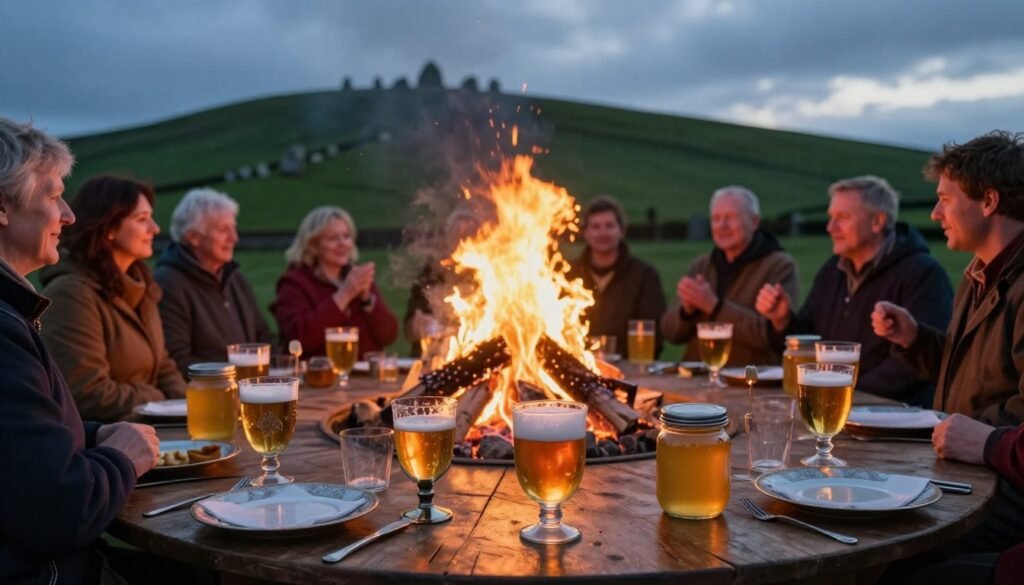
The Great Mead Hall of Tara, called Tech Midchuarta, was a timber hall about 45 feet high that could sleep up to 1,000 people. In Ireland, mead shaped the calendar, the church and the courts. Bees were legal property, valued like livestock.
The Great Mead Hall of Tara and Bealtaine Fires
Guests at Tara drank from methers, wooden vessels with four lips and four handles. In the legend of the Children of Lir, Fionnuala recalls a hazel mead sipped from four-lipped cups.
Bealtaine marks the start of May, midway between the spring equinox and the summer solstice. People lit bonfires and drank mead. Archaeologists found thick layers of charcoal on the Hill of Uisneach in Co. Westmeath, a hill about 600 feet tall from which 20 counties can be seen.
Saints Who Kept Bees: Modomnóc and Gobnait
Monks and saints carried beekeeping through Ireland. St Modomnóc, also called Molaige, is said to have brought bees to Ireland in the 5th century, and his bees followed his ship.
St Gobnait, patron saint of bees, is linked with Ballyvourney in Cork. Harry Clarke’s window in the Honan Chapel, finished 1916, shows her with her bees.
Bee Laws: Trespass, Swarms and Stings
The Bechbreatha, the Brehon bee laws, were written about the 7th century after centuries of oral transmission. They treat bees with care. A beekeeper owed neighbors a share of honey where his bees foraged.
The owners of a swarm kept a third of the honey for 3 years. A stinging bee could cost a hive by lot, unless the victim swore not to have provoked it.
Bees could even change history. King Congal, blinded by bees, lost his kingship. Later feasts moved to English tables, where mead was spiced.
Why Mead Faded From the Table
Sugar, grain and lost bee habitat pushed honey out of the cup. Mead peaked in Tudor England, then slipped from daily life. Sir Kenelm Digby’s recipe collection of more than 100 meads was published in 1669.
Queen Elizabeth I’s mead recipe, recorded by her beekeeper Charles Butler, used sweetbriar, bay, thyme and rosemary. Mead peaked just before cheap sugar ended its reign. Five causes explain why we no longer drink it as before:
- Cane sugar from the Americas displaced honey in the 16th-17th centuries.
- Grain farming scaled up, so beer, ale and wine got cheaper.
- Whale oil replaced beeswax candles, so wax was worth less.
- Forests were cut, and bees lost their habitat.
- Monasteries were destroyed, and beekeeping skill went with them.
Honey also stayed hard work to harvest. In 1822 a Dublin merchant, John Donaghoe and Co., advertised 200 pipes of mead and metheglin as a healthful beverage at 4 shillings 4d per gallon. It was one of the last commercial traces. The revival came later, with new makers and a new way of making mead.
How Mead Is Made and What It Tastes Like Today
Making mead takes honey, water and yeast. The mixture before fermentation is called must: honey and water, plus any fruit or spices, that yeast ferments into mead. Four brief steps carry it from must to bottle:
- Dilute honey with water, often heating the must before the yeast.
- Add wine yeast and nutrients, and track gravity with a hydrometer or refractometer.
- Rack the mead off the sediment after primary fermentation.
- Age it from a few months to several years.
Is mead sweet? Not always. It spans bone-dry to very sweet, still or sparkling, hot or cold. Mead alcohol runs from about 3.5% to 22% ABV, so strength varies a lot by bottle.
One mistake: store honey undiluted is too dense to ferment well. Water gives the yeast room to work.
| Style | Added ingredient | Example flavor note |
|---|---|---|
| Braggot | Malt | Bready, like beer |
| Cyser | Apples | Crisp, cider-like |
| Melomel | Fruit | Berry or peach brightness |
| Metheglin | Herbs and spices | Warm, like clove |
| Pyment | Grapes | Winelike, round |
Rarer styles exist too, like rhodomel with roses and capsicumel with chilies. Pour a glass at home, and the old halls are in it.
Bringing Mead Into the Modern World
A canned mead sits on a modern bar, cold and fizzing beside the craft beers. Craft meaderies now explore barrel-aging, canned and sparkling meads, and fruit-forward melomels. Wine barrels give age to modern mead, and new drinkers find it.
The Cultural Echo: Cinema, Music & Modern Table
Tolkien, George R.R. Martin, T.H. White and Neil Gaiman all feature mead in their work. For the Norse and Anglo-Saxon halls, read the Old English poem Beowulf, set in the mead hall Heorot. The film The 13th Warrior also puts a feast of horns and honey on screen.
To buy mead, a local meadery or specialty shop is the best start. Ask about the honey source and the style. Staff can point a newcomer toward dry or sweet.
Ask a meadery where the honey came from and which style it is. That one question tells you most of what is in the glass.
Bringing the History Home
A hydrometer, a glass carboy with an airlock, and wooden or horn drinking cups are heritage tools that suit the craft. Single-source local honey and wine yeast form the base of a first batch.
For an Elizabethan touch, add sweetbriar, bay, thyme and rosemary, as the queen’s recipe did. Here are the essentials:
- A hydrometer to track gravity
- A glass carboy with an airlock
- Wooden or horn drinking cups
- Single-source local honey
- Sweetbriar, bay, thyme and rosemary
Tasting mead is tasting centuries.
Conclusion
Few drinks have been poured in so many places, from a Chinese pot to a Celtic grave and an Irish hall. Mead began wherever bees lived, and it came back because craft makers wanted honest ingredients.
The simplest way to feel that history is to taste it. Buy one dry mead and one sweet mead, pour them side by side, and compare.