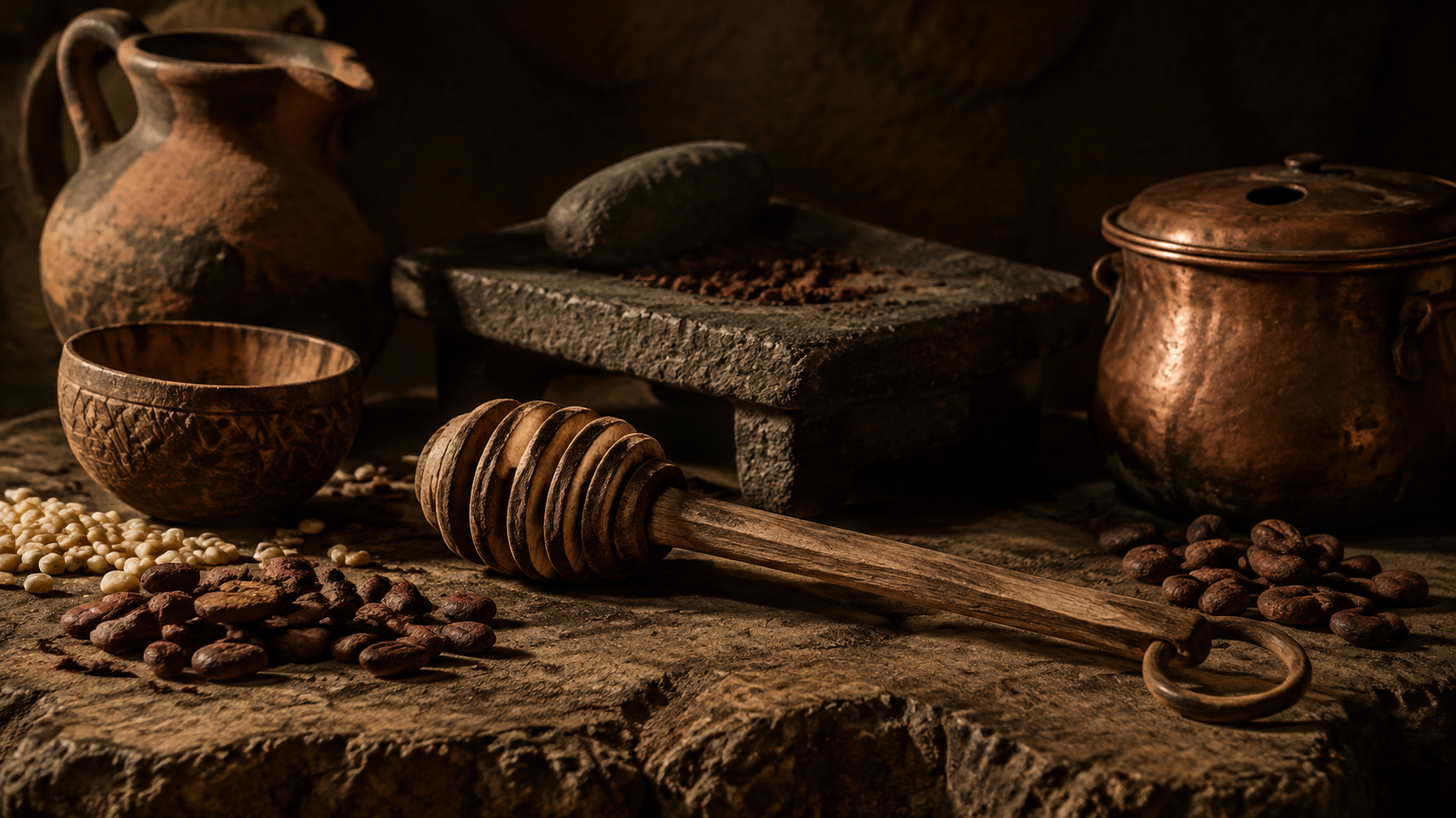
A wooden stick spins between two palms in a steaming pot, and the smell of cinnamon fills a colonial-era kitchen. The wood knocks softly against the clay, and the rings on its head rattle as the chocolate turns thick and dark. This sound is the history of molinillo whisk in a single moment.
The molinillo is a carved wooden whisk used in Mexico and the Philippines. Cooks have rolled it between their hands for centuries to make hot chocolate with a thick cap of foam. Its past is worth a closer look because three stories compete for credit: Maya foam, Spanish colonists, and Mexican craft.
The molinillo looks like a simple stick, yet its beginnings are still argued over.
Key Takeaways
- The molinillo is a one-piece carved whisk rolled between the palms.
- The Maya made foam by pouring chocolate from a height, long before any whisk.
- Historians disagree on whether Spanish colonists or Mesoamerican cooks invented it.
- Oily European chocolate had to be stirred constantly, which kept the tool in use.
- Michoacán, Oaxaca and Puebla are the main carving centers.
- A good molinillo has loose rings that spin freely.
How Did the Maya and Aztecs Froth Chocolate Before the Molinillo?
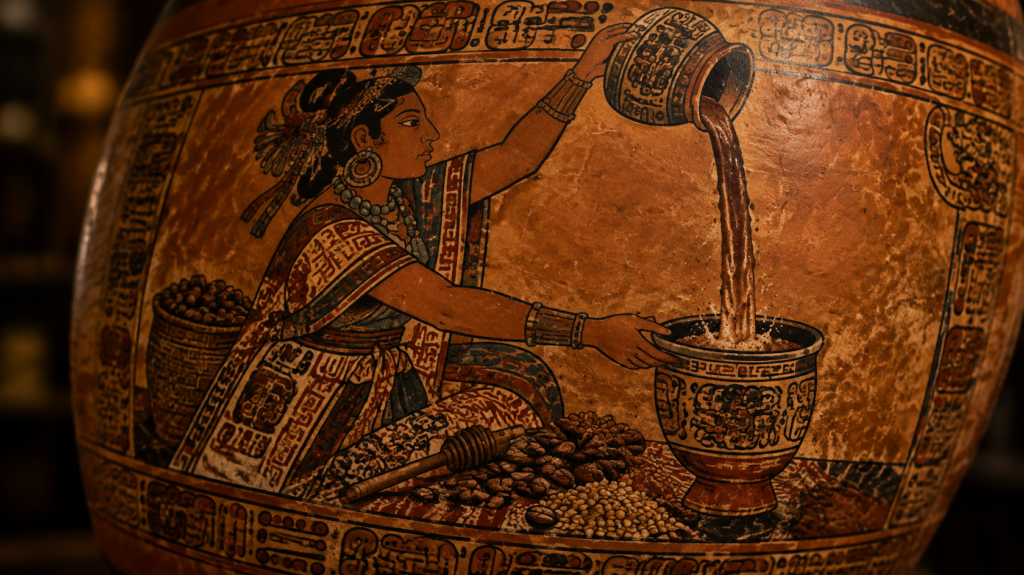
They made foam by pouring the drink from one vessel to another in a long stream. A Maya painter, around A.D. 700, showed a woman doing exactly this. Froth is the foam of fine bubbles that forms on top of a chocolate drink when it is beaten or poured from a height.
The Princeton Vase, a Maya chocolate vessel dated A.D. 670-750, shows chocolate frothed by pouring from a height. The ceramic piece stands 21.5 cm high. The Metropolitan Museum of Art describes chocolate poured into a larger cylinder vessel to build the foam.
Foam was the sign of a well-made chocolate drink, and the Maya treated it as the spiritual essence of the cup.
Early evidence of cacao-drink consumption in Mesoamerica dates to 1900-900 BC. Mayan and Aztec chocolate drinks were typically served cold and mixed with chile, cinnamon and vanilla. The Codex Zouche-Nuttall, produced between 1200 and 1521, shows a Mixtec woman handing her husband a cup of foaming chocolate.
The Codex Tudela, around 1540-1553, records Aztec ceremonies, customs, rituals and festivals. Cacao also served as money. On August 15, 1502, Columbus’s men met a Chontal Maya trading canoe near Guanaja, Honduras, and Ferdinand Columbus described cacao beans used as currency.
Foam was prized as the best part of the drink long before any carved stick touched it.
Who Invented the History of Molinillo Whisk? Maya Roots or Spanish Colonists
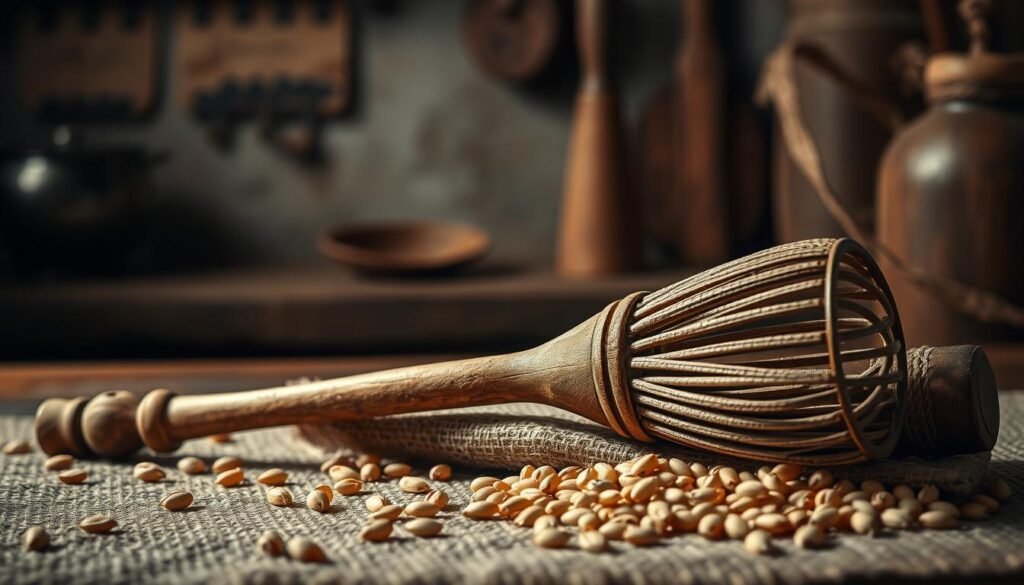
The molinillo has two families of claimants, and each points to a different piece of evidence. One side credits Spanish colonists, who arrived in Mexico in 1519. The other side sees a Mesoamerican stirring stick behind the tool.
The Spanish-invention view rests on early accounts. Hernán Cortés and his conquistadors initially refused the local chocolate drink. When they did describe the preparation, one early conquistador account lists only a spoon and moving the drink between basins to raise foam. Mayan scholar Michael Coe held that pouring was the exclusive pre-conquest method and that the molinillo came from the Spanish.
The other side points to language and relatives. Nahuatl names for a chocolate-agitating tool, aneloloni, amoloniloni and apozoniloni, were recorded in the 1571 dictionary of Alonso de Molina. The chicoli, a stirring stick used in Chiapas and Tabasco, is considered a relative of the molinillo and among the oldest chocolate mixers.
The name itself is Spanish. It comes from molino, meaning mill. That fits a likely answer: a hybrid of Mesoamerican chocolate practice and European turned wood.
Most historians lean toward a Spanish colonial invention, yet the older stirring sticks keep the question open.
Why Did Chocolate Need Constant Stirring in Europe?
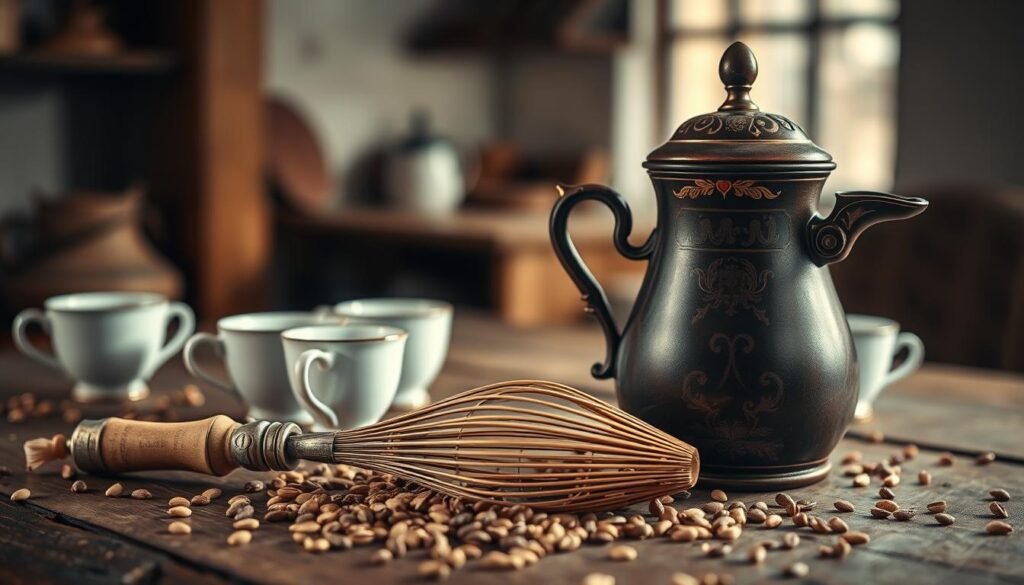
Chocolate before industrial pressing was oily and separated within minutes. It held a large amount of fat that did not dissolve in water, so the drink had to be stirred continuously. European chocolate shifted from cold to hot, probably because heat helped the fats mix with water.
The change in temperature changed the recipe too. Hot drinks suited sugar and cinnamon, and chile was dropped. In 17th-century Europe, drinking chocolate was reserved for the wealthy.
| Period | Who drank chocolate | How it was frothed | Tool |
|---|---|---|---|
| Pre-1519 Mesoamerica | Elites and ritual guests | Pouring from a height | Vessels |
| 17th century Europe | The wealthy | Spoon and moving between pots | Spoon, pots |
| Mid-18th century | Middle class | Stirring in the pot | Molinillo |
| 1780s | Mexican households | Rolling between palms | Molinillo |
By the mid-18th century chocolate reached the middle class, and a ritual grew around it with extra serveware. A small molinillo suited a single cup and a large one a chocolate pot. The molinillo may have been invented in 18th-century Europe as an alternative to pouring chocolate between two pots from a height. By 1780 it had completely replaced pouring in descriptions of Mexican life.
Once cocoa fat could be pressed out in the 19th century, the constant churning stopped being a necessity and became a tradition.
How Is a Molinillo Carved and Why Does It Work?
Every molinillo starts as one block of wood with no joints and no glue. The carver shapes a long handle, grooves and rings from that single piece. The rings spin independently of the head.
Carved from a Single Piece of Wood
Carvers cut symmetrical shapes around a lathe’s axis to form the central carvings. A molinillo is always one piece of wood. Its parts are easy to name:
- A long handle for the palms
- Carved grooves around the head
- A ball or bulb at the end
- Loose rings that spin on their own
- One piece of wood, with no glue
Loose Rings and the Science of Foam
A 2014 analysis by researchers at the National Autonomous University of Mexico’s Institute of Biotechnology found blades reaching about 7 miles per hour while foaming. The same analysis found cocoa’s protein and fatty-acid content helped produce finer, more uniform bubbles.
Regional Workshops and the Courtship Legend
Michoacán, Oaxaca and Puebla are centers of molinillo production. Older molinillos were plainer, and the heavily decorated type is more recent.
Legend holds that in some regions of Mexico a young woman’s well-frothed chocolate helped her find a husband. A ring that wobbles but never falls off is the sign of a well-cut piece.
How Do You Use a Molinillo for Hot Chocolate?
Hold the handle upright and the rest takes care of itself. For molinillo hot chocolate, set the head in a pot or jarro, a jug holding the ingredients, and roll the handle. Hold the narrow end between the palms and rub the hands together to rotate it.
- Warm the liquid in the jarro.
- Add pieces of chocolate tablet.
- Set the molinillo head into the jarro.
- Roll the handle between your palms.
- Keep going until foam forms.
Roll the handle; never press it flat. Pressing flat wastes the foam, because the rings need to spin freely against the liquid.
The same use works for atole, including chocolate champurrado. Molinillo is pronounced roughly moh-lee-NEE-yoh, with the stress on the third syllable.
Serve right away, since the foam fades within minutes.
What Can Readers Still See and Taste Today?
Museums keep molinillos in glass cases, but the tradition lives in kitchens. The Smithsonian holds molinillos in its collection, and readers can still taste the same drink at home. Mexican chocolate is ground cacao with sugar and usually cinnamon.
The Cultural Echo: Cinema, Music & Modern Table
Like Water for Chocolate (1992), based on Laura Esquivel’s novel, carries the kitchen’s mood onto the screen. Its tablets are harder and grainier than a smooth bar. That grit and sugar are by design, not a flaw.
Tablets stay gritty and sugary on purpose, so judge them by the foam and flavor, not by smoothness.
Bringing the History Home
A small set is enough to start:
- A hand-carved molinillo from Oaxaca, Puebla or Michoacán
- A jarro
- Tablets from Ibarra or Abuelita
- Cinnamon
Buy a molinillo with loose, freely spinning rings and rinse it by hand rather than soaking it.
Conclusion
A stick of carved wood holds three centuries of argument. The molinillo joins Maya foam tradition and Spanish woodwork, and no one has settled which gave it life.
The tool also outlived its original need. Pressed cocoa no longer separates, yet cooks still reach for the handle because the foam and the ritual taste better together.
Warm a cup of Mexican chocolate and roll the handle between your palms.